A Comprehensive Biological and Ecological Study of a Sacred Wetland Herb
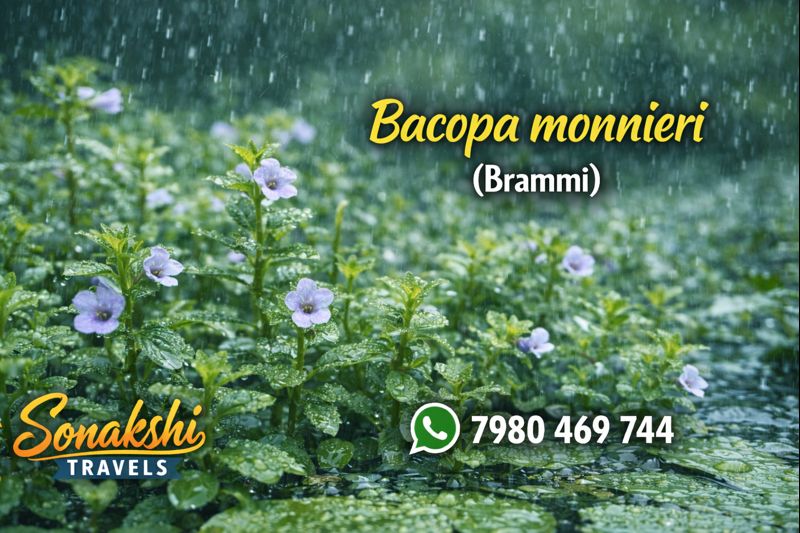
Bacopa monnieri, commonly known as Brammi, is a creeping, succulent aquatic herb of profound biological, ecological, and cultural significance across South and Southeast Asia. Renowned for its long-standing association with traditional knowledge systems, wetland ecology, and freshwater landscapes, this species represents a classic example of a plant that bridges natural ecosystems and human civilization. Its delicate appearance masks a remarkable resilience, allowing it to thrive in periodically inundated environments where few terrestrial plants can survive.
As a perennial amphibious herb, Bacopa monnieri is uniquely adapted to fluctuating hydrological regimes. It prospers in shallow water, muddy margins, and seasonally flooded lowlands, displaying structural and physiological plasticity that enables survival under both submerged and emergent conditions. Beyond its botanical interest, the species is deeply embedded in the ecological fabric of wetlands, contributing to soil stabilization, nutrient cycling, and habitat provision for a wide range of microfauna.
This article provides a detailed, research-oriented exploration of Bacopa monnieri, covering its taxonomy, morphology, habitat preferences, ecological role, and conservation considerations, with special emphasis on its occurrence within the Sundarbans region.
Taxonomy & Classification
Bacopa monnieri belongs to the family Plantaginaceae, a taxonomically diverse group that includes numerous aquatic and semi-aquatic species. Its systematic position is as follows:
Kingdom: Plantae
Clade: Angiosperms
Clade: Eudicots
Order: Lamiales
Family: Plantaginaceae
Genus: Bacopa
Species:Bacopa monnieri (L.) Wettst.
The genus Bacopa is characterized by creeping or floating herbs with opposite leaves and solitary axillary flowers. The species epithet monnieri honors the French botanist Louis Guillaume Le Monnier, while the common name “Brammi” reflects its deep-rooted cultural and spiritual associations in the Indian subcontinent.
Morphology & Field Identification
Bacopa monnieri is a low-growing, mat-forming perennial herb with a distinctive succulent texture. Its morphology is finely tuned for life in waterlogged or semi-aquatic habitats.
Stem Characteristics
The stems are prostrate, creeping, and highly branched, often rooting at the nodes when in contact with moist soil or shallow water. They are fleshy, smooth, and green to light purplish in color, enabling efficient storage of water and nutrients. This growth habit allows the plant to spread rapidly across suitable substrates.
Leaves
Leaves are opposite, sessile, and obovate to spatulate, measuring approximately 1–2.5 cm in length. The leaf surface is smooth, thick, and succulent, reflecting an adaptation to water-rich environments. The margins are entire, and the apex is rounded, giving the plant a soft, delicate appearance that aids field identification.
Flowers
Flowers are solitary, axillary, and relatively small but conspicuous, borne on short pedicels. The corolla is actinomorphic, typically pale blue, white, or lavender, with five rounded petals. Flowering occurs throughout the warmer months, particularly during the monsoon and post-monsoon periods.
Fruit and Seeds
The fruit is a small, ovoid capsule containing numerous tiny seeds. Seed dispersal is facilitated by water movement, enabling colonization of adjacent wetlands and low-lying areas.
Habitat & Distribution
Bacopa monnieri is intrinsically associated with freshwater and semi-aquatic habitats. Its distribution reflects a strong preference for warm climates and moist environments.
Global Range
The species has a broad native and naturalized range across the tropics and subtropics. It is widely distributed in India, Bangladesh, Sri Lanka, Nepal, Southeast Asia, southern China, Australia, Africa, and parts of the Americas. In many regions, it has been introduced intentionally or unintentionally and has successfully naturalized due to its ecological flexibility.
Preferred Habitat
Bacopa monnieri thrives in shallow freshwater environments such as ponds, marshes, swamps, rice fields, canal margins, and seasonally flooded grasslands. It prefers soft, silty or clay-rich soils with high organic content and neutral to slightly acidic pH. The plant tolerates prolonged inundation as well as short periods of exposure, making it well suited to dynamic wetland systems.
Occurrence
The species occurs both as scattered individuals and as dense mats covering moist substrates. In rural landscapes, it is commonly found along pond edges, irrigation channels, and low-lying fields. Seasonal abundance increases during the monsoon, when water availability and nutrient input are at their peak.
Preferred Habitat in the Sundarbans Region
Within the Sundarbans, Bacopa monnieri is predominantly confined to freshwater-influenced zones rather than saline mangrove interiors. It grows along rain-fed ponds, freshwater canals, village wetlands, and low-salinity creeks located at the margins of the mangrove forest.
The monsoonal influx of freshwater creates ideal conditions for the species by reducing salinity and replenishing nutrient-rich sediments. Its presence often indicates relatively stable freshwater conditions within the otherwise saline-dominated deltaic environment.
Exploring freshwater herbs along the delta enhances any Sundarban Tour, revealing the subtle ecological diversity beyond mangroves.
Ecological Role
Bacopa monnieri plays a crucial ecological role in wetland ecosystems. Its creeping growth stabilizes soft, waterlogged soils, reducing erosion caused by flowing or receding water. The plant contributes organic matter to the sediment through leaf and stem turnover, enhancing nutrient cycling and microbial activity.
Dense mats of Bacopa monnieri provide shelter for aquatic invertebrates, amphibian larvae, and juvenile fish, supporting complex food webs. Its flowers attract small pollinating insects, further integrating the species into local ecological networks.
Habitat Alteration
Habitat alteration poses a significant threat to Bacopa monnieri. Wetland drainage, conversion of marshes into intensive agricultural land, pollution from agrochemicals, and unregulated urban expansion can severely reduce suitable habitats. In coastal regions, increasing salinity intrusion further limits its distribution by altering soil and water chemistry.
Conservation Efforts
Although Bacopa monnieri is not currently listed as globally threatened, localized conservation measures are essential for maintaining healthy populations. Protecting freshwater wetlands, regulating chemical runoff, and preserving traditional water bodies are critical strategies.
Community-based wetland management and awareness programs emphasizing the ecological value of aquatic plants contribute significantly to long-term conservation. Sustainable harvesting practices, where applicable, also help ensure population stability.
A carefully planned Sundarban Tour offers opportunities to observe freshwater plants like Brammi within their natural habitats.
Did You Know?
Bacopa monnieri can grow both submerged and on moist soil.
The plant spreads rapidly by rooting at stem nodes.
Its presence often indicates low-salinity, freshwater conditions.
It belongs to a group of amphibious plants with high morphological plasticity.