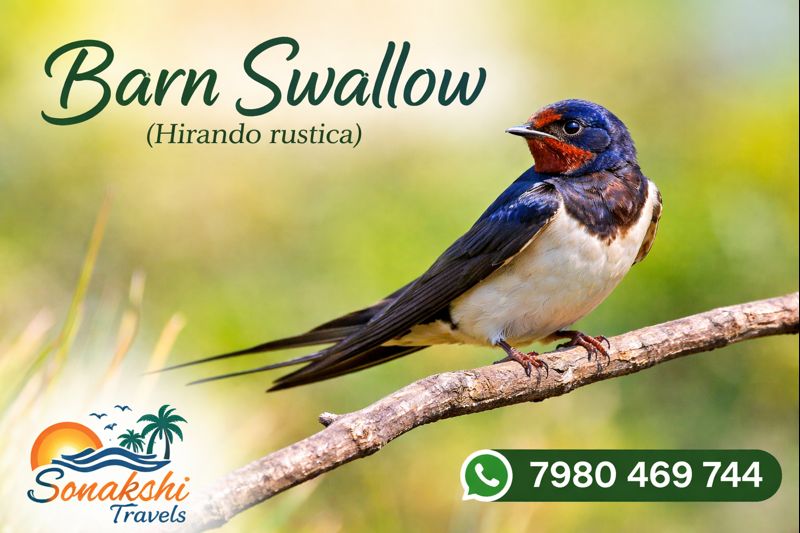
The Barn Swallow (Hirundo rustica) stands as one of the most widely recognized and extensively studied passerine birds in the world. Celebrated for its deeply forked tail, streamlined silhouette, and extraordinary aerial agility, this species has forged a unique ecological and cultural association with human settlements. Its cosmopolitan distribution, remarkable migratory endurance, and insectivorous feeding strategy render it a key indicator of ecosystem health across continents. This article presents an in-depth, research-oriented examination of the Barn Swallow’s taxonomy, morphology, behavior, habitat preferences, and ecological significance, with particular attention to its occurrence in the Indian subcontinent and the Sundarbans region.
Taxonomy & Classification
The Barn Swallow belongs to the order Passeriformes, the largest avian order, encompassing perching birds characterized by advanced vocal abilities and complex behaviors. Within this order, it is classified under the family Hirundinidae, a group commonly known as swallows and martins, adapted primarily for sustained aerial foraging.
Kingdom: Animalia
Phylum: Chordata
Class: Aves
Order: Passeriformes
Family: Hirundinidae
Genus: Hirundo
Species: Hirundo rustica
Several subspecies have been identified across its vast range, reflecting subtle geographic variations in plumage coloration and tail length, shaped by regional environmental pressures and migratory routes.
Morphology & Field Identification
The Barn Swallow exhibits a highly aerodynamic body structure optimized for rapid, energy-efficient flight. Its slender form, long pointed wings, and deeply forked tail serve as immediate field identification markers. The dorsal plumage is a glossy steel-blue, contrasting sharply with the warm rufous tones of the throat and forehead and the pale buff to whitish underparts.
Male Features
Male Barn Swallows are distinguished by elongated outer tail streamers, which play a significant role in sexual selection. These streamers are often darker and more pronounced, serving as visual signals of fitness to potential mates. Males also tend to exhibit richer rufous coloration on the throat and face.
Female Features
Females closely resemble males in general coloration but typically possess shorter tail streamers and slightly duller plumage. These differences, while subtle, are consistent across populations and assist ornithologists in sex identification during breeding studies.
Size & Wingspan
Adult Barn Swallows measure approximately 17–19 cm in total length, including tail streamers. The wingspan ranges from 32 to 34 cm, providing ample lift and maneuverability for prolonged aerial feeding sessions.
Flight Characteristics
Flight in the Barn Swallow is fluid, agile, and highly responsive. Rapid wingbeats interspersed with gliding phases allow precise directional changes, enabling the bird to pursue fast-moving insect prey with exceptional accuracy.
Habitat & Distribution
Global Range
The Barn Swallow boasts one of the broadest distributions of any passerine bird. It breeds across Europe, Asia, and North America and migrates to Africa, South America, South Asia, and Southeast Asia during the non-breeding season. This transcontinental movement underscores its remarkable physiological resilience.
Preferred Habitat
Open landscapes with access to flying insects define the Barn Swallow’s preferred habitat. Agricultural fields, grasslands, wetlands, and coastal plains are commonly utilized. Proximity to water bodies enhances insect availability, making such areas particularly attractive.
Diet & Feeding Ecology
The Barn Swallow is a strict insectivore, feeding predominantly on dipterans, coleopterans, hymenopterans, and other small airborne arthropods. Its diet composition fluctuates seasonally in response to insect abundance and climatic conditions.
Foraging Technique
Foraging occurs almost exclusively on the wing. The swallow skims low over fields and water surfaces, capturing insects mid-air with rapid bill snaps. This feeding strategy minimizes competition with ground-feeding insectivores.
Breeding & Reproduction
Breeding typically coincides with peak insect availability. Courtship displays involve aerial chases and vocalizations, reinforcing pair bonds.
Nesting Sites
Barn Swallows construct cup-shaped nests using mud pellets reinforced with grass and feathers. These nests are commonly attached to vertical surfaces under roofs, bridges, and other sheltered structures, reflecting the species’ long-standing commensal relationship with humans.
Unique Adaptations & Behavioral Ecology
Speed & Agility
Exceptional flight speed and agility allow Barn Swallows to exploit transient insect swarms efficiently. Their muscular wings and lightweight skeletal structure contribute to sustained endurance during migration.
Camouflage and Nesting Strategy
The earthen coloration of mud nests blends seamlessly with surrounding structures, offering passive camouflage against predators. Nest placement under overhangs further reduces exposure to weather and threats.
Social Behavior
Highly social, Barn Swallows often form large communal roosts outside the breeding season. Such aggregations facilitate information exchange regarding food sources and enhance predator vigilance.
Occurrence & Seasonal Movement
In the Indian subcontinent, Barn Swallows are predominantly winter visitors, arriving from northern breeding grounds between September and October and departing by March or April. Their migratory timing closely follows monsoonal and temperature patterns influencing insect abundance.
Preferred Habitat in the Sundarbans Region
Within the Sundarbans, Barn Swallows frequent open riverbanks, mangrove clearings, and human habitations bordering agricultural land. The region’s rich insect diversity, sustained by tidal waterways and humid climate, provides ideal foraging conditions during winter months.
For travelers interested in observing winter migratory birds amid mangrove landscapes, a well-planned Sundarban Tour
offers exceptional opportunities for nature interpretation and ecological exploration.
Ecological Role
As prolific insect predators, Barn Swallows contribute significantly to natural pest regulation. By consuming vast quantities of agricultural pests, they provide an essential ecosystem service that supports sustainable farming practices.
Habitat Alteration
Modern agricultural intensification, pesticide use, and loss of traditional nesting structures pose emerging challenges. Declines in insect populations directly affect feeding success and reproductive output.
Conservation Efforts
Although currently classified as a species of least concern, long-term monitoring programs emphasize the importance of conserving open foraging habitats and maintaining insect diversity. Public awareness and bird-friendly architectural practices play a vital role in sustaining populations.
Nature enthusiasts seeking immersive wildlife experiences can consider curated Sundarban Tour
itineraries that highlight migratory birds, riverine ecosystems, and mangrove biodiversity.
Did You Know?
The Barn Swallow can travel thousands of kilometers during migration without stopping for extended periods.
Its deeply forked tail improves maneuverability rather than speed.
Historical records link the presence of Barn Swallows with good agricultural fortune.
External Reference
For additional scientific details and taxonomic updates, consult the authoritative reference available on Wikipedia.