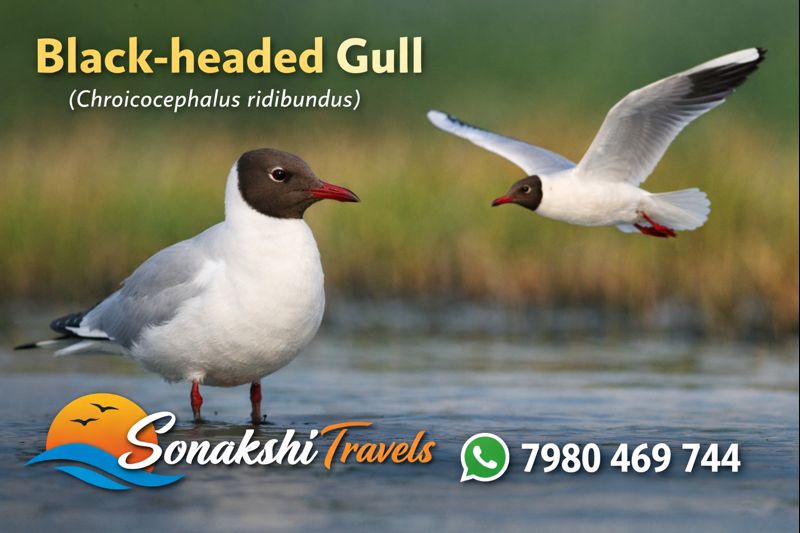
The Black-headed Gull (Chroicocephalus ridibundus) is one of the most widespread and ecologically versatile gull species across Eurasia and parts of Africa. Despite its common name, the species does not retain a fully black head throughout the year; instead, a deep chocolate-brown hood appears only during the breeding season. This medium-sized gull has attracted the attention of ornithologists for decades due to its adaptability to diverse habitats, complex social behavior, and remarkable migratory strategies. In coastal wetlands, estuaries, inland lakes, agricultural fields, and urban water bodies, the Black-headed Gull plays a significant ecological role as both predator and scavenger.
Taxonomy & Classification
Scientific Classification
The Black-headed Gull belongs to the family Laridae, a group that includes gulls, terns, and skimmers. Earlier classified under the genus Larus, detailed morphological studies and modern molecular analyses led to its reassignment to the genus Chroicocephalus. This reclassification reflects closer evolutionary relationships with smaller hooded gulls rather than larger white-headed gulls.
The Black-headed Gull is a slim, graceful gull characterized by long, narrow wings and a buoyant flight style. During the breeding season, adults exhibit a rich chocolate-brown hood extending from the crown to the nape, sharply contrasting with the white neck and body. Outside the breeding season, the hood disappears, leaving a white head with a dark ear-spot behind the eye.
Male Features
Male Black-headed Gulls are marginally larger than females, though sexual dimorphism is subtle. Males typically have slightly longer wings and a marginally heavier bill. During courtship, males display more pronounced vocalizations and ritualized postures, particularly head-tossing and calling displays used to attract females.
Female Features
Females closely resemble males in plumage and coloration. However, they are often slightly lighter in body mass and may have a finer bill structure. Behavioral differences become more apparent during the breeding season, when females invest more time in nest construction and incubation.
Size & Wingspan
Adult Black-headed Gulls typically measure between 35 and 39 cm in length. Their wingspan ranges from 86 to 99 cm, allowing efficient gliding and maneuverability. Body weight generally falls between 200 and 400 grams, depending on season and food availability.
Flight Characteristics
In flight, the species appears light and agile, with elastic wingbeats interspersed with glides. The upperwings are pale grey with distinct white leading edges, while the black tips with white mirrors provide reliable identification cues. Their flight style is well adapted for both long-distance migration and precise aerial foraging.
Habitat & Distribution
Global Range
The Black-headed Gull has an extensive distribution across Europe and Asia, breeding from the British Isles through Scandinavia and Central Asia. During winter, populations migrate southwards to the Mediterranean region, Africa, the Middle East, South Asia, and East Asia. This broad range highlights the species’ ecological flexibility.
Preferred Habitat
Breeding habitats include freshwater marshes, lakes with emergent vegetation, wet grasslands, and riverine floodplains. Outside the breeding season, the species occupies coastal mudflats, estuaries, agricultural fields, sewage treatment plants, and urban reservoirs. Its tolerance of human-modified landscapes is notably high.
Diet & Feeding Ecology
Diet Composition
The Black-headed Gull is an opportunistic omnivore. Its diet consists of aquatic and terrestrial invertebrates such as insects, earthworms, mollusks, crustaceans, and small fish. It also consumes plant matter, grains, and human food waste, particularly in urban environments.
Foraging Technique
Foraging methods are diverse and adaptive. The species frequently engages in surface picking while walking in fields, shallow plunge-diving in water bodies, and aerial hawking of insects. It often follows agricultural machinery to capture exposed invertebrates, demonstrating learned behavior and problem-solving ability.
Breeding & Reproduction
Breeding Season
Breeding typically begins in late spring. Black-headed Gulls are colonial nesters, forming large, noisy colonies that may include hundreds or thousands of pairs. Colony formation provides protection against predators through collective vigilance.
Nesting Sites
Nests are usually constructed on the ground among reeds, grasses, or low vegetation, often near water. In some regions, floating vegetation mats are used. The nest is a shallow cup made of plant material. Clutch size generally ranges from two to three eggs.
Unique Adaptations & Behavioral Ecology
Speed & Agility
The Black-headed Gull exhibits remarkable agility, particularly during aerial insect hunting and evasive maneuvers. Its relatively narrow wings and lightweight body allow rapid changes in direction, providing an advantage in both feeding and predator avoidance.
Camouflage and Nesting Strategy
Egg coloration and nest placement provide effective camouflage against ground predators. The speckled eggs blend seamlessly with surrounding vegetation and substrate. Additionally, adults employ distraction displays, feigning injury to lure predators away from nests.
Social Behavior
This species is highly social throughout the year. Vocal communication plays a central role in maintaining pair bonds, coordinating colony defense, and mediating social hierarchies. Aggressive interactions are ritualized and rarely escalate to physical conflict.
Occurrence & Seasonal Movement
Seasonal migration is a defining feature of the Black-headed Gull’s life cycle. Northern breeding populations migrate southward during autumn, while some temperate populations remain resident. Spring migration sees large flocks returning to traditional breeding sites with remarkable site fidelity.
Preferred Habitat in the Sundarbans Region
In the Sundarbans, the Black-headed Gull is primarily a winter visitor. It frequents estuarine mudflats, tidal creeks, riverbanks, and open coastal zones. The dynamic tidal system provides abundant food resources, particularly small fish and invertebrates, making the region an important seasonal refuge.
Visitors interested in coastal birdlife can combine wildlife observation with a guided mangrove exploration through a carefully curated Sundarban Tour, offering close encounters with migratory waterbirds in their natural habitat.
Ecological Role
As both predator and scavenger, the Black-headed Gull contributes significantly to ecosystem balance. By controlling insect populations and recycling organic waste, it supports nutrient cycling across wetland and coastal ecosystems. Its presence often indicates healthy, productive habitats.
Habitat Alteration
Wetland drainage, pollution, and unsustainable urban expansion pose long-term threats to suitable habitats. Although the species is adaptable, large-scale habitat degradation can reduce breeding success and food availability, particularly in densely populated regions.
Conservation Efforts
Currently classified as a species of Least Concern, the Black-headed Gull benefits from legal protection in many countries. Conservation strategies focus on wetland preservation, pollution control, and sustainable water management. Long-term monitoring programs provide valuable data on population trends and migration patterns.
Did You Know?
The scientific name ridibundus means “laughing,” referring to the gull’s distinctive, high-pitched calls. Black-headed Gulls have also demonstrated problem-solving skills, such as learning to exploit new food sources in urban environments with remarkable speed.
Nature enthusiasts seeking immersive wetland experiences may consider a professionally guided Sundarban Tour, where seasonal migratory birds such as the Black-headed Gull are regularly observed.