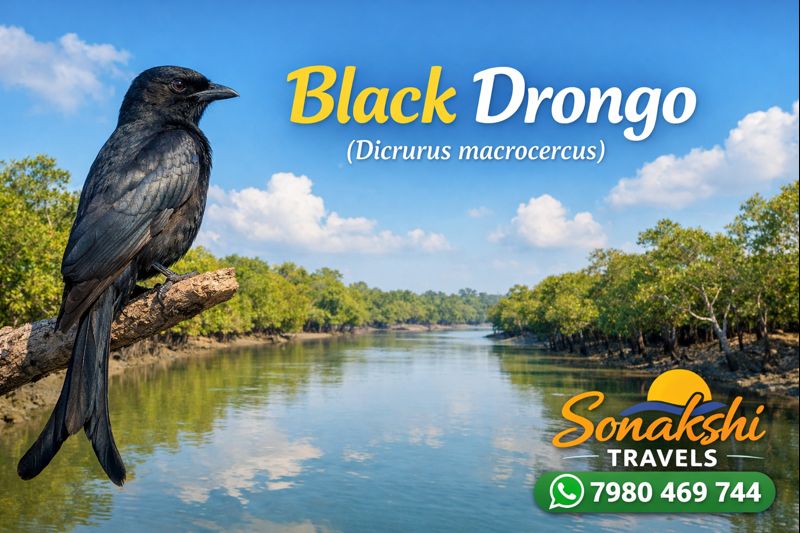
The Black Drongo (Dicrurus macrocercus) is one of the most familiar and ecologically significant passerine birds of South Asia. Easily recognized by its glossy black plumage and deeply forked tail, this species is a dominant aerial insectivore and an active defender of territory. Its adaptability to both natural and human-modified landscapes has made it one of the most successful birds across the Indian subcontinent. This article provides an in-depth, research-oriented examination of the Black Drongo, focusing on taxonomy, morphology, behavior, habitat preferences, and ecological importance, with special reference to its presence in the Sundarbans region.
Taxonomy & Classification
Systematic Position
The Black Drongo belongs to the family Dicruridae, a group commonly known as drongos. The genus Dicrurus includes more than two dozen species distributed primarily across Africa and Asia. The species name macrocercus is derived from Greek roots meaning “long-tailed,” a direct reference to the bird’s distinctive caudal morphology. Molecular phylogenetic studies suggest that Asian drongos diversified rapidly in response to expanding open habitats during the late Miocene and Pliocene epochs.
Morphology & Field Identification
General Appearance
The Black Drongo is a medium-sized passerine characterized by uniform jet-black plumage with a subtle metallic sheen under direct sunlight. Its most striking feature is the deeply forked tail, which is longer and more pronounced than that of most related species. The bill is stout, slightly hooked at the tip, and adapted for capturing flying insects. The eyes are dark brown to black, providing excellent contrast against the glossy feathers.
Male Features
Adult males exhibit intense black coloration with a high gloss, especially noticeable during the breeding season. The tail streamers are well-developed and symmetrical, enhancing aerial maneuverability. Males are highly territorial and often perch conspicuously on exposed branches or wires, from where they actively scan for prey and intruders.
Female Features
Females closely resemble males in coloration, though they may appear slightly less glossy. Morphological differences between the sexes are minimal, reflecting the species’ reliance on behavioral rather than visual cues for mate recognition. Females play a central role in nest construction and chick rearing.
Size & Wingspan
The average body length of the Black Drongo ranges between 28 and 34 centimeters, including the elongated tail. Wingspan typically measures 38 to 45 centimeters. Despite its relatively modest size, the bird’s aerodynamic design enables exceptional flight efficiency.
Flight Characteristics
Flight in the Black Drongo is swift, agile, and highly controlled. The species frequently engages in acrobatic maneuvers, including sudden turns, dives, and mid-air captures. Its long tail acts as a stabilizing rudder, allowing precise directional control during pursuit of insects.
Habitat & Distribution
Global Range
The Black Drongo is widely distributed across South and Southeast Asia. Its range extends from Iran and Afghanistan in the west to Myanmar, Thailand, and southern China in the east. The species has also expanded into parts of Indonesia, demonstrating remarkable ecological flexibility.
Preferred Habitat
This bird thrives in open landscapes such as agricultural fields, grasslands, scrublands, forest edges, wetlands, and semi-urban areas. It avoids dense forest interiors but readily occupies areas with scattered trees and open airspace suitable for aerial foraging.
Diet & Feeding Ecology
Primary Food Sources
The Black Drongo is predominantly insectivorous. Its diet includes grasshoppers, beetles, moths, termites, dragonflies, and flies. During certain seasons, it may also consume small reptiles, amphibians, and occasionally nectar or berries.
Foraging Technique
Foraging behavior is highly specialized. The bird typically employs a “sallying” technique, launching from a perch to capture insects mid-air before returning to the same or a nearby perch. It is also known to follow grazing cattle or agricultural machinery, exploiting disturbed insects.
Breeding & Reproduction
Breeding Season
Breeding generally occurs between April and August, coinciding with increased insect abundance during the monsoon. Courtship involves aerial displays, vocalizations, and mutual chases.
Nesting Sites
Nests are typically built in the fork of a tree branch, often at moderate heights. The structure is a shallow cup composed of twigs, grasses, rootlets, and spider silk, which provides flexibility and strength. Both sexes participate in nest construction.
Unique Adaptations & Behavioral Ecology
Speed & Agility
Exceptional speed and agility allow the Black Drongo to outcompete other insectivorous birds. Its rapid acceleration and sharp turning radius are key adaptations for aerial hunting.
Camouflage and Nesting Strategy
Although the bird itself is conspicuous, its nest blends effectively with surrounding branches. Strategic placement reduces visibility to predators while maintaining proximity to open foraging areas.
Social Behavior
The species is highly aggressive and fearless, often mobbing much larger birds and mammals. This bold behavior deters predators and indirectly benefits nearby species, making the Black Drongo an important component of mixed-species assemblages.
Occurrence & Seasonal Movement
The Black Drongo is largely resident across most of its range, though local movements may occur in response to rainfall patterns and food availability. In northern regions, partial migration to warmer areas has been documented.
Preferred Habitat in the Sundarbans Region
Within the Sundarbans, the Black Drongo is commonly observed along forest edges, riverbanks, village clearings, and agricultural fringes. It avoids dense mangrove interiors but plays an active role in controlling insect populations around human settlements and buffer zones.
Planning a guided mangrove adventure? Explore our Sundarban Tour Packages and choose the best itinerary for your dates.
Ecological Role
As a dominant insect predator, the Black Drongo plays a vital role in regulating insect populations, including agricultural pests. Its presence contributes to ecological balance and supports sustainable agro-ecosystems.
Habitat Alteration
While the species shows high tolerance to habitat modification, excessive pesticide use and loss of perching sites can negatively impact local populations. Conservation of open landscapes with scattered trees is essential for its long-term survival.
Conservation Efforts
Currently classified as a species of least concern, the Black Drongo benefits from its adaptability and wide distribution. Conservation measures should focus on minimizing chemical pesticide use and maintaining heterogeneous landscapes.
Did You Know?
The Black Drongo is renowned for its fearless nature and has been observed chasing away birds of prey many times its size, earning it a reputation as one of the boldest small birds in Asia.
Discover wildlife-rich mangrove landscapes with our curated Sundarban Tour Packages, designed for nature enthusiasts and bird lovers.
External Reference
For additional taxonomic and distributional information, refer to the species profile available on Wikipedia.
 omprehensive Biological and Ecological Study