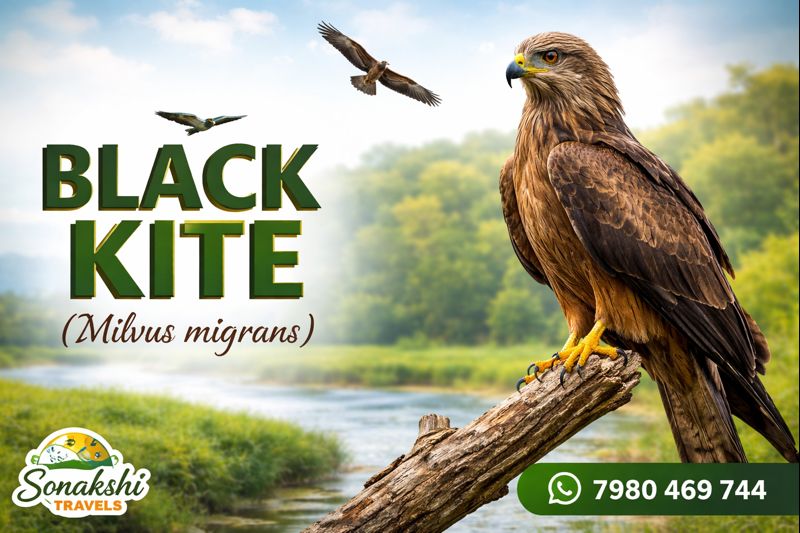
The Black Kite (Milvus migrans) is one of the most widespread and adaptable birds of prey across the Old World. Recognized by its forked tail, buoyant soaring flight, and remarkable tolerance of human-dominated environments, this medium-sized raptor occupies a unique ecological position. From pristine wetlands and mangrove forests to densely populated cities, the Black Kite demonstrates extraordinary ecological plasticity. Within the Indian subcontinent, including the Sundarbans delta, it serves as both an efficient predator and an essential scavenger, contributing significantly to ecosystem balance.
Taxonomy & Classification
The Black Kite belongs to the order Accipitriformes, which includes hawks, eagles, vultures, and harriers. It is a member of the family Accipitridae, characterized by strong hooked bills, sharp talons, and exceptional visual acuity. The genus Milvus comprises several species of kites known for their graceful flight and opportunistic feeding habits.
Multiple subspecies of Milvus migrans are recognized worldwide, reflecting regional variations in size, plumage tone, and migratory behavior. In South Asia, the subspecies Milvus migrans govinda is predominant and is commonly associated with urban and semi-urban landscapes.
Morphology & Field Identification
The Black Kite is a medium-sized raptor with long, narrow wings and a shallowly forked tail. Its streamlined body structure is well adapted for sustained soaring and agile maneuvering. In the field, it is often identified by its relaxed wing posture, with wings held slightly angled downward while gliding.
Male Features
Adult males display dark brown upperparts with slightly paler flight feathers. The head and neck may appear lighter, often marked with subtle streaking. The bill is black with a yellow cere, and the eyes are dark brown, reflecting keen alertness. Sexual dimorphism is limited, though males are generally marginally smaller than females.
Female Features
Females closely resemble males in plumage coloration but are typically larger and heavier. This size advantage supports greater energetic demands during egg production and incubation. Juvenile birds exhibit paler brown plumage with buff-edged feathers and a less pronounced tail fork.
Size & Wingspan
The Black Kite measures approximately 48–60 cm in body length. Its wingspan ranges from 130 to 155 cm, facilitating efficient use of thermal air currents. Adult body mass typically varies between 500 and 900 grams, depending on sex and regional environmental conditions.
Flight Characteristics
The species is renowned for its elegant and effortless flight. Black Kites frequently soar on thermals, circling high above the landscape. Wingbeats are shallow and elastic, alternating with long glides. During foraging descents, they display impressive aerial agility and precision.
Habitat & Distribution
Global Range
The Black Kite has an extensive global distribution across Europe, Africa, Asia, and parts of Australasia. While populations in temperate regions exhibit migratory behavior, tropical populations remain largely resident throughout the year.
Preferred Habitat
This species occupies a wide range of habitats, including wetlands, river systems, coastal zones, agricultural landscapes, mangrove forests, and urban centers. Habitat selection is strongly influenced by food availability rather than vegetation structure alone.
Diet & Feeding Ecology
The Black Kite is an opportunistic omnivorous raptor. Its diet includes small mammals, birds, reptiles, amphibians, fish, insects, and carrion. In human-dominated landscapes, it frequently consumes organic waste, fish offal, and discarded food.
Foraging Technique
Foraging methods include aerial scanning, ground scavenging, and opportunistic food theft. The species often follows fishing boats, livestock activity, or urban waste sites, capitalizing on predictable food sources.
Breeding & Reproduction
Breeding timing varies geographically but generally coincides with periods of food abundance. Black Kites form monogamous pair bonds, engaging in aerial courtship displays and mutual soaring.
Nesting Sites
Nests are constructed on tall trees, mangroves, cliffs, electric pylons, or building ledges. The nest is a bulky platform made of sticks and lined with softer materials. Typical clutch size ranges from two to three eggs.
Unique Adaptations & Behavioral Ecology
Speed & Agility
Although not among the fastest raptors, the Black Kite exhibits remarkable maneuverability. Its elongated wings and tail provide fine control during flight, enabling precise navigation through complex airspaces.
Camouflage and Nesting Strategy
The muted brown plumage blends effectively with tree canopies, riverbanks, and urban structures. Nest placement often prioritizes concealment and structural stability.
Social Behavior
Unlike many solitary raptors, Black Kites frequently form communal roosts and feeding aggregations. Such social behavior enhances foraging efficiency and information sharing.
Occurrence & Seasonal Movement
Across India, the Black Kite is largely resident, with local movements influenced by food availability and seasonal weather patterns. Winter migration from northern regions may increase local populations.
Preferred Habitat in the Sundarbans Region
In the Sundarbans delta, the Black Kite is commonly observed along riverbanks, fishing zones, mangrove edges, and village settlements. The abundance of fish waste and small prey makes the region particularly suitable.
Planning a guided mangrove adventure? Explore our Sundarban Tour packages and choose the best itinerary for your dates.
Ecological Role
By consuming carrion and organic waste, the Black Kite contributes significantly to nutrient recycling and disease control. Its role as a biological cleaner is particularly valuable in densely populated regions.
Habitat Alteration
Urban expansion, pollution, and pesticide use present growing challenges. While the species adapts well to moderate human disturbance, excessive environmental degradation can negatively affect breeding success.
Conservation Efforts
The Black Kite is currently categorized as Least Concern due to its wide range and stable population. Conservation priorities include habitat protection, pollution reduction, and sustainable waste management.
Planning a guided mangrove adventure? Explore our Sundarban Tour packages and choose the best itinerary for your dates.
Did You Know?
The Black Kite is known for its high intelligence and problem-solving abilities.
It often exploits human activity to access predictable food sources.
Large communal roosts can contain hundreds of individuals.