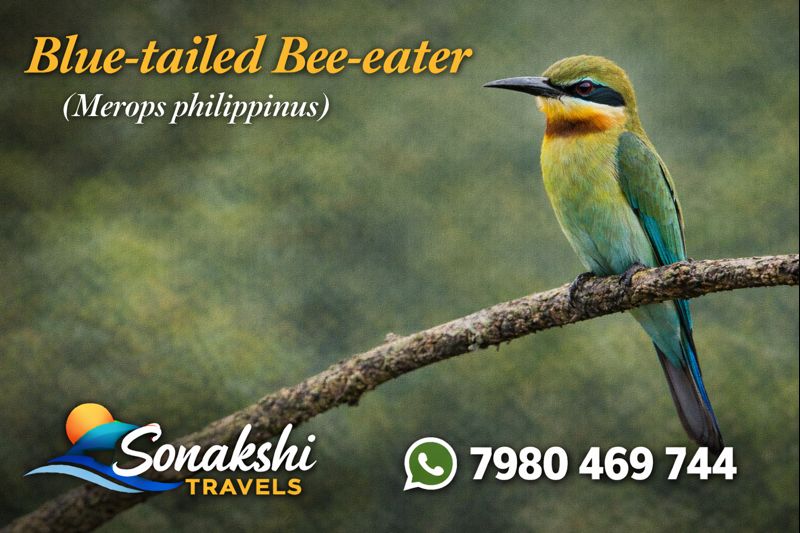
The Blue-tailed Bee-eater (Merops philippinus) is one of the most visually striking aerial insectivorous birds of South and Southeast Asia. Renowned for its iridescent plumage, graceful flight, and complex social behavior, this species plays a vital ecological role in regulating insect populations across wetlands, riverine landscapes, and open agricultural zones. In eastern India, particularly within the lower Gangetic delta and mangrove-dominated ecosystems, the species is a familiar seasonal visitor whose presence reflects habitat health and prey availability.
Taxonomy & Classification
Systematic Position
The Blue-tailed Bee-eater belongs to the family Meropidae, a specialized group of birds adapted for aerial insect hunting. Within the order Coraciiformes, bee-eaters are closely related to rollers and kingfishers, sharing similar skeletal adaptations for agile flight and precise visual targeting.
This species is immediately recognizable by its elongated central tail feathers, vibrant green body, blue tail streamers, and contrasting black eye-stripe bordered by pale blue. The slender, slightly decurved bill is adapted for seizing flying insects mid-air.
Male Features
Males typically exhibit longer and more pronounced central tail streamers. The blue coloration of the tail and lower back appears deeper and more saturated in mature males, especially during the breeding season.
Female Features
Females closely resemble males but usually have marginally shorter tail extensions and slightly duller hues. Sexual dimorphism is subtle and often indistinguishable in the field without prolonged observation.
Size & Wingspan
Adults measure approximately 23–26 cm in length, excluding elongated tail feathers. The wingspan ranges from 30 to 36 cm, allowing sustained gliding and rapid aerial turns.
Flight Characteristics
The flight of the Blue-tailed Bee-eater is buoyant and fluid, interspersed with rapid wingbeats and gliding phases. It is capable of sudden directional changes while pursuing agile prey such as dragonflies and bees.
Habitat & Distribution
Global Range
The species occurs across South Asia, Southeast Asia, and parts of East Asia. Its range includes India, Bangladesh, Sri Lanka, Myanmar, Thailand, Vietnam, southern China, and the Indonesian archipelago.
Preferred Habitat
Blue-tailed Bee-eaters favor open landscapes near water bodies, including riverbanks, wetlands, mangrove fringes, paddy fields, and grasslands with exposed perches such as electric wires or bare branches.
Diet & Feeding Ecology
Primary Diet
The diet consists predominantly of flying insects, including bees, wasps, dragonflies, butterflies, moths, and flying ants. Despite their name, bees form only a portion of their prey spectrum.
Foraging Technique
Typically adopting a sit-and-wait strategy, the bird launches from a perch to capture insects mid-air. After capture, prey is returned to the perch, where stingers are removed by repeated beating against hard surfaces.
Breeding & Reproduction
Breeding Season
Breeding generally coincides with the pre-monsoon and monsoon periods, when insect abundance peaks. Seasonal timing varies regionally depending on rainfall patterns.
Nesting Sites
Nests are constructed in horizontal burrows excavated into sandy riverbanks, mud embankments, or coastal dunes. These tunnels may extend over one meter in length, terminating in a nesting chamber.
Unique Adaptations & Behavioral Ecology
Speed & Agility
The species exhibits exceptional aerial agility, enabling it to intercept fast-moving prey in complex three-dimensional flight paths.
Camouflage and Nesting Strategy
Subterranean nesting provides protection from predators and thermal extremes. The choice of vertical or sloped banks minimizes flooding risk during heavy rains.
Social Behavior
Blue-tailed Bee-eaters are highly social, often nesting colonially. Cooperative behaviors, including sentinel duty and communal roosting, are commonly observed.
Occurrence & Seasonal Movement
In many regions, the species is partially migratory. Populations breeding in northern areas often move southward during winter, while tropical populations remain largely resident.
Preferred Habitat in the Sundarbans Region
Within the Sundarbans, Blue-tailed Bee-eaters are frequently observed along tidal creeks, river embankments, reclaimed agricultural fields, and mangrove edges. Exposed mudflats and sandy banks provide ideal nesting substrates, while the insect-rich environment ensures abundant food supply.
Exploring bird-rich mangrove landscapes enhances understanding of species like the Blue-tailed Bee-eater. Discover curated itineraries through our Sundarban Tour options and plan a nature-focused journey.
Ecological Role
By regulating insect populations, the Blue-tailed Bee-eater contributes to ecological balance and indirectly benefits agriculture. Its presence often indicates healthy wetland and riparian ecosystems.
Habitat Alteration
Riverbank erosion, sand mining, pesticide use, and large-scale land conversion pose localized threats. Disturbance of nesting banks during breeding season can significantly affect reproductive success.
Conservation Efforts
The species is currently listed as Least Concern, yet sustained conservation requires habitat protection, reduced pesticide application, and preservation of natural riverbanks and wetlands.
Nature interpretation tours provide valuable insight into avian ecology. Enhance your wildlife experience with a guided Sundarban Tour designed for bird and nature enthusiasts.
Did You Know?
Before swallowing bees or wasps, Blue-tailed Bee-eaters carefully remove the sting by repeatedly rubbing the insect against a hard surface, demonstrating remarkable learned behavior.