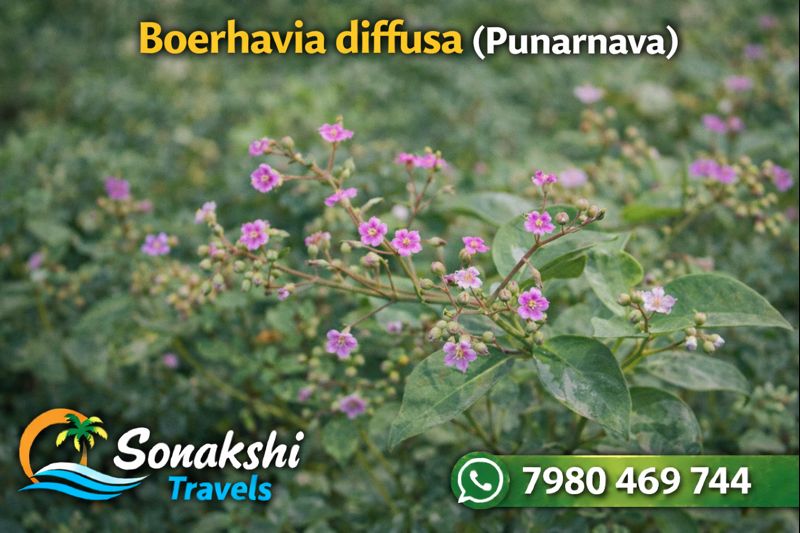
Botanical Identity, Ecological Adaptations, and Conservation Relevance
Boerhavia diffusa, popularly known as Punarnava in India, is a perennial creeping herb of remarkable biological resilience and ecological importance. The name “Punarnava,” meaning “the one that renews itself,” aptly reflects the plant’s extraordinary regenerative capacity and adaptive growth habit. Belonging to the family Nyctaginaceae, this species is widely distributed across tropical and subtropical regions and has long been embedded in traditional knowledge systems for its medicinal and ecological value.
Beyond its ethnobotanical prominence, Boerhavia diffusa plays a vital role in disturbed and semi-natural ecosystems. It thrives in open landscapes, agricultural margins, and riverine environments, demonstrating exceptional tolerance to drought, soil disturbance, and periodic flooding. In deltaic regions such as the Sundarbans periphery, Punarnava represents an important ground-cover species that contributes to soil stabilization, biodiversity support, and early successional processes.
This article presents a detailed, research-based overview of Boerhavia diffusa, focusing on its taxonomy, morphology, habitat preferences, global distribution, ecological functions, and conservation concerns, with special emphasis on its occurrence in and around the Sundarbans region.
Taxonomy & Classification
The taxonomic classification of Boerhavia diffusa reflects its placement among flowering plants adapted to warm climates and open habitats. Its systematic position is outlined below.
Taxonomic Hierarchy
Kingdom: Plantae
Clade: Angiosperms
Clade: Eudicots
Order: Caryophyllales
Family: Nyctaginaceae
Genus: Boerhavia
Species: Boerhavia diffusa L.
The family Nyctaginaceae includes herbs, shrubs, and trees often characterized by unique floral structures and adaptability to harsh environments. The genus Boerhavia comprises several species, but Boerhavia diffusa is the most widespread and ecologically significant, known for its creeping habit and regenerative root system.
Morphology & Field Identification
Boerhavia diffusa displays a suite of morphological traits that facilitate easy identification in the field, particularly in open and disturbed habitats.
Growth Habit and Stems
The plant is a low-growing, perennial, prostrate or creeping herb with spreading branches that often root at the nodes. Stems are slender, reddish to greenish-purple, and glabrous or slightly hairy. This creeping habit allows the plant to cover ground rapidly and regenerate even after physical disturbance.
Leaves
Leaves are opposite, broadly ovate to nearly round, with a slightly fleshy texture. The upper surface is green, while the underside often appears paler. Leaf margins are entire, and the petioles are relatively long. The leaves exhibit a degree of succulence, enabling moisture retention during dry periods.
Flowers
The flowers of Boerhavia diffusa are small, tubular, and typically pink, purplish, or reddish in color. They are borne in small clusters on slender stalks. Although inconspicuous individually, the flowers are produced in abundance, ensuring successful reproduction. Pollination is mainly carried out by insects attracted to subtle color and nectar cues.
Fruits and Seeds
The fruit is a small, sticky, glandular anthocarp that adheres easily to animal fur or human clothing, facilitating dispersal. This adaptation enhances the plant’s ability to colonize new habitats. Each fruit contains a single seed, capable of germinating under favorable conditions.
Habitat & Distribution
Boerhavia diffusa is a highly adaptable species, occupying a wide range of habitats influenced by both natural and anthropogenic factors.
Global Range
The species has a pantropical distribution, occurring across Asia, Africa, the Americas, and parts of Australia. It is widely distributed throughout the Indian subcontinent, where it is found from plains to lower hill regions. Its extensive range reflects its adaptability to varied climatic and soil conditions.
In India, Punarnava is commonly encountered in agricultural fields, fallow lands, roadsides, and riverbanks, often regarded as a hardy native herb rather than a cultivated plant.
Preferred Habitat
Boerhavia diffusa prefers open, sunny locations with well-drained soils. It thrives in sandy, loamy, and even compacted soils, provided drainage is adequate. The plant tolerates moderate salinity and periodic flooding, but avoids prolonged waterlogging. Its ability to grow in nutrient-poor soils makes it a successful colonizer of degraded lands.
Occurrence
In natural and semi-natural environments, Boerhavia diffusa occurs as a ground-cover species, often forming mats that spread across open areas. It is frequently found in disturbed sites, such as construction zones, agricultural margins, and pathways, where competition from taller vegetation is limited.
The species regenerates readily from roots and seeds, allowing rapid recolonization after grazing, trampling, or seasonal dieback. This regenerative capacity underlies its vernacular name and ecological success.
Preferred Habitat in the Sundarbans Region
Within the Sundarbans region, Boerhavia diffusa does not occur in core mangrove forests subjected to daily tidal inundation. Instead, it is commonly found in peripheral zones, village outskirts, embankments, agricultural fields, and elevated open grounds where salinity levels are lower and soils are well-drained.
In these transitional landscapes, Punarnava plays a valuable role in stabilizing soil surfaces and maintaining green cover during dry seasons. Its presence reflects the interface between natural deltaic processes and human-modified land use patterns surrounding the Sundarbans.
Exploring village-edge vegetation reveals resilient native herbs like Punarnava. A guided Sundarban Tour offers insight into these transitional ecosystems.
Ecological Role
The ecological role of Boerhavia diffusa is particularly significant in disturbed and early successional habitats. As a ground-cover species, it reduces soil erosion by protecting the soil surface from wind and water impact. Its spreading growth habit helps retain moisture and moderate soil temperature.
The plant supports insect communities by providing nectar and pollen, while its dense mats offer shelter for small invertebrates. Leaf litter contributes organic matter to the soil, enhancing nutrient cycling and supporting microbial activity.
Habitat Alteration
Habitat alteration affects Boerhavia diffusa in nuanced ways. While the species benefits from moderate disturbance and open habitats, excessive urbanization, chemical pollution, and intensive monoculture agriculture can reduce suitable niches. Heavy herbicide use in agricultural landscapes poses a particular threat.
In the Sundarbans periphery, embankment development and land-use change have both reduced natural vegetation and created new open habitats where Boerhavia diffusa can establish, highlighting its dual role as a disturbance-tolerant species and an ecological indicator.
Conservation Efforts
Boerhavia diffusa is not currently considered threatened due to its wide distribution and high regenerative capacity. Conservation efforts therefore focus on habitat quality rather than species protection. Maintaining heterogeneous landscapes with native ground flora supports its continued presence.
Promoting awareness of its ecological value, alongside sustainable land management practices, ensures that Punarnava remains a functional component of agro-ecological and natural systems.
Understanding hardy herbs enriches any nature journey. Join a curated Sundarban Tour to experience the botanical diversity of delta landscapes.
Did You Know?
Boerhavia diffusa can regenerate even after severe cutting or drought.
The plant spreads efficiently through both seeds and creeping stems.
Its sticky fruits aid long-distance dispersal.
Punarnava thrives in nutrient-poor and disturbed soils.
The species is a common component of traditional agro-ecosystems.
External Reference
For additional botanical and taxonomic information, consult the following external source: Boerhavia diffusa – Wikipedia