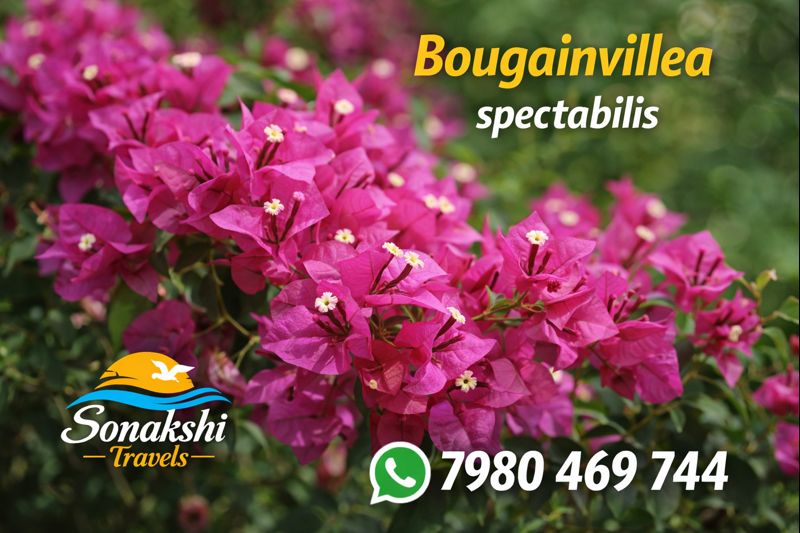
Bougainvillea spectabilis is one of the most visually striking ornamental plants of tropical and subtropical regions, admired worldwide for its vibrant bracts, vigorous growth habit, and remarkable tolerance to environmental stress. Commonly cultivated as a climber, shrub, hedge, or small tree, this species has transcended its native range to become a defining element of urban landscapes, rural homesteads, and garden architecture across continents.
Beyond its ornamental value, Bougainvillea spectabilis holds ecological relevance in disturbed habitats, roadside vegetation, and semi-natural landscapes. Its resilience to drought, poor soils, and pruning has made it a preferred plant for erosion control, living fences, and landscape stabilization. This article presents an in-depth, research-based exploration of the species, focusing on its taxonomy, morphology, habitat preferences, ecological role, and relevance within the Sundarbans fringe region.
Taxonomy & Classification
Systematic Position
Bougainvillea spectabilis belongs to the family Nyctaginaceae, a group of flowering plants known for their distinctive bracts and adaptation to warm climates. The genus Bougainvillea includes approximately 18 species, most of which are native to South America.
Kingdom: Plantae
Clade: Angiosperms
Clade: Eudicots
Order: Caryophyllales
Family: Nyctaginaceae
Genus: Bougainvillea
Species: Bougainvillea spectabilis Willd.
The species is taxonomically distinct for its large, leathery leaves and robust growth habit, which differentiate it from closely related ornamental species such as Bougainvillea glabra.
Morphology & Field Identification
Growth Habit
Bougainvillea spectabilis is a vigorous, woody climber or sprawling shrub that can reach heights of 8 to 12 meters when provided with adequate support. The plant exhibits strong, arching branches equipped with sharp, curved thorns that aid in climbing and provide protection against herbivory.
Leaves
Leaves are simple, ovate to elliptic, and comparatively large, measuring up to 13 centimeters in length. The leaf surface is softly pubescent, especially on the underside, giving the plant its specific epithet “spectabilis,” meaning showy or remarkable. The foliage is typically deep green and deciduous in regions experiencing prolonged dry seasons.
Flowers and Bracts
The true flowers of Bougainvillea spectabilis are small, tubular, and creamy white to pale yellow. These flowers are enclosed by three large, brightly colored bracts that range from magenta and purple to crimson, orange, pink, and white, depending on cultivar. The bracts are the primary ornamental feature and can persist for several weeks.
Roots and Stems
The species develops a strong, spreading root system capable of penetrating compact soils. Stems become woody with age and respond well to pruning, making the plant highly adaptable to various landscape forms, including bonsai and espalier.
Habitat & Distribution
Native Habitat
Bougainvillea spectabilis is native to Brazil and adjacent regions of South America, where it naturally occurs in dry forests, rocky slopes, and open scrublands. In its native range, the plant thrives under intense sunlight and seasonal moisture availability.
Introduced Habitats
Due to its ornamental appeal and hardiness, the species has been extensively introduced into tropical and subtropical regions worldwide. It is commonly found along roadsides, gardens, coastal settlements, and urban landscapes.
Global Range
Today, Bougainvillea spectabilis is cultivated across Asia, Africa, the Middle East, Australia, and the Mediterranean region. In India, it is one of the most widely planted ornamental climbers, thriving in both arid and humid climates.
Its global success is attributed to its ability to tolerate drought, salinity, air pollution, and nutrient-poor soils—traits that make it especially suitable for rapidly urbanizing environments.
Preferred Habitat
Soil and Climate Requirements
The species prefers well-drained sandy or loamy soils with moderate fertility. Although it tolerates poor soils, excessive moisture and waterlogging negatively affect root health. Optimal flowering occurs under full sunlight and slightly dry conditions.
Light and Temperature
Bougainvillea spectabilis requires direct sunlight for abundant bract production. It thrives in warm climates with temperatures ranging between 18°C and 35°C and exhibits limited tolerance to frost.
Occurrence
In India, the plant is widely cultivated in gardens, public parks, institutional campuses, and along highways. It often escapes cultivation and persists in semi-wild conditions near human settlements, walls, and abandoned structures.
Nature and landscape aesthetics blend beautifully across delta regions. Discover curated journeys through our
Sundarban Tour Package options designed for immersive exploration.
Preferred Habitat in the Sundarbans Region
Landscape Role in the Delta
Within the Sundarbans region, Bougainvillea spectabilis is primarily found in village settlements, tourist lodges, embankments, and elevated non-saline zones. It is absent from core mangrove forests but plays a significant role in stabilizing soils along embankments and enhancing the aesthetic value of human-inhabited areas.
Its tolerance to salinity spray and high humidity allows it to flourish in coastal villages, where it often functions as a living fence or windbreak.
Ecological Role
Pollinator Support
The small flowers of Bougainvillea spectabilis attract bees, butterflies, and other nectar-feeding insects. Although the bracts are sterile, their bright coloration enhances pollinator visitation by visually signaling floral presence.
Soil Stabilization and Microhabitats
The dense root system contributes to soil binding on slopes and embankments. The thorny branches also provide shelter for small birds and reptiles, creating microhabitats within urban and semi-rural landscapes.
Habitat Alteration
Response to Disturbance
Bougainvillea spectabilis thrives in disturbed environments and is often among the first woody plants to establish along cleared or degraded land. While not invasive in most regions, its vigorous growth can suppress smaller native plants if unmanaged.
In the Sundarbans fringe, increased construction and landscaping have expanded its presence, replacing native shrubs in some areas.
Conservation Efforts
Sustainable Landscaping
As a widely cultivated ornamental, Bougainvillea spectabilis does not require species-level conservation. However, responsible landscaping practices encourage balanced use alongside native plants to maintain ecological diversity.
In coastal regions, integrating Bougainvillea with native vegetation helps prevent erosion while preserving regional biodiversity.
For a more personalized experience exploring delta landscapes, consider our
Sundarban Private Tour experiences crafted for nature-focused travelers.
Did You Know?
Cultural and Medicinal Notes
In traditional medicine, extracts from Bougainvillea spectabilis leaves and flowers have been studied for their potential antimicrobial and anti-inflammatory properties. The plant is also symbolically associated with resilience and endurance due to its ability to flourish under harsh conditions.
Regular pruning stress often enhances flowering intensity, making controlled hardship a key factor in its spectacular display.