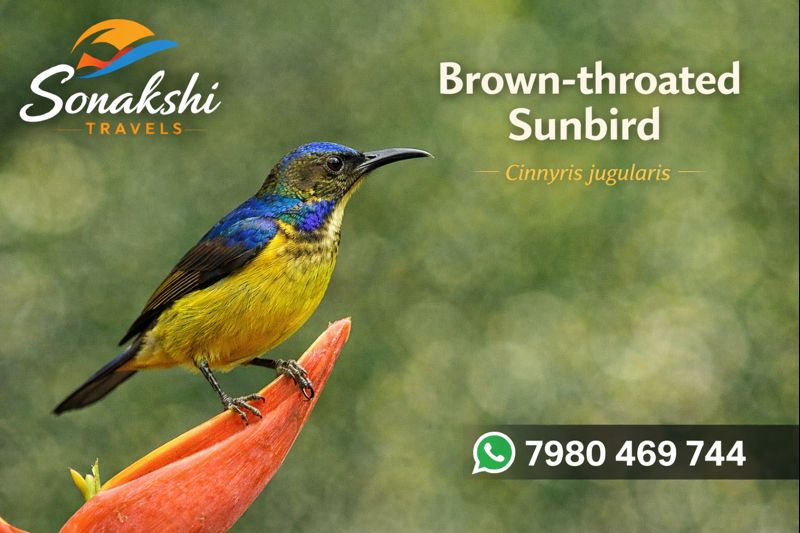
The Brown-throated Sunbird (Cinnyris jugularis) is a small yet ecologically influential nectar-feeding passerine bird distributed widely across South and Southeast Asia. Known for its iridescent plumage, energetic movements, and close association with flowering vegetation, this species represents an important functional link between plant reproduction and insect population regulation. Its ability to thrive in natural forests, mangrove systems, coastal belts, and human-altered landscapes highlights its ecological adaptability and evolutionary success.
Taxonomy & Classification
Systematic Position
The Brown-throated Sunbird belongs to the order Passeriformes and the family Nectariniidae, a lineage of Old World nectar-feeding birds often compared ecologically to hummingbirds of the Americas. The genus Cinnyris includes numerous species characterized by curved bills, brush-tipped tongues, and strong associations with flowering plants.
The Brown-throated Sunbird is a compact, slender-bodied bird with a gently down-curved bill adapted for nectar extraction. Its short tail, rapid wingbeats, and continuous activity around flowering plants make it conspicuous despite its small size. Field identification relies on plumage coloration, habitat association, and feeding behavior.
Male Features
Adult males exhibit glossy metallic plumage with deep blue, purple, and green iridescence across the head, mantle, and upperparts. The throat and upper breast are characteristically dark brown to maroon, forming a distinctive contrast with the shimmering upper plumage. In bright sunlight, the feathers display vivid color shifts due to structural iridescence.
Female Features
Females lack iridescence and display olive-brown upperparts with pale yellow to whitish underparts. This muted coloration provides effective camouflage during nesting and incubation. Sexual dimorphism is pronounced, facilitating easy visual differentiation between the sexes.
Size & Wingspan
The Brown-throated Sunbird measures approximately 10 to 11 centimeters in length. The wingspan typically ranges between 13 and 15 centimeters, enabling swift, agile movements in cluttered vegetation.
Flight Characteristics
Flight is rapid, buzzing, and highly maneuverable. The species is capable of brief hovering while feeding on nectar, though it more commonly perches on flower stalks. Short, direct flights between feeding sites dominate its daily activity.
Habitat & Distribution
Global Range
The Brown-throated Sunbird has a broad distribution across South Asia, Southeast Asia, southern China, and parts of Australasia. Its range includes coastal regions, islands, and mainland habitats, reflecting exceptional dispersal capability.
Preferred Habitat
This species occupies open forests, mangrove edges, coastal scrub, gardens, plantations, and urban green spaces. It shows a strong preference for habitats with continuous flowering plant availability.
Diet & Feeding Ecology
Diet Composition
The primary diet consists of floral nectar, supplemented by small insects, spiders, and larvae. Animal prey provides essential proteins, particularly during breeding and chick-rearing periods.
Foraging Technique
Foraging involves probing flowers with the curved bill and extensible tongue. The bird may hover briefly or perch while feeding. Insects are captured through short aerial sallies or gleaned from leaves and flower bases.
Breeding & Reproduction
Breeding Season
Breeding occurs over an extended period, often synchronized with regional flowering cycles. In many areas, nesting activity peaks between March and August.
Nesting Sites
The nest is a hanging, pouch-shaped structure suspended from thin branches, wires, or creepers. Constructed mainly by the female, it is woven from plant fibers, spider silk, and fine grasses, providing flexibility and concealment.
Unique Adaptations & Behavioral Ecology
Speed & Agility
High wingbeat frequency and lightweight skeletal structure enable rapid acceleration and precise maneuvering. These traits are critical for exploiting scattered floral resources and avoiding predators.
Camouflage and Nesting Strategy
Female plumage blends effectively with foliage, reducing nest visibility. Suspended nest placement minimizes access by ground-based and arboreal predators.
Social Behavior
The Brown-throated Sunbird is typically solitary or occurs in pairs. Males are highly territorial during the breeding season and aggressively defend nectar-rich feeding zones.
Occurrence & Seasonal Movement
This species is largely resident across its range. Localized movements may occur in response to seasonal flowering patterns, but long-distance migration is absent.
Preferred Habitat in the Sundarbans Region
In the Sundarbans, the Brown-throated Sunbird is frequently observed along mangrove fringes, village gardens, flowering shrubs, and coastal vegetation belts. It benefits from the region’s extended flowering season and structural plant diversity.
Planning a nature-focused mangrove journey? Explore curated itineraries through our Sundarban Tour experiences and witness avian diversity firsthand.
Ecological Role
The Brown-throated Sunbird is an effective pollinator for numerous flowering plants. Its insectivorous feeding further contributes to controlling small arthropod populations within its habitat.
Habitat Alteration
Urbanization, pesticide use, and removal of native flowering vegetation pose localized threats. However, the species demonstrates notable resilience in moderately altered landscapes.
Conservation Efforts
Currently classified as Least Concern, conservation priorities include preservation of flowering plant diversity, sustainable urban landscaping, and reduction of chemical pesticide use.
Planning a guided mangrove exploration? Browse thoughtfully crafted Sundarban Tour programs and choose an itinerary aligned with your interests.
Did You Know?
The iridescent colors of the Brown-throated Sunbird are produced not by pigments alone, but by microscopic feather structures that refract and reflect light at different angles.