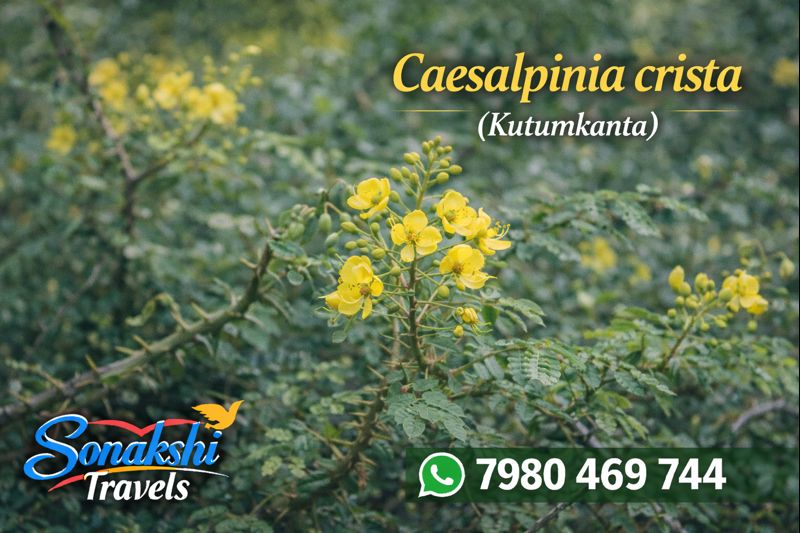
Caesalpinia crista, locally known in Bengal and parts of coastal eastern India as Kutumkanta, is a robust, spiny climbing shrub belonging to the legume family. Widely recognized for its thorny stems, bipinnate foliage, and medicinally valued seeds, this species occupies an important niche in coastal scrublands, mangrove fringes, and tropical forest margins. The plant is particularly notable for its ability to thrive in harsh environmental conditions, including saline soils, strong winds, and periodic inundation.
Kutumkanta is deeply embedded in traditional ecological knowledge systems and has long been associated with coastal resilience. In the Sundarbans and similar deltaic landscapes, Caesalpinia crista contributes to natural fencing, soil stabilization, and habitat complexity. Its spiny growth habit deters grazing, allowing it to persist in disturbed areas where other species fail to establish. This article presents a detailed, research-oriented examination of the species, covering its taxonomy, morphology, habitat preferences, distribution, ecological role, and conservation outlook.
Taxonomy & Classification
Systematic Placement
Caesalpinia crista is a member of the family Fabaceae, one of the largest plant families globally, well known for nitrogen-fixing capabilities and ecological versatility. The genus Caesalpinia comprises trees, shrubs, and climbers adapted to tropical and subtropical environments.
The genus name Caesalpinia honors Andrea Cesalpino, a Renaissance botanist, while the species epithet crista refers to the crested or spiny appearance of parts of the plant.
Morphology & Field Identification
Growth Habit
Caesalpinia crista is a woody, scrambling shrub or climber that can extend several meters in length. It often forms dense, tangled thickets, using surrounding vegetation for support.
Stem and Thorns
The stems are strong, woody, and densely armed with sharp, recurved thorns. These spines provide effective protection against herbivory and make the plant easily identifiable in the field.
Leaf Characteristics
Leaves are bipinnate, with multiple pairs of pinnae bearing small, oblong leaflets. The leaflets are smooth, bright green, and arranged symmetrically, giving the foliage a delicate, feathery appearance despite the plant’s thorny nature.
Flowers and Inflorescence
The flowers are yellow, moderately sized, and borne in axillary or terminal racemes. Each flower exhibits the typical leguminous structure, attracting insects such as bees and butterflies for pollination.
Fruits and Seeds
The fruit is a flattened, woody pod containing one or two large, hard seeds. The seeds are globose to ovoid and have been traditionally valued for their medicinal and cultural significance.
Habitat & Distribution
Natural Habitat
Caesalpinia crista is commonly found in coastal scrublands, forest edges, mangrove margins, riverbanks, and open woodlands. It shows a strong preference for sunny locations with well-drained soils.
Altitude Range
The species primarily occurs in lowland regions from sea level up to approximately 500 meters, particularly in coastal and subcoastal environments.
Global Range
Geographical Distribution
Caesalpinia crista has a wide distribution across tropical Asia, Africa, northern Australia, and parts of the Pacific. Its presence in coastal regions worldwide reflects its tolerance to saline air and sandy soils.
Distribution in the Indian Subcontinent
In India, Kutumkanta is widely distributed along coastal belts and riverine plains, particularly in West Bengal, Odisha, Andhra Pradesh, Tamil Nadu, Kerala, and parts of northeastern India.
Preferred Habitat
Soil Preferences
The plant thrives in sandy to loamy soils with good drainage. It tolerates poor soil fertility and mild salinity, making it well suited to coastal and estuarine zones.
Light and Moisture Requirements
Full sunlight is essential for vigorous growth and flowering. While drought-tolerant once established, the species benefits from seasonal rainfall.
Occurrence
Seasonal Growth Pattern
Vegetative growth accelerates during the monsoon, followed by flowering and fruiting in the post-monsoon period. The woody structure persists year-round.
Preferred Habitat in the Sundarbans Region
Local Distribution
In the Sundarbans, Caesalpinia crista is mainly found along mangrove fringes, embankments, village boundaries, and elevated islands where salinity is moderate. It avoids permanently waterlogged core mangrove zones.
Deltaic Adaptation
Its spiny habit, salt tolerance, and ability to stabilize loose soil make Kutumkanta particularly well adapted to the dynamic conditions of the Sundarbans.
Exploring thorny coastal shrubs that protect embankments and villages adds ecological depth to a guided Sundarban Tour, where resilience defines the landscape.
Ecological Role
Soil Stabilization
The extensive root system of Caesalpinia crista helps bind sandy and loose soils, reducing erosion in coastal and riverine environments.
Habitat and Shelter
Dense, thorny thickets provide refuge for small mammals, birds, and reptiles, enhancing local biodiversity.
Habitat Alteration
Human Impact
Coastal development, land conversion, and excessive clearing can reduce natural populations. However, the species often survives due to its resilience and low palatability.
Environmental Resilience
Kutumkanta demonstrates strong tolerance to wind, salt spray, and periodic flooding, making it resistant to many forms of habitat stress.
Conservation Efforts
Conservation Status
Caesalpinia crista is not considered globally threatened, though localized declines may occur due to habitat loss.
Sustainable Use and Protection
Preserving coastal scrublands and integrating native thorny species into embankment protection programs can support long-term conservation.
Understanding how thorny climbers safeguard fragile coastlines enriches an immersive Sundarban Tour,
revealing nature’s defensive strategies.
Did You Know?
Natural Fencing Plant
Because of its dense thorns, Caesalpinia crista has traditionally been used as a living fence in rural landscapes.
Seeds with Cultural Value
The hard seeds have been used in traditional practices and folk remedies across coastal regions.
External Reference
For further botanical and taxonomic information, consult the Wikipedia page on Caesalpinia crista.