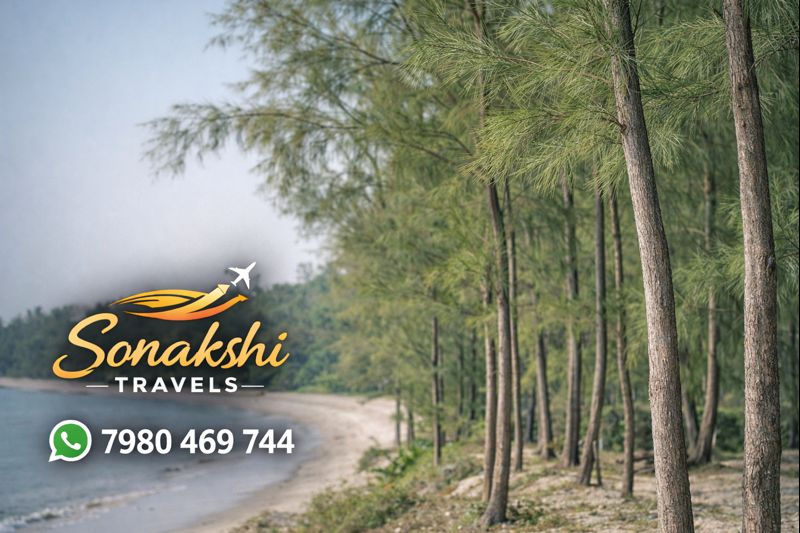
Casuarina equisetifolia, commonly known as Jhaw, She-oak, or Australian Pine, is a distinctive evergreen tree widely recognized for its coastal adaptability, wind resistance, and soil-stabilizing properties. Although its appearance resembles that of a conifer, Casuarina equisetifolia is a flowering plant belonging to the family Casuarinaceae. The species plays a vital role in coastal ecosystems, shelterbelt plantations, and erosion control programs across tropical and subtropical regions.
In eastern India and the Sundarbans-adjacent landscapes, Jhaw is an ecologically significant species frequently planted along embankments, coastal belts, and sandy tracts to protect human settlements and agricultural land from cyclonic winds and saline intrusion. This article presents an in-depth, research-oriented account of Casuarina equisetifolia, detailing its taxonomy, morphology, habitat preferences, distribution, ecological role, and conservation relevance, with special emphasis on its presence in the Sundarbans region.
Taxonomy & Classification
Systematic Position
Casuarina equisetifolia belongs to the family Casuarinaceae, a small group of trees and shrubs adapted primarily to nutrient-poor and coastal soils. The genus Casuarina is notable for its unique morphological adaptations, including jointed branchlets and reduced leaves.
Kingdom: Plantae
Clade: Angiosperms
Clade: Eudicots
Order: Fagales
Family: Casuarinaceae
Genus: Casuarina
Species:Casuarina equisetifolia
The species epithet equisetifolia refers to the resemblance of its fine, segmented branchlets to the horsetail plant (Equisetum), highlighting its distinctive appearance.
Morphology & Field Identification
Growth Habit and Trunk
Casuarina equisetifolia is a medium to tall evergreen tree, typically reaching heights of 15–30 meters, with some individuals growing even taller under optimal conditions. The trunk is straight and cylindrical, covered with rough, fissured bark that ranges from grey to reddish-brown in color.
The crown is generally narrow and conical in younger trees, becoming more spreading and irregular with age. Its overall silhouette is slender, allowing it to withstand strong coastal winds.
Branchlets and Leaves
One of the most distinctive features of Jhaw is its needle-like branchlets, which are green, jointed, and photosynthetic. True leaves are reduced to minute, scale-like structures arranged in whorls at the joints of the branchlets. This adaptation minimizes water loss and enhances tolerance to dry, saline environments.
Flowers and Fruits
The species is monoecious, bearing male and female flowers on the same plant. Male flowers appear as slender spikes, while female flowers develop into small, woody cone-like structures. These cones contain numerous winged seeds that are dispersed primarily by wind.
Habitat & Distribution
Natural Habitat
Casuarina equisetifolia is naturally adapted to coastal habitats, thriving on sandy soils, dunes, and beach ridges. It is commonly found along shorelines, estuaries, and riverbanks where salinity, wind exposure, and nutrient limitations restrict the growth of many other tree species.
The species is also capable of forming symbiotic associations with nitrogen-fixing microorganisms, allowing it to improve soil fertility over time.
Global Range
The native range of Casuarina equisetifolia includes coastal regions of Australia, Southeast Asia, and the Pacific Islands. Due to its ecological and economic value, it has been widely introduced to tropical and subtropical regions across Asia, Africa, and the Americas.
In India, the species is extensively planted along the eastern and western coastlines, as well as in inland areas with sandy or degraded soils.
Preferred Habitat
Soil and Climatic Preferences
Jhaw thrives in well-drained sandy soils with low to moderate nutrient content. It exhibits remarkable tolerance to salinity, drought, and high wind speeds, making it ideally suited to coastal and semi-arid environments.
The species prefers full sunlight and warm temperatures but can tolerate seasonal variations in rainfall and humidity.
Occurrence
Casuarina equisetifolia occurs both in naturalized coastal stands and as part of managed plantations. It is commonly used in shelterbelts, windbreaks, and afforestation programs aimed at stabilizing sand dunes and protecting agricultural land.
In many regions, the tree has become a dominant feature of coastal landscapes, shaping local microclimates and influencing vegetation dynamics.
Preferred Habitat in the Sundarbans Region
Ecological Placement
In the Sundarbans region, Casuarina equisetifolia is primarily found along embankments, coastal fringes, and human-modified landscapes rather than within core mangrove forests. Its tolerance to salinity and wind makes it a valuable species for stabilizing levees and protecting villages from storm surges.
The species thrives in slightly elevated areas where tidal inundation is limited, benefiting from the region’s alluvial sands and humid climate.
Role in Coastal Protection
Jhaw plantations in the Sundarbans act as bio-shields, reducing wind velocity, trapping airborne salt particles, and minimizing soil erosion. These functions are particularly critical during cyclonic events.
Ecological Role
Soil Stabilization and Improvement
The extensive root system of Casuarina equisetifolia binds loose sandy soils, preventing erosion and dune migration. Through its association with nitrogen-fixing bacteria, the species enriches otherwise nutrient-poor soils.
Microclimate Regulation
Casuarina stands reduce wind speed and evapotranspiration, creating more favorable conditions for understory vegetation and adjacent agricultural fields.
Biodiversity Support
Although not as species-rich as mangrove forests, Casuarina groves provide habitat for birds, insects, and small mammals, contributing to overall landscape-level biodiversity.
Habitat Alteration
Anthropogenic Influences
Large-scale monoculture plantations of Casuarina equisetifolia can alter native vegetation patterns if not managed responsibly. Replacement of diverse coastal flora with single-species stands may reduce habitat heterogeneity.
Climate Change Impacts
Rising sea levels, increased cyclone frequency, and changes in sediment dynamics influence the long-term viability of Casuarina plantations. While the species is resilient, extreme and repeated disturbances may affect regeneration.
Conservation Efforts
Sustainable Plantation Management
Balanced use of Casuarina equisetifolia in coastal protection programs requires integration with native species and mixed planting strategies. Such approaches enhance ecological resilience while retaining protective benefits.
Community Participation
Involving local communities in plantation maintenance and monitoring promotes sustainable use and increases awareness of the species’ ecological role.
Did You Know?
Casuarina equisetifolia can grow in soils with very low nutrient availability due to its nitrogen-fixing ability.
Despite its pine-like appearance, it is a flowering plant, not a true conifer.
The tree is widely used as a windbreak along coastal highways and embankments.
Its wood burns well and has been traditionally used as fuel in coastal regions.
Explore the dynamic coastal landscapes where species like Jhaw shape the environment. Discover curated itineraries through our
Sundarban Tour Package experiences designed for nature enthusiasts.
For a deeper, private exploration of mangrove-edge ecosystems and coastal forests, explore our exclusive
Sundarban Private Tour options guided by local experts.
External Reference
Further botanical and distributional information can be found on the Wikipedia page for Casuarina equisetifolia.