Ruddy-breasted Crake (Zapornia fusca) – A Detailed Biological and Ecological Profile The Ruddy-breasted Crake (Zapornia fusca) is a small, secretive wetland bird belonging to the rail family, renowned for its elusive behavior, rich chestnut underparts, and remarkable adaptation to densely vegetated freshwater habitats. Often heard rather than seen, this crake exemplifies the cryptic lifestyle characteristic […]

Category: Blog
Watercock (Gallicrex cinerea)
Watercock (Gallicrex cinerea) – A Detailed Biological and Ecological Account The Watercock (Gallicrex cinerea) is one of the most enigmatic and visually striking members of the rail family inhabiting Asian wetlands. Known for its dramatic sexual dimorphism during the breeding season, the species is especially remarkable for the male’s transformation into a dark-plumaged bird crowned […]
Common Coot (Fulica atra)
Common Coot (Fulica atra) – A Comprehensive Biological and Ecological Study The Common Coot (Fulica atra) is one of the most widespread and ecologically significant waterbirds across Eurasia, Africa, and parts of Australasia. Recognized instantly by its dark slate-black plumage and distinctive white frontal shield, this species belongs to the rail family and exhibits a […]
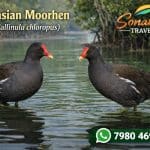
Eurasian Moorhen (Gallinula chloropus)
Eurasian Moorhen (Gallinula chloropus) – A Detailed Biological and Ecological Study Introduction The Eurasian Moorhen (Gallinula chloropus) is a widely distributed and highly adaptable wetland bird, instantly recognizable by its dark plumage, contrasting white flank stripes, and striking red frontal shield. Occupying a broad range of freshwater habitats across Europe, Asia, Africa, and parts of […]
Little Grebe (Tachybaptus ruficollis)
Little Grebe (Tachybaptus ruficollis) – A Detailed Biological and Ecological Study Introduction The Little Grebe (Tachybaptus ruficollis), also widely known as the Dabchick, is one of the smallest and most agile members of the grebe family. Despite its modest size, this freshwater diving bird is biologically sophisticated, ecologically important, and behaviorally intriguing. Found across vast […]
Red Junglefowl (Gallus gallus)
Red Junglefowl (Gallus gallus) – A Comprehensive Biological and Ecological Profile Introduction The Red Junglefowl (Gallus gallus) is one of the most significant bird species in the natural and cultural history of humanity. Widely recognized as the wild ancestor of the domestic chicken, this species occupies a unique position at the intersection of evolutionary biology, […]
Rain Quail (Coturnix coromandelica)
Rain Quail (Coturnix coromandelica): A Comprehensive Biological and Ecological Study The Rain Quail (Coturnix coromandelica) is a small, elusive ground-dwelling bird of the family Phasianidae, renowned for its strong association with the Indian monsoon and seasonal grassland ecosystems. Despite its modest size and cryptic nature, the Rain Quail holds considerable ecological significance as an insect […]
Grey Francolin (Francolinus pondicerianus)
Grey Francolin (Ortygornis pondicerianus): A Detailed Biological and Ecological Study The Grey Francolin (Ortygornis pondicerianus), commonly known as the Grey Partridge, is a ground-dwelling game bird of South Asia that holds considerable ecological, cultural, and biological importance. Recognized for its distinctive vocalizations, cryptic plumage, and adaptability to human-modified landscapes, this species plays a significant role […]
Indian Peafowl (Pavo cristatus)
Indian Peafowl (Pavo cristatus): A Comprehensive Biological and Ecological Study Introduction The Indian Peafowl (Pavo cristatus), commonly referred to as the peacock (male) and peahen (female), is one of the most visually striking birds of the Indian subcontinent. Revered for centuries in art, mythology, and folklore, this species is not only India’s national bird but […]
Tufted Duck (Aythya fuligula)
Tufted Duck (Aythya fuligula): A Comprehensive Biological and Ecological Study The Tufted Duck (Aythya fuligula) is a distinctive diving duck of the family Anatidae, instantly recognizable by its compact body, striking plumage contrasts, and the characteristic drooping crest that gives the species its common name. Widely distributed across the temperate and subarctic regions of Eurasia, […]