A Comprehensive Ecological and Botanical Profile of a Vital Mangrove Species
Ceriops decandra is a true mangrove species of exceptional ecological importance, forming an integral component of tropical and subtropical mangrove ecosystems across South and Southeast Asia. Often overshadowed by more dominant mangrove trees, this species plays a subtle yet crucial role in stabilizing intertidal mudflats, maintaining sediment balance, and supporting estuarine biodiversity. In the Sundarbans—the world’s largest contiguous mangrove forest—Ceriops decandra contributes significantly to shoreline resilience, nutrient cycling, and the structural complexity of mangrove habitats.
This article presents an in-depth, research-based botanical and ecological overview of Ceriops decandra, with particular emphasis on its taxonomy, morphology, habitat preferences, global distribution, ecological functions, conservation status, and its localized significance within the Sundarbans region.
Taxonomy & Classification
The scientific classification of Ceriops decandra reflects its close evolutionary association with other Indo–West Pacific mangrove taxa. It belongs to a group of mangroves characterized by specialized reproductive strategies, salt tolerance mechanisms, and morphological adaptations to anaerobic soils.
Systematic Position
Kingdom: Plantae
Clade: Angiosperms
Clade: Eudicots
Order: Malpighiales
Family: Rhizophoraceae
Genus: Ceriops
Species: Ceriops decandra (Griff.) Ding Hou
The genus Ceriops comprises a small number of mangrove species distributed mainly along sheltered tropical coastlines. Ceriops decandra is closely related to Ceriops tagal, but differs in floral structure, fruit morphology, and ecological niche preferences.
Morphology & Field Identification
Accurate field identification of Ceriops decandra requires close observation of its bark texture, leaf arrangement, floral parts, and propagule structure. This species typically occurs as a small to medium-sized evergreen tree, often forming dense stands in suitable intertidal zones.
General Growth Form
Ceriops decandra usually attains a height of 3–8 meters, though under optimal conditions it may reach up to 10 meters. The trunk is slender and often slightly twisted, with a relatively narrow crown compared to other mangrove trees. The bark is grey to dark brown, rough, and fissured, providing protection against salinity stress and tidal abrasion.
Leaves and Shoots
The leaves are simple, opposite, and leathery in texture—an adaptation that reduces water loss in saline environments. They are elliptic to obovate in shape, with entire margins and a glossy green upper surface. The underside is paler, often with a subtle yellowish hue. Petioles are short, and leaf scars are distinctly visible on young branches.
Flowers and Reproductive Structures
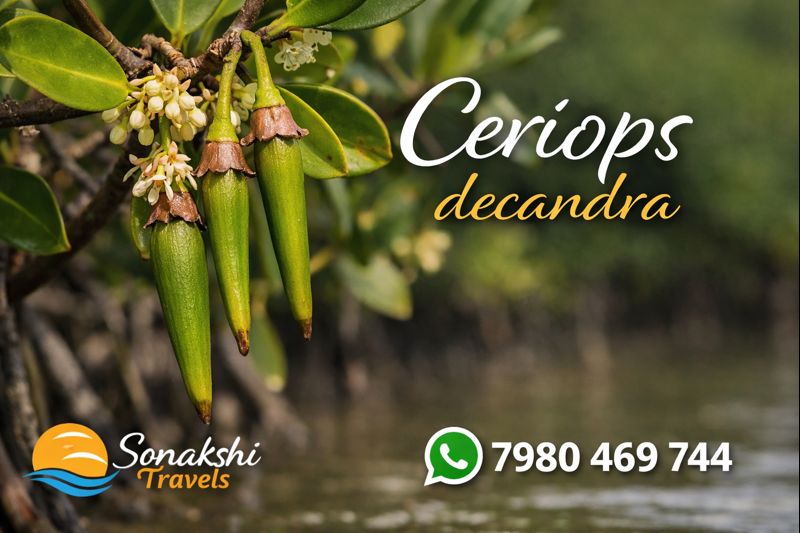
The flowers of Ceriops decandra are small, bisexual, and typically borne in axillary clusters. Each flower possesses a tubular calyx with multiple lobes and creamy-white petals. The reproductive organs are enclosed within the calyx, protecting them from tidal inundation and salt spray.
Fruit and Propagules
Like other members of the Rhizophoraceae, Ceriops decandra exhibits vivipary. The seed germinates while still attached to the parent tree, forming a cylindrical propagule. These propagules eventually detach and disperse via tidal currents, embedding themselves in soft substrates upon settlement.
Habitat & Distribution
Ceriops decandra is a true mangrove species restricted to intertidal coastal environments. It thrives in areas influenced by regular tidal flushing, moderate salinity, and fine-textured sediments.
Environmental Conditions
The species prefers sheltered estuarine zones, creek banks, and back-mangrove areas where wave energy is low. It tolerates fluctuating salinity levels but generally avoids highly exposed seafronts dominated by stronger tidal forces.
Global Range
The natural distribution of Ceriops decandra extends across South Asia and Southeast Asia. It is found along the coastlines of India, Bangladesh, Sri Lanka, Myanmar, Thailand, Malaysia, Indonesia, and parts of the Philippines. Within this range, its occurrence is often patchy, influenced by local geomorphology and hydrological conditions.
Preferred Habitat
Ceriops decandra shows a marked preference for muddy or silty substrates with high organic content. These soils provide the anaerobic conditions and nutrient availability required for its growth. The species often occupies mid-intertidal zones, where it experiences periodic submergence and exposure.
Occurrence
Although not always a dominant species, Ceriops decandra occurs consistently in well-preserved mangrove systems. Its presence is often indicative of stable sedimentary environments and relatively undisturbed tidal regimes.
Preferred Habitat in the Sundarbans Region
Within the Sundarbans, Ceriops decandra is commonly found along inner creek margins, tidal flats, and protected backwater zones. It frequently associates with other mangrove species such as Avicennia, Bruguiera, and Excoecaria, contributing to multi-layered forest structure.
Exploring the intricate mangrove ecology where species like Ceriops decandra thrive is best experienced through a guided Sundarban Tour, allowing visitors to understand the forest beyond its surface beauty.
Ecological Role
Ceriops decandra performs multiple ecological functions within mangrove ecosystems. Its dense root network stabilizes sediments, reducing erosion and enhancing land accretion. Leaf litter from the species contributes organic matter to estuarine food webs, supporting detritivores and microbial communities.
The species also provides habitat and shelter for juvenile fish, crustaceans, and invertebrates, indirectly supporting coastal fisheries. By sequestering carbon in its biomass and soils, Ceriops decandra contributes to climate regulation and blue carbon storage.
Habitat Alteration
Habitat alteration poses a significant threat to Ceriops decandra. Coastal development, aquaculture expansion, altered freshwater inflows, and pollution have led to the degradation of many mangrove habitats. Changes in sediment supply and salinity regimes can disrupt the delicate balance required for its survival.
Conservation Efforts
Conservation of Ceriops decandra depends largely on the protection and restoration of mangrove ecosystems as a whole. In the Sundarbans, legal protection under forest and wildlife regulations has helped preserve large tracts of mangrove habitat. Restoration initiatives focusing on natural regeneration and hydrological rehabilitation are particularly beneficial for this species.
For travelers interested in conservation-focused experiences, a thoughtfully planned Sundarban Tour offers insight into mangrove protection efforts and the vital role of species like Ceriops decandra.
Did You Know?
Ceriops decandra is often considered a “soil-binding” mangrove due to its exceptional sediment-stabilizing capacity.
The species’ viviparous propagules increase seedling survival in harsh intertidal environments.
Traditional coastal communities have historically used its wood for small implements and fuel, though large-scale extraction is now restricted.
External Reference
For additional botanical details and global context, readers may consult the publicly available reference: