Ceropegia lucida:
A Comprehensive Botanical and Ecological Study
Ceropegia lucida is a rare and ecologically intriguing species belonging to the genus Ceropegia, a group well known for its extraordinary floral morphology and specialized pollination strategies. Characterized by its delicate climbing habit and lantern-shaped flowers, Ceropegia lucida occupies a unique niche within tropical and subtropical ecosystems of the Indian subcontinent. Although less conspicuous than many woody forest species, its ecological importance, evolutionary adaptations, and conservation value are considerable.
Species of Ceropegia are often referred to as “lantern flowers” or “parachute flowers” due to their tubular corollas and fused petals, which form elaborate traps for pollinating insects. Ceropegia lucida exemplifies this evolutionary innovation, demonstrating a highly specialized interaction between plant and pollinator. This article presents a detailed, research-oriented account of Ceropegia lucida, covering its taxonomy, morphology, habitat preferences, distribution, ecological role, and conservation relevance, with special reference to eastern India and the Sundarbans fringe.
Taxonomy & Classification
Systematic Position
Ceropegia lucida belongs to the family Apocynaceae, subfamily Asclepiadoideae, a lineage renowned for complex floral structures and intricate pollination mechanisms. The genus Ceropegia comprises more than 200 species, many of which are narrow endemics with highly restricted distributions.
- Kingdom: Plantae
- Clade: Angiosperms
- Clade: Eudicots
- Order: Gentianales
- Family: Apocynaceae
- Subfamily: Asclepiadoideae
- Genus: Ceropegia
- Species: Ceropegia lucida Wall.
The taxonomic placement of Ceropegia lucida is supported by floral morphology, pollinia structure, and vegetative characteristics that clearly align it with other Asian members of the genus.
Morphology & Field Identification
Growth Habit
Ceropegia lucida is a perennial, twining or trailing herbaceous climber. The plant typically exhibits slender, flexible stems that coil around nearby vegetation for support. This climbing habit allows it to access filtered sunlight in forest margins and open woodland environments.
Stems and Latex
The stems are thin, green to slightly purplish, and contain milky latex—a characteristic feature of the Apocynaceae. The latex acts as a defensive mechanism against herbivores and pathogens.
Leaves
Leaves are opposite, simple, and ovate to elliptic in shape, with a smooth, glabrous surface that gives the species its epithet “lucida,” meaning shiny or glossy. The leaf blades are typically bright green, with a distinct midrib and entire margins.
Flowers
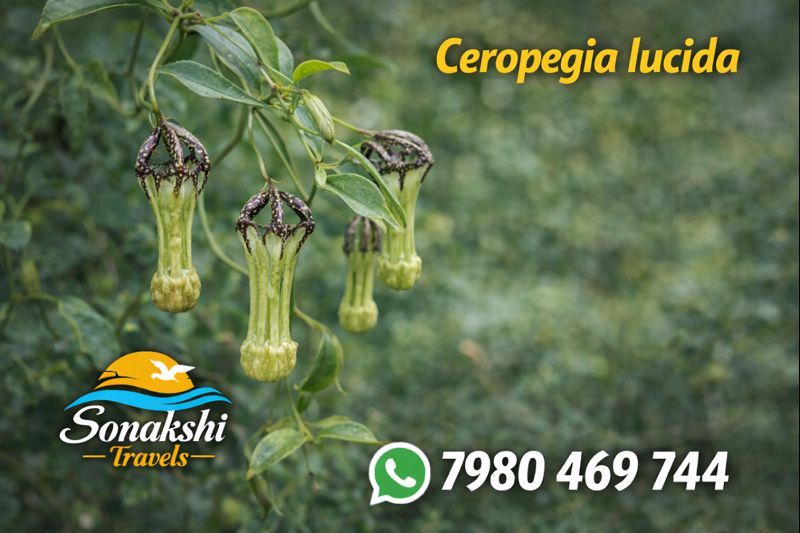
The flowers of Ceropegia lucida are its most distinctive feature. They are tubular and elongated, often curved, with the corolla lobes fused at the tips to form a cage-like or lantern-shaped structure. Coloration varies from pale green to cream, often marked with purple or brownish mottling.
These flowers function as temporary traps for small flies, which are guided inside by visual cues and scent. Once pollination occurs, the insects are released unharmed, making the system both efficient and ecologically specialized.
Fruits and Seeds
The fruit consists of paired follicles, typical of the Apocynaceae, containing numerous seeds equipped with silky coma hairs. These hairs facilitate wind dispersal, allowing the species to colonize suitable microhabitats.
Habitat & Distribution
Natural Habitat
Ceropegia lucida inhabits open forests, forest edges, scrublands, and semi-shaded slopes. It prefers habitats with moderate moisture, good drainage, and partial sunlight. The species is often associated with mixed deciduous vegetation and transitional zones between dense forest and open land.
Microhabitat Preferences
The plant frequently grows among shrubs or low trees, using surrounding vegetation as structural support. It avoids dense shade and waterlogged soils, indicating sensitivity to both light availability and soil aeration.
Global Range
Ceropegia lucida is primarily distributed in South Asia, with confirmed occurrences in India and neighboring regions. Its range is considerably narrower compared to many widespread climbers, reflecting the specialized ecological requirements typical of the genus.
Within India, the species has been recorded from eastern and northeastern regions, where suitable climatic and edaphic conditions persist.
Preferred Habitat
Soil Requirements
The species prefers well-drained loamy or sandy soils rich in organic matter. Slightly acidic to neutral soil conditions favor healthy vegetative growth and flowering.
Climate and Light
Ceropegia lucida thrives in warm, humid climates with seasonal rainfall. Partial sunlight or dappled shade is ideal, as excessive exposure can stress the delicate stems and leaves.
Occurrence
Occurrences of Ceropegia lucida are typically localized and scattered, often limited to specific forest patches or scrub zones. Such patchy distribution makes the species vulnerable to habitat disturbance and land-use change.
Sundarban Tour Package
options designed for ecological exploration.
Preferred Habitat in the Sundarbans Region
Role in Transitional Vegetation
Within the broader Sundarbans landscape, Ceropegia lucida is not found in core mangrove forests but may occur in inland fringe zones, village woodlands, and elevated non-saline areas. These transitional habitats provide the partial shade and soil conditions necessary for its survival.
Such fringe areas act as ecological buffers, supporting non-mangrove flora that contributes to overall landscape diversity.
Ecological Role
Pollination Ecology
The specialized floral structure of Ceropegia lucida supports a unique pollination system involving small dipteran insects. This interaction highlights the plant’s role in maintaining niche pollinator populations within forest ecosystems.
Contribution to Biodiversity
As a climber with distinctive flowers, the species adds structural and functional diversity to vegetation layers. Its presence indicates relatively undisturbed microhabitats and ecological continuity.
Habitat Alteration
Threats and Pressures
Habitat loss due to deforestation, agricultural expansion, and infrastructure development poses a significant threat to Ceropegia lucida. Because of its localized distribution, even small-scale disturbances can lead to population decline.
In delta-adjacent regions, changes in hydrology and increasing soil salinity further restrict suitable habitats.
Conservation Efforts
Protection and Awareness
Conservation of Ceropegia lucida depends on habitat protection, documentation of existing populations, and inclusion in regional biodiversity assessments. Promoting awareness among local communities and forest managers is essential for long-term survival.
Ex situ conservation through botanical gardens and controlled propagation may provide additional safeguards against extinction.
Sundarban Private Tour
experiences curated for nature-focused travelers.
Did You Know?
Unique Floral Strategy
Species of Ceropegia, including Ceropegia lucida, employ a “temporary trapping” pollination strategy, where insects are momentarily confined within the flower and later released, ensuring effective pollination without harming the pollinator.
Many Ceropegia species are narrow endemics, making the genus a priority group for plant conservation in India.
External Reference
For further botanical and taxonomic information: