A Comprehensive Botanical, Ecological and Environmental Study
Chenopodium album, popularly known in eastern India and Bangladesh as Botuashak, is a fast-growing annual herb widely distributed across temperate and tropical regions of the world. Often regarded as a common weed in agricultural landscapes, this plant holds significant ecological, nutritional, and cultural value. In rural Bengal, Botuashak has long been recognized as a traditional leafy green, while ecologically it functions as a pioneer species capable of colonizing disturbed soils with remarkable efficiency.
Belonging to the family Amaranthaceae, Chenopodium album demonstrates exceptional adaptability to diverse climatic and soil conditions. Its presence across farmlands, riverbanks, village outskirts, and wastelands highlights its resilience and ecological versatility. This article provides a detailed, research-based exploration of Chenopodium album, covering its taxonomy, morphology, habitat preferences, global distribution, ecological role, and conservation relevance, with special reference to its occurrence in the Sundarbans region.
Taxonomy & Classification
The taxonomic identity of Chenopodium album reflects its close relationship with other herbaceous plants adapted to open and disturbed environments. The genus Chenopodium includes numerous species known for their nutritional and ecological significance.
Kingdom: Plantae
Clade: Angiosperms
Clade: Eudicots
Order: Caryophyllales
Family: Amaranthaceae
Genus: Chenopodium
Species:Chenopodium album
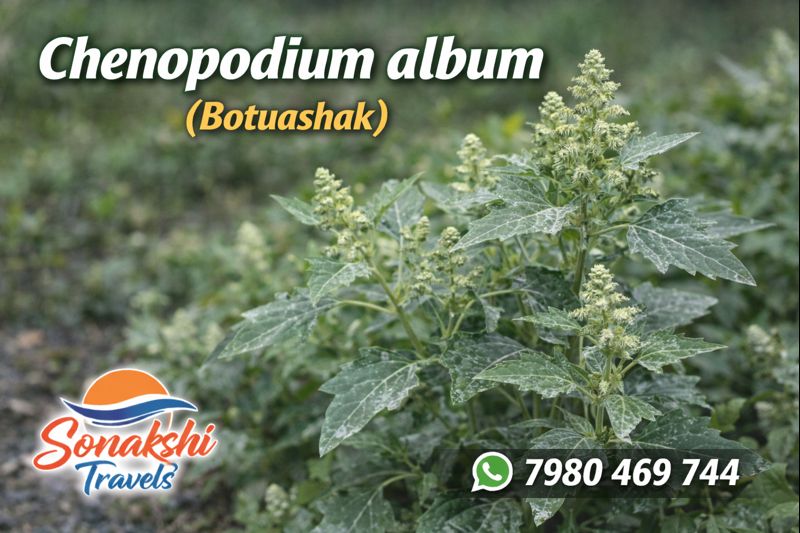
The species epithet album, meaning “white,” refers to the fine, mealy coating often visible on young leaves and stems, a distinctive feature useful for field identification.
Morphology & Field Identification
Growth Habit
Chenopodium album is an erect, annual herb that typically grows between 30 centimeters and 1.5 meters in height. The plant exhibits a rapid growth rate, completing its life cycle within a single growing season. Its upright habit and branching pattern allow it to dominate open spaces quickly.
Stem Characteristics
The stem is angular to slightly grooved, green to reddish in color, and often coated with a whitish, powdery layer. It is usually branched, especially in nutrient-rich soils, contributing to the plant’s bushy appearance.
Leaves
Leaves are alternate, variable in shape, and range from triangular to lanceolate. Margins may be toothed or irregularly lobed. Young leaves are characteristically covered with a mealy, silvery-white coating, while mature leaves appear greener and smoother.
Leaf size typically ranges from 3 to 10 centimeters in length. The variability in leaf shape is one of the defining features of this species.
Flowers and Seeds
The flowers of Chenopodium album are small, greenish, and inconspicuous, arranged in dense clusters at the ends of branches or in leaf axils. They are primarily wind-pollinated.
The fruit is a small utricle containing a single black, shiny seed. Each plant can produce thousands of seeds, contributing to its widespread occurrence.
Habitat & Distribution
Chenopodium album is commonly associated with open, disturbed habitats. It thrives in environments influenced by human activity and natural soil disturbance.
Typical Habitat Types
Agricultural fields and crop margins
Roadsides and fallow lands
Riverbanks and floodplains
Village surroundings and wastelands
Its ability to grow in a wide range of soil types makes it one of the most successful colonizers of disturbed land.
Global Range
Originally native to Eurasia, Chenopodium album now has a nearly cosmopolitan distribution. It is found across Europe, Asia, Africa, North America, South America, and Australia.
The species has spread globally through agricultural practices, trade, and natural dispersal mechanisms. In many regions, it is considered a common weed, while in others it is valued as a traditional food plant.
Preferred Habitat
Chenopodium album prefers:
Well-drained to moderately moist soils
Neutral to slightly alkaline soil pH
Open, sunlit environments
Areas with periodic soil disturbance
Its adaptability allows it to flourish in both fertile agricultural soils and nutrient-poor wastelands.
Interested in exploring delta landscapes and traditional plant life? Discover immersive Sundarban Tour
experiences blending ecology and culture.
Occurrence
In eastern India and Bangladesh, Chenopodium album appears abundantly during the winter and early spring months. It is commonly seen in crop fields after harvest, along irrigation channels, and near homesteads.
Its seeds germinate readily following soil disturbance, ensuring consistent annual reappearance.
Preferred Habitat in the Sundarbans Region
Within the Sundarbans landscape, Chenopodium album is not a mangrove species but occurs in freshwater and terrestrial zones surrounding mangrove forests. It is particularly common in:
Village agricultural plots
Freshwater embankments
Seasonally exposed floodplains
Human-influenced clearings
Its presence reflects the dynamic interaction between natural ecosystems and human land use in the Sundarbans buffer zones.
Ecological Role
Pioneer Species
Chenopodium album functions as a pioneer species, rapidly colonizing disturbed soils and initiating ecological succession.
Soil Enrichment
The plant contributes organic matter to the soil upon decomposition, enhancing soil fertility and microbial activity.
Food Web Contribution
Its seeds serve as food for birds and small mammals, while the foliage supports various insect species.
Habitat Alteration
While highly adaptable, Chenopodium album is influenced by changes in land use patterns, including:
Intensive agricultural practices
Excessive herbicide application
Urban expansion
Altered flooding regimes
Such factors can either suppress or promote its growth depending on management practices.
Conservation Efforts
Chenopodium album is not considered threatened due to its widespread distribution and adaptability. However, conserving traditional knowledge associated with its use as a leafy vegetable is increasingly important.
Sustainable agricultural practices and biodiversity-friendly farming can ensure the continued presence of such native edible plants.
Did You Know?
Chenopodium album is closely related to quinoa.
It has been consumed as a leafy vegetable for centuries.
The plant can produce tens of thousands of seeds in a single season.
Its mealy leaf coating helps reduce water loss.
External Reference
For general botanical information and taxonomic background, readers may consult: