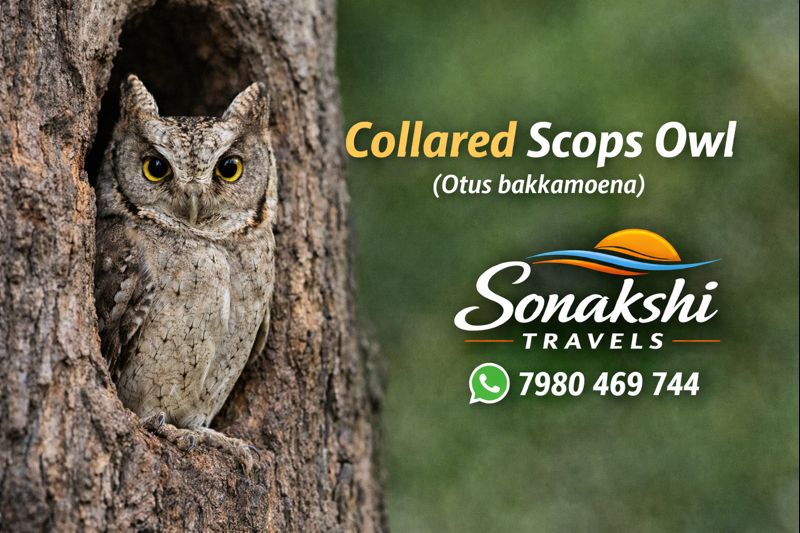
The Collared Scops Owl (Otus bakkamoena) is a small yet remarkably adaptable owl species widely distributed across South and Southeast Asia. Despite its modest size and nocturnal habits, it plays a significant ecological role as a predator of insects and small vertebrates. This owl is often detected more by its repetitive, whistling call than by sight, as its cryptic plumage allows it to blend seamlessly into tree bark during daytime roosting.
In forested landscapes, village groves, and even semi-urban environments, the Collared Scops Owl demonstrates an exceptional capacity to coexist with humans. This article presents a detailed, research-oriented overview of its taxonomy, morphology, behavior, ecology, and conservation, with special reference to its occurrence in eastern India and the Sundarbans region. The content is designed to support academic study, birdwatching, and conservation awareness.
Taxonomy & Classification
Systematic Position
The Collared Scops Owl belongs to the order Strigiformes, which includes all true owls, characterized by nocturnal activity, silent flight, and advanced sensory adaptations. Within this order, it is placed in the family Strigidae, commonly referred to as typical owls.
The genus Otus comprises the scops owls, a group of generally small, ear-tufted owls distributed across Europe, Africa, and Asia. Otus bakkamoena has historically been treated as a complex of closely related forms, with several subspecies recognized across its extensive range. These subspecies exhibit subtle differences in size, plumage tone, and vocalization.
Morphology & Field Identification
General Appearance
The Collared Scops Owl is a small, compact owl with a rounded head, prominent ear tufts, and a short tail. Its plumage is predominantly greyish-brown to rufous-brown, intricately patterned with fine streaks, bars, and mottling. This complex coloration closely resembles tree bark, offering excellent camouflage.
The facial disc is well defined, bordered by a darker rim, and the eyes are bright yellow, providing a striking contrast against the muted plumage. A pale collar-like marking on the nape, from which the species derives its common name, is often visible when the bird is observed from behind.
Male Features
Male Collared Scops Owls are slightly smaller and lighter than females, though sexual dimorphism is minimal and difficult to detect in the field. Males are more vocal, particularly during the breeding season, when they produce persistent, rhythmic calls to establish territory and attract mates.
Female Features
Females are generally larger and heavier, an adaptation associated with egg production and incubation. Their plumage is similar to that of males, although some females may appear marginally darker or more robust in build. During nesting periods, females spend extended periods within the nest cavity.
Size & Wingspan
Adult Collared Scops Owls typically measure between 23 and 25 centimeters in length. The wingspan ranges from approximately 55 to 65 centimeters. Despite their small stature, their wings are broad and rounded, allowing controlled and maneuverable flight within dense vegetation.
Flight Characteristics
Flight is silent, direct, and agile. Specialized feather structures reduce aerodynamic noise, enabling the owl to approach prey undetected. The species is capable of quick takeoffs from perches and short, precise flights through forest undergrowth.
Habitat & Distribution
Global Range
The Collared Scops Owl has a wide distribution across South Asia, Southeast Asia, and parts of East Asia. Its range extends from the Indian subcontinent through Myanmar, Thailand, Malaysia, Indonesia, southern China, and parts of the Philippines.
Preferred Habitat
This species inhabits a variety of wooded environments, including tropical and subtropical forests, mangroves, plantations, orchards, and village groves. It shows a strong preference for areas with mature trees that provide suitable nesting cavities.
Diet & Feeding Ecology
Primary Food Items
The Collared Scops Owl is primarily insectivorous. Its diet includes beetles, moths, grasshoppers, crickets, termites, and other nocturnal insects. Occasionally, it also preys on small vertebrates such as lizards, frogs, and small rodents.
Foraging Technique
Foraging typically occurs during dusk and throughout the night. The owl employs a sit-and-wait strategy, scanning the surroundings from a low perch before swooping down on prey. Aerial hawking of insects is also common, particularly around artificial lights.
Breeding & Reproduction
Breeding Season
Breeding seasons vary geographically but generally occur from late winter to early summer. Courtship involves persistent calling by males and mutual interactions between pairs.
Nesting Sites
The Collared Scops Owl is a cavity nester, utilizing natural tree hollows, abandoned woodpecker holes, and occasionally cavities in old structures. No nesting material is added, and eggs are laid directly on the cavity floor.
Unique Adaptations & Behavioral Ecology
Speed & Agility
Although not a long-distance flier, the species exhibits remarkable agility over short distances. This allows it to maneuver efficiently through dense foliage while pursuing prey.
Camouflage and Nesting Strategy
Its bark-like plumage provides exceptional camouflage. During daytime roosting, the owl often elongates its body, raises its ear tufts, and remains motionless, closely resembling a broken branch.
Social Behavior
The Collared Scops Owl is generally solitary or found in pairs. Strong territorial behavior is observed during the breeding season, with vocalizations serving as the primary means of communication.
Occurrence & Seasonal Movement
This species is largely resident throughout its range. While minor local movements may occur in response to food availability, it does not undertake long-distance migrations.
Preferred Habitat in the Sundarbans Region
In the Sundarbans, the Collared Scops Owl is most frequently encountered in mangrove edges, village woodlands, and forest-buffer zones rather than deep mangrove interiors. The availability of mature trees with cavities and abundant insect life makes these transitional habitats ideal.
Exploring owl habitats within mangrove landscapes becomes more meaningful with expert guidance. Discover immersive wildlife experiences through our Sundarban Tour
options and observe nocturnal biodiversity responsibly.
Ecological Role
As an efficient nocturnal predator, the Collared Scops Owl contributes significantly to controlling insect populations. This natural regulation benefits forest health and nearby agricultural systems by reducing pest abundance.
Habitat Alteration
Habitat loss due to deforestation, removal of old trees, and urban expansion poses localized threats. The decline of mature trees reduces nesting opportunities, while pesticide use diminishes prey availability.
Conservation Efforts
Currently classified as a species of Least Concern, the Collared Scops Owl nevertheless benefits from habitat protection and awareness initiatives. Conservation strategies should emphasize the preservation of old-growth trees and mixed woodland landscapes.
Nature-focused journeys offer rare insights into nocturnal species like the Collared Scops Owl. Plan your next field experience with a thoughtfully designed Sundarban Tour
and witness the ecological balance of mangrove regions.
Did You Know?
The Collared Scops Owl often remains unnoticed due to its exceptional camouflage.
Its repetitive call can be heard throughout the night during breeding season.
This species frequently roosts close to human settlements without conflict.