Botanical Characteristics, Ecological Role, and Regional Importance
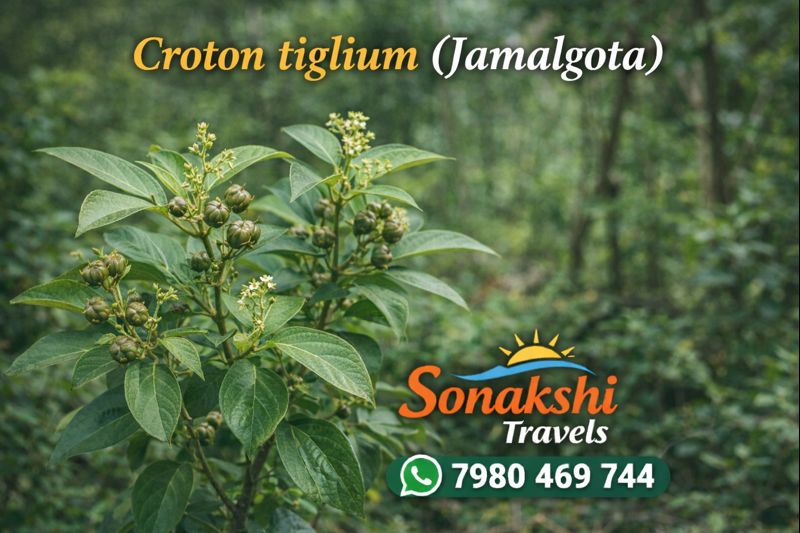
Croton tiglium, commonly known as Jamalgota, Purging Croton, or Croton oil plant, is a small to medium-sized tree belonging to the family Euphorbiaceae. The species is historically renowned for its potent medicinal properties, particularly the oil extracted from its seeds, which has been used in traditional medical systems for centuries. Beyond its pharmacological significance, Croton tiglium represents an ecologically adaptive species capable of surviving in diverse tropical habitats.
In South Asia, including eastern India and Bangladesh, Jamalgota occurs in forest margins, village woodlands, and semi-wild conditions. Its presence in deltaic environments surrounding the Sundarbans highlights its tolerance of humid climates and periodically disturbed landscapes. This article provides a comprehensive, research-based overview of Croton tiglium, focusing on its taxonomy, morphology, habitat preferences, ecological function, and relevance to the Sundarbans region.
Taxonomy & Classification
The taxonomic placement of Croton tiglium reflects its evolutionary adaptation within a family known for latex-bearing plants and bioactive compounds.
Kingdom: Plantae
Clade: Angiosperms
Clade: Eudicots
Order: Malpighiales
Family: Euphorbiaceae
Genus: Croton
Species:Croton tiglium L.
The genus Croton encompasses a wide variety of herbs, shrubs, and trees, many of which produce chemically active secondary metabolites that serve as defensive and adaptive mechanisms.
Morphology & Field Identification
Growth Habit
Croton tiglium is a deciduous to semi-evergreen small tree or large shrub, generally attaining heights of 5–12 meters. The plant exhibits an upright growth form with a moderately spreading crown, making it easily distinguishable in mixed vegetation.
Stem, Bark, and Latex
The trunk is slender to moderately thick, with greyish-brown bark that becomes slightly fissured with age. Like other members of Euphorbiaceae, the plant exudes a milky latex when cut. This latex contains irritant compounds that protect the plant from herbivory.
Leaves
Leaves are simple, alternate, ovate to elliptic, and measure approximately 8–18 cm in length. The leaf surface is smooth to slightly pubescent, with a distinct midrib and lateral veins. Petioles are long and flexible, allowing leaves to flutter easily in wind, which aids in heat dissipation.
Flowers
The species is monoecious, bearing separate male and female flowers on the same plant. Flowers are small, greenish to yellowish, and arranged in terminal or axillary racemes. Pollination occurs primarily through insects.
Fruits and Seeds
The fruit is a three-lobed capsule containing large, smooth, brown seeds. These seeds are rich in oil, historically extracted for medicinal use. Seed morphology is a key identification feature of the species.
Habitat & Distribution
Global Range
Croton tiglium is believed to be native to South and Southeast Asia. Its natural and cultivated range includes:
India
Bangladesh
Sri Lanka
Myanmar
Thailand
Southern China
Due to historical medicinal trade, the species has also been introduced to other tropical regions.
Preferred Habitat
The species thrives in tropical and subtropical climates with warm temperatures and moderate to high rainfall. It prefers well-drained loamy or sandy soils but can tolerate moderately poor soils. Partial sunlight to open conditions favor optimal growth.
Occurrence
In eastern India, Croton tiglium is commonly encountered in forest edges, village woodlands, abandoned homestead gardens, and semi-wild landscapes. It is often retained intentionally due to its traditional medicinal value.
Preferred Habitat in the Sundarbans Region
Within the Sundarbans landscape, Jamalgota does not occur in core saline mangrove forests. Instead, it is found in:
Inhabited islands with freshwater influence
Village peripheries and homestead groves
Raised embankments and inland forest patches
Transition zones between mangrove forests and agricultural land
Its tolerance of high humidity and seasonal rainfall allows it to persist in deltaic environments, provided salinity levels remain low.
Exploring medicinal plants in deltaic villages offers insight into traditional ecological knowledge. Experience this living heritage through a guided Sundarban Tour
that connects nature, culture, and history.
Ecological Role
Croton tiglium contributes to ecological stability by supporting insect populations through its flowers and providing shelter within mixed vegetation. As a secondary forest species, it participates in successional processes, particularly in disturbed forest margins.
Leaf litter from the species contributes organic matter to soil, enhancing nutrient cycling in semi-natural ecosystems.
Habitat Alteration
Habitat alteration through deforestation, agricultural expansion, and urbanization has reduced naturally occurring populations in some regions. In deltaic landscapes, increasing soil salinity and embankment construction may further restrict suitable habitats.
Conservation Efforts
Croton tiglium is not currently listed as threatened; however, localized conservation is important due to declining traditional cultivation. Preservation of medicinal plant diversity through community awareness and integration into agroforestry systems supports long-term sustainability.
Witness how medicinal trees coexist with deltaic life through an immersive Sundarban Tour
designed for deeper ecological and cultural understanding.
Did You Know?
Jamalgota seeds were historically used as a powerful purgative in traditional medicine.
The oil extracted from the seeds is extremely potent and must be used with caution.
The plant produces natural chemical defenses that deter grazing animals.
Croton tiglium has been cultivated in home gardens for centuries for medicinal purposes.