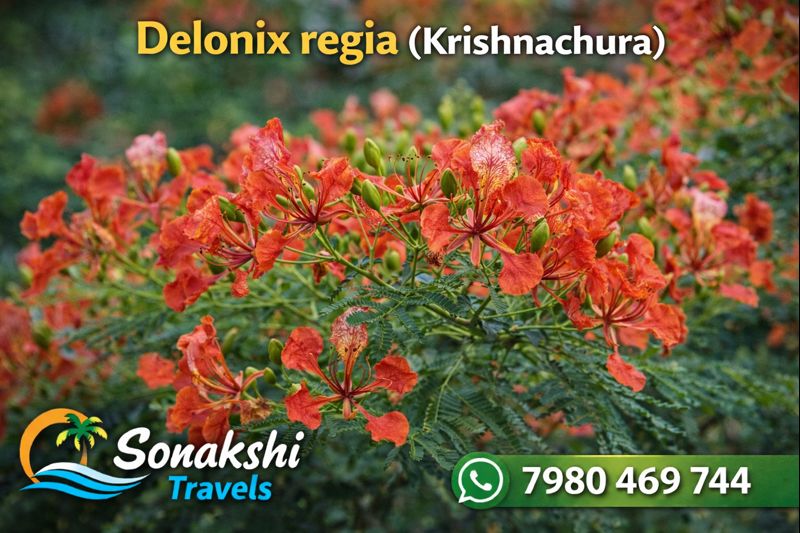
Botanical Grandeur, Ecological Functions, and Conservation Outlook
Delonix regia, popularly known as Krishnachura in Bengal and widely referred to as the Flame Tree or Gulmohar, is one of the most visually striking flowering trees of the tropical world. Celebrated for its brilliant scarlet-red blossoms and expansive umbrella-shaped canopy, this species has become an iconic component of urban avenues, institutional campuses, and cultural landscapes across South Asia. Beyond its ornamental appeal, Delonix regia represents a fascinating subject of botanical study due to its distinctive morphology, ecological interactions, and global dispersal history.
Originally native to Madagascar, Delonix regia has achieved near-global recognition through human-mediated introduction. In India, and particularly in eastern regions including West Bengal, the tree holds deep cultural resonance, symbolizing summer, festivity, and seasonal change. While often viewed primarily as an ornamental species, Krishnachura also plays important ecological roles in modified landscapes, contributing to shade provision, soil enrichment, and urban biodiversity.
This article offers a comprehensive, research-based exploration of Delonix regia, examining its taxonomy, morphology, habitat preferences, global distribution, ecological functions, and conservation considerations, with specific reference to its occurrence in and around the Sundarbans region.
Taxonomy & Classification
The taxonomic identity of Delonix regia places it within the legume family, a group renowned for ecological versatility and symbiotic soil enrichment. Its systematic classification is outlined below.
Taxonomic Hierarchy
Kingdom: Plantae
Clade: Angiosperms
Clade: Eudicots
Order: Fabales
Family: Fabaceae
Subfamily: Caesalpinioideae
Genus: Delonix
Species: Delonix regia (Bojer ex Hook.) Raf.
The genus Delonix comprises a small number of species, most of which are endemic to Madagascar. Delonix regia is by far the most widely cultivated member of the genus. Its placement within Fabaceae reflects its leguminous characteristics, including pod-bearing fruits and associations with nitrogen-fixing microorganisms, although its nitrogen-fixation capacity is relatively modest compared to other legumes.
Morphology & Field Identification
Delonix regia is readily identifiable due to its flamboyant floral display and distinctive architectural form. These morphological traits make it one of the easiest tropical trees to recognize in the field.
Growth Habit and Trunk
The tree typically reaches heights of 8 to 15 meters, though its lateral spread often exceeds its vertical growth. The trunk is relatively short and stout, branching early to form a broad, spreading crown. Bark is light grey to brownish, smooth in young trees and becoming slightly fissured with age. This growth habit results in an expansive canopy that provides extensive shade.
Leaves
Leaves are large, bipinnate, and finely divided, giving the foliage a soft, fern-like appearance. Each leaf may measure up to 50 centimeters in length and consists of numerous small leaflets arranged symmetrically along secondary axes. This finely dissected structure reduces wind resistance and water loss, while allowing filtered sunlight to reach the ground beneath.
Flowers
The flowers of Delonix regia are its most celebrated feature. They are large, showy, and typically bright scarlet to orange-red, with one upper petal often marked by yellow or white streaks. Flowers are borne in large terminal clusters and bloom profusely during the pre-monsoon and early summer months. This synchronized flowering often results in entire trees appearing aflame, inspiring the common name “Flame Tree.”
Fruits and Seeds
The fruit is a long, flat, woody pod that can reach lengths of 30 to 60 centimeters. These pods turn dark brown upon maturity and may persist on the tree for many months. Each pod contains numerous hard seeds, which contribute to the species’ propagation and dispersal.
Habitat & Distribution
Although widely cultivated, Delonix regia exhibits specific habitat preferences that influence its growth and longevity.
Global Range
Delonix regia is native to the dry deciduous forests of Madagascar, where it evolved under seasonal rainfall regimes. Due to its ornamental value, it has been extensively introduced across tropical and subtropical regions worldwide, including South Asia, Southeast Asia, Africa, the Caribbean, Central America, and northern Australia.
In India, the species is now naturalized in many regions and is a common sight along roadsides, educational institutions, parks, and residential areas.
Preferred Habitat
The species prefers well-drained soils and open, sunny locations. It thrives in tropical climates with distinct wet and dry seasons. While moderately drought-tolerant once established, young trees require adequate moisture for optimal growth. Delonix regia does not tolerate prolonged waterlogging or high soil salinity.
Occurrence
Delonix regia is most commonly encountered in cultivated and semi-natural environments rather than undisturbed forests. It is widely planted as an avenue and shade tree, often forming linear alignments along roads and public spaces. In some regions, it has escaped cultivation and established in open wastelands and secondary growth areas.
The species is valued for its rapid growth and dramatic seasonal flowering, making it a preferred choice in urban landscaping programs.
Preferred Habitat in the Sundarbans Region
Within the Sundarbans region, Delonix regia is not a native mangrove species and does not occur in core tidal forests. Instead, it is commonly found in peripheral and human-inhabited zones, including villages, embankments, schools, and administrative compounds where salinity influence is minimal.
These areas provide the elevated, well-drained soils necessary for the tree’s survival. In the Sundarbans landscape, Krishnachura contributes to the visual identity of settlements and provides shade and aesthetic value, particularly during the intense summer months.
Exploring village landscapes around the delta reveals iconic trees like Krishnachura. A guided Sundarban Tour offers a balanced experience of nature, culture, and scenery.
Ecological Role
While primarily ornamental, Delonix regia plays several ecological roles in modified ecosystems. Its broad canopy provides shade that reduces ground temperature, benefiting understory plants and human users alike. The flowers attract pollinating insects such as bees and butterflies, contributing to urban and peri-urban biodiversity.
Leaf litter from the tree adds organic matter to the soil, enhancing nutrient cycling. In open landscapes, the tree also serves as a habitat and perching site for birds, supporting localized faunal diversity.
Habitat Alteration
Habitat alteration affects Delonix regia primarily through urban expansion and infrastructure development. While the species is tolerant of urban conditions, soil compaction, root damage, and pollution can reduce tree health and longevity. In coastal regions, increasing salinity and waterlogging pose additional challenges.
In the Sundarbans region, embankment reinforcement and settlement growth influence planting choices. Although Delonix regia continues to be planted, its survival depends on careful site selection and maintenance.
Conservation Efforts
Delonix regia is not considered threatened globally due to its widespread cultivation. However, in its native range in Madagascar, natural populations have declined significantly due to habitat loss. Conservation efforts therefore emphasize ex situ preservation, seed banking, and responsible cultivation.
In India, sustainable urban forestry practices, including proper spacing, soil management, and protection of mature trees, ensure the continued presence of this iconic species in cultural landscapes.
Seasonal colors and floral diversity enrich every journey. Experience these elements alongside wildlife on a curated Sundarban Tour across the delta.
Did You Know?
Delonix regia is native to Madagascar but widely cultivated worldwide.
The tree’s flowering often coincides with school examination season in India, making it culturally symbolic.
Its large seed pods can remain on the tree for months after flowering.
The finely divided leaves allow filtered light beneath the canopy.
The species is often used as a visual indicator of summer in eastern India.
External Reference
For additional botanical and taxonomic information, consult the following external source: