Dolichandrone spathacea (Garshingia):
Botanical Identity, Ecology, and Conservation Significance in the Sundarbans
Dolichandrone spathacea, locally known as Garshingia, is a distinctive coastal tree species strongly associated with mangrove and mangrove-adjacent ecosystems across tropical Asia. Though not a true mangrove, this species plays a crucial ecological role within intertidal and estuarine landscapes, particularly in the Sundarbans delta. Its resilience to salinity, tidal inundation, and coastal winds makes it a vital stabilizing element along creek banks and forest margins.
The Sundarbans, recognized as the world’s largest mangrove ecosystem, support a complex assemblage of flora that extends beyond classic mangrove taxa. Garshingia represents this transitional vegetation, bridging the ecological gap between inland forest communities and saline tidal zones. Its biological characteristics, ecological functions, and conservation relevance merit detailed examination.
Taxonomy & Classification
Scientific Position
Dolichandrone spathacea belongs to the family Bignoniaceae, a plant family renowned for its woody trees, shrubs, and climbers, many of which exhibit showy flowers and ecological adaptability. The genus Dolichandrone comprises several tropical species distributed mainly across South and Southeast Asia.
Taxonomic hierarchy:
Kingdom: Plantae
Clade: Angiosperms
Clade: Eudicots
Order: Lamiales
Family: Bignoniaceae
Genus: Dolichandrone
Species: Dolichandrone spathacea
The species epithet spathacea refers to the spathe-like floral structure, which is one of its key morphological identifiers. In regional botanical literature, Garshingia is often cited as an indicator species for saline-tolerant coastal woodlands.
Morphology & Field Identification
Growth Form and Bark
Dolichandrone spathacea is a medium-sized evergreen to semi-evergreen tree, typically reaching heights of 10–15 meters under favorable conditions. The trunk is often moderately straight, with a greyish to pale brown bark that becomes slightly fissured with age. Younger branches are smooth and lenticellate, aiding gaseous exchange in humid environments.
Leaves
The leaves are compound, usually trifoliate, with glossy, leathery leaflets. Each leaflet is elliptic to obovate, featuring an entire margin and a pronounced midrib. The leathery texture reduces water loss and provides tolerance against saline spray and high humidity, common in coastal habitats.
Flowers
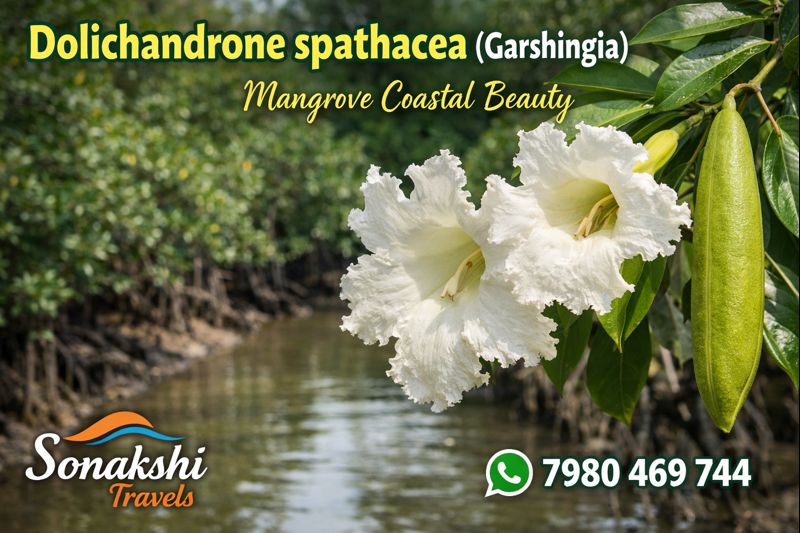
One of the most striking features of Garshingia is its large, white, tubular flowers. These flowers are nocturnally fragrant and typically bloom in clusters. The corolla is long and trumpet-shaped, an adaptation that facilitates pollination by nocturnal insects, particularly moths.
Fruits and Seeds
The fruit is a long, slender capsule containing numerous flat, winged seeds. These seeds are well adapted for dispersal by wind and water, enabling colonization along riverbanks and tidal flats.
Habitat & Distribution
General Habitat
Dolichandrone spathacea thrives in coastal forests, estuarine margins, tidal creeks, and riverbanks influenced by saline or brackish water. Although not a core mangrove species, it tolerates periodic tidal flooding and saline soils better than most inland trees.
Climatic Requirements
The species prefers tropical and subtropical climates with high humidity, moderate to heavy rainfall, and warm temperatures throughout the year. It exhibits strong resistance to cyclonic winds, making it particularly valuable in coastal stabilization.
Global Range
The natural distribution of Dolichandrone spathacea spans a wide geographic range across the Indo-Pacific region. It is recorded from eastern India and Bangladesh through Myanmar, Thailand, Malaysia, Indonesia, and parts of northern Australia. Its presence along coastal belts highlights its ecological adaptability to saline and tidal influences.
In India, the species is primarily found along the eastern coastline, with notable populations in West Bengal’s Sundarbans, Odisha’s coastal forests, and the Andaman and Nicobar Islands.
Preferred Habitat
Soil and Hydrology
Garshingia prefers silty to clayey soils with moderate organic content. These soils are often waterlogged or periodically inundated by tides. The species exhibits physiological mechanisms that allow root respiration under low-oxygen conditions.
Light and Canopy Position
The tree typically occupies semi-open canopies or forest margins, where it receives sufficient sunlight while remaining protected from extreme exposure. In dense mangrove forests, it is more commonly found along edges and transitional zones.
Occurrence
Within its natural range, Dolichandrone spathacea occurs in scattered to moderately dense populations. It is rarely dominant but consistently present in suitable ecological niches. In the Sundarbans, it appears in association with both true mangroves and mangrove associates, contributing to overall forest heterogeneity.
Preferred Habitat in the Sundarbans Region
In the Sundarbans, Garshingia is most commonly observed along tidal creek banks, embankments, and elevated forest margins. These microhabitats experience regular tidal flushing without prolonged submergence, creating ideal conditions for the species.
Its presence enhances shoreline stability and provides ecological continuity between mangrove interiors and adjacent terrestrial zones. This makes Dolichandrone spathacea particularly important in areas exposed to erosion and cyclonic disturbances.
Ecological Role
Coastal Stabilization
Dolichandrone spathacea contributes significantly to soil stabilization along estuarine banks. Its root system binds sediment and reduces erosion caused by tidal currents and storm surges.
Biodiversity Support
The flowers provide nectar for nocturnal pollinators, while the tree canopy offers shelter for birds and arboreal fauna. Fallen leaves enrich the detrital food web, supporting invertebrates and nutrient cycling.
Ecotonal Importance
As a mangrove associate, Garshingia enhances ecological connectivity between saline and freshwater systems, increasing the resilience of coastal forests to environmental change.
Habitat Alteration
Rapid coastal development, embankment construction, aquaculture expansion, and pollution have altered many of the habitats where Dolichandrone spathacea naturally occurs. Changes in tidal flow and increased salinity can disrupt seedling establishment and long-term population stability.
In the Sundarbans, climate-induced sea-level rise and intensifying cyclones pose additional challenges by reshaping forest structure and sediment dynamics.
Conservation Efforts
Although Dolichandrone spathacea is not currently classified as endangered, its ecological importance warrants proactive conservation. Protection of mangrove-associated forests, restoration of degraded creek banks, and sustainable coastal management are essential for maintaining healthy populations.
Inclusion of mangrove associates in afforestation and coastal resilience programs can significantly enhance ecosystem stability and biodiversity conservation.
Did You Know?
- Dolichandrone spathacea flowers often open at night and emit a subtle fragrance to attract nocturnal pollinators.
- The winged seeds can travel long distances by wind and water, aiding natural regeneration.
- Though not a true mangrove, Garshingia tolerates salinity levels that are lethal to most inland tree species.
- The species plays a silent but critical role in reducing coastal erosion.
External Reference
For further botanical and taxonomic details, refer to the comprehensive overview available on Wikipedia:
https://en.wikipedia.org/wiki/Dolichandrone_spathacea