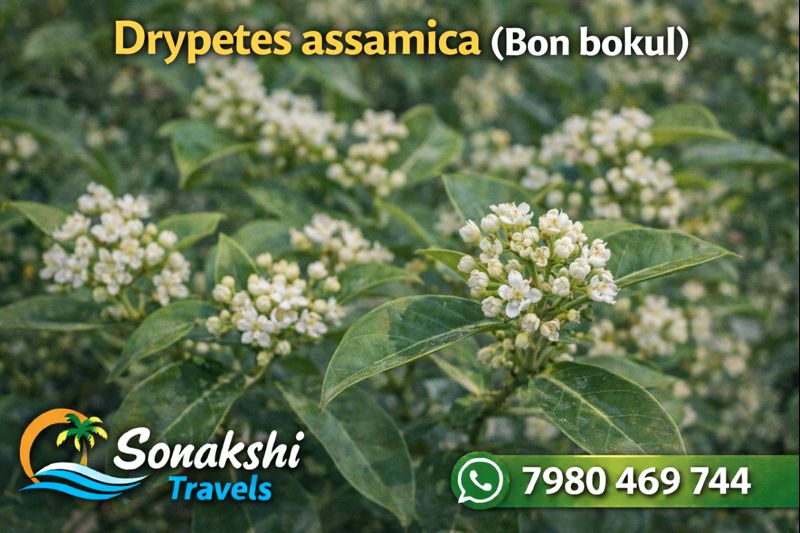
Botanical Identity, Forest Ecology, and Conservation Significance
Drypetes assamica, locally known in parts of eastern India and the lower Gangetic plains as Bon Bokul, is a lesser-known yet ecologically significant evergreen tree species belonging to the family Putranjivaceae. Though it does not command the visual flamboyance of many ornamental trees, Drypetes assamica plays a quiet but vital role in sustaining forest structure, wildlife interactions, and ecological stability within tropical and subtropical forest ecosystems.
Primarily associated with moist deciduous to semi-evergreen forests, this species is valued for its dense foliage, durable wood, and adaptability to shaded forest environments. In regions like eastern India, Assam, and the fringes of the Sundarbans landscape, Bon Bokul represents an important component of native forest vegetation, contributing to biodiversity maintenance and long-term ecosystem resilience.
This article presents a comprehensive, research-oriented account of Drypetes assamica, covering its taxonomy, morphology, habitat preferences, geographic distribution, ecological functions, and conservation concerns, with special emphasis on its occurrence in and around the Sundarbans region.
Taxonomy & Classification
The taxonomic classification of Drypetes assamica reflects its placement among evergreen woody plants adapted to forest interiors and shaded habitats. Its systematic position is outlined below.
Taxonomic Hierarchy
Kingdom: Plantae
Clade: Angiosperms
Clade: Eudicots
Order: Malpighiales
Family: Putranjivaceae
Genus: Drypetes
Species: Drypetes assamica Pax & K.Hoffm.
The family Putranjivaceae consists primarily of evergreen trees and shrubs, many of which were previously included under Euphorbiaceae. Members of the genus Drypetes are widely distributed in tropical regions and are known for their ecological roles within forest understories and mid-canopy layers.
Morphology & Field Identification
Drypetes assamica exhibits morphological traits typical of evergreen forest trees, enabling reliable identification through careful observation of vegetative and reproductive features.
Growth Habit and Trunk
The species typically grows as a medium-sized evergreen tree, attaining heights of approximately 10 to 20 meters under favorable forest conditions. The trunk is straight and cylindrical, with a moderately spreading crown. Bark is greyish-brown to dark brown, relatively smooth in younger trees and becoming rough and slightly fissured with age.
Leaves
Leaves are simple, alternate, and elliptic to oblong in shape, with a glossy dark-green upper surface. The leaf texture is leathery, an adaptation that reduces water loss and enhances longevity. Leaf margins are entire, and the venation is clearly visible, particularly on the underside. Being evergreen, the foliage persists year-round, contributing to continuous canopy cover.
Flowers
The flowers of Drypetes assamica are relatively small and inconspicuous, often greenish or yellowish-white. They are usually borne in axillary clusters. The species may be dioecious or functionally unisexual, with male and female flowers occurring on separate individuals. Pollination is primarily mediated by insects attracted to subtle floral cues.
Fruits and Seeds
The fruit is a small, fleshy drupe, typically containing a single seed. When ripe, the fruit may turn yellowish to reddish, attracting birds and small mammals that act as dispersal agents. This biotic seed dispersal mechanism supports natural regeneration within forest ecosystems.
Habitat & Distribution
Drypetes assamica is primarily associated with forested habitats characterized by moderate to high humidity and relatively stable microclimatic conditions.
Global Range
The species is native to South and Southeast Asia, with confirmed occurrences in India, particularly in Assam, parts of northeastern India, and adjoining regions. It is generally restricted to tropical and subtropical forest belts and does not exhibit a broad global distribution like many widely cultivated trees.
Its relatively narrow geographic range highlights its importance as a regional forest species rather than a cosmopolitan one.
Preferred Habitat
Drypetes assamica prefers moist deciduous to semi-evergreen forests, thriving in well-drained soils rich in organic matter. It is commonly found in forest interiors, along gentle slopes, and in areas receiving filtered sunlight. The species tolerates shade well and is often part of the mid-canopy or understory layer.
Occurrence
In natural landscapes, Drypetes assamica occurs as scattered individuals rather than forming pure stands. It is often interspersed with other evergreen and semi-evergreen species, contributing to structural and compositional diversity within forests.
The species shows steady but slow growth, relying on stable habitat conditions for successful regeneration. Natural seed dispersal by birds plays a key role in maintaining population continuity.
Preferred Habitat in the Sundarbans Region
Within the broader Sundarbans region, Drypetes assamica is not a core mangrove species and does not occur in regularly inundated tidal forests. Instead, it is found in peripheral zones, elevated forest patches, and transitional areas where salinity influence is minimal and freshwater input is relatively higher.
In these habitats, Bon Bokul contributes to evergreen vegetation cover, supporting wildlife and maintaining microclimatic stability. Its presence reflects the ecological gradient between true mangrove forests and inland terrestrial forests surrounding the Sundarbans delta.
Exploring forest-edge vegetation reveals many lesser-known native trees like Bon Bokul. A guided Sundarban Tour offers insight into these transitional ecosystems.
Ecological Role
The ecological role of Drypetes assamica lies primarily in its contribution to forest structure and biodiversity support. As an evergreen tree, it provides year-round foliage cover, which is essential for maintaining humidity and temperature regulation within forest ecosystems.
Its fruits serve as a food source for birds and small mammals, facilitating seed dispersal and supporting trophic interactions. The tree also contributes leaf litter, enriching the forest floor with organic matter and aiding nutrient cycling.
Habitat Alteration
Habitat alteration poses a significant threat to Drypetes assamica. Deforestation, fragmentation of forest corridors, and conversion of forest land for agriculture or infrastructure reduce suitable habitats. Because the species depends on relatively stable forest environments, it is less tolerant of intense disturbance compared to pioneer species.
In the Sundarbans periphery, embankment construction and settlement expansion have altered natural vegetation patterns, potentially limiting the distribution of evergreen forest species such as Drypetes assamica.
Conservation Efforts
Drypetes assamica is not widely assessed in global conservation frameworks, largely due to limited data on population trends. However, its dependence on forest habitats underscores the importance of conserving native forest cover and maintaining ecological connectivity.
Effective conservation strategies include protection of forest remnants, promotion of native species in restoration projects, and avoidance of large-scale habitat conversion. Incorporating species like Bon Bokul into afforestation and ecological restoration programs helps preserve regional biodiversity.
Understanding native evergreen trees enhances any nature exploration. Join a curated Sundarban Tour to experience the botanical richness of delta landscapes.
Did You Know?
Drypetes assamica is an evergreen tree that contributes year-round canopy cover.
The species relies on birds for seed dispersal.
It thrives best in shaded, moist forest environments.
Bon Bokul is primarily a forest species rather than a plantation tree.
Its presence indicates relatively undisturbed forest conditions.
External Reference
For additional botanical and taxonomic information, consult the following external source: