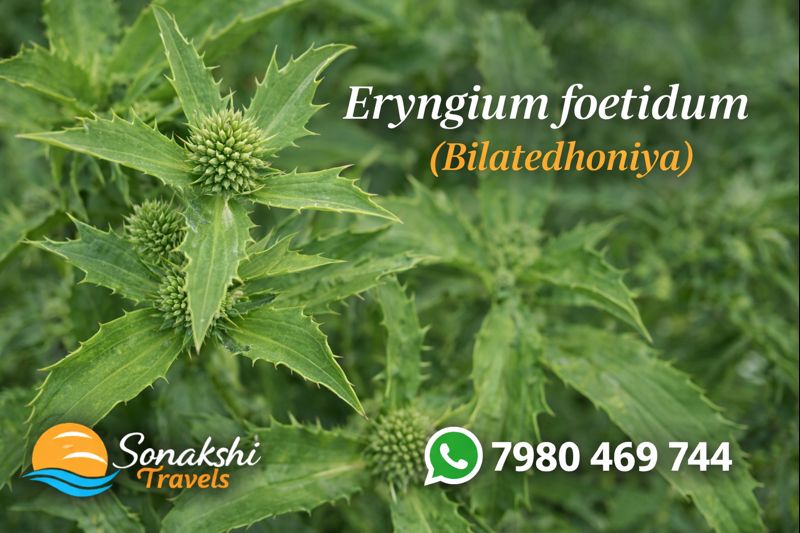
– Botanical Identity, Ecology, and Regional Importance
Eryngium foetidum, popularly known as Bilatedhoniya, long coriander, or culantro, is a perennial aromatic herb belonging to the family Apiaceae. Widely recognized for its strong fragrance and culinary significance, this species occupies a distinctive niche within tropical and subtropical ecosystems. Beyond its gastronomic value, Eryngium foetidum holds ecological, medicinal, and ethnobotanical importance, especially in humid lowland regions of South Asia.
In eastern India, including West Bengal and the Sundarbans hinterland, Bilatedhoniya is both cultivated and naturally occurring in semi-wild conditions. Its resilience to moisture fluctuations, partial shade tolerance, and adaptability to disturbed soils have enabled it to thrive in village landscapes, forest margins, and deltaic agro-ecosystems. This article presents a detailed, research-oriented botanical profile of Eryngium foetidum, emphasizing its taxonomy, morphology, habitat preferences, ecological role, and regional relevance in the Sundarbans region.
Taxonomy & Classification
The taxonomic placement of Eryngium foetidum reflects its evolutionary association with aromatic umbellifers, many of which are valued for culinary and medicinal properties. Unlike the delicate appearance of common coriander, this species exhibits robust morphological adaptations suited to tropical environments.
Systematic Classification
Kingdom: Plantae
Clade: Angiosperms
Clade: Eudicots
Order: Apiales
Family: Apiaceae
Genus: Eryngium
Species: Eryngium foetidum L.
The genus Eryngium comprises over 200 species distributed worldwide, many of which occupy dry grasslands or coastal zones. Eryngium foetidum is unique within the genus for its culinary prominence and adaptation to humid tropical climates.
Morphology & Field Identification
Accurate field identification of Eryngium foetidum is facilitated by its distinctive leaf shape, strong aroma, and characteristic inflorescence structure. These features make the plant easily recognizable even in mixed vegetation.
Growth Habit
Bilatedhoniya is a perennial herb that typically grows 30–60 cm in height. It forms a basal rosette of leaves during its vegetative phase, later producing an erect flowering stalk. The plant has a fibrous root system that anchors it firmly in loose or moist soils.
Leaves
Leaves are elongated, lanceolate, and distinctly serrated with sharp spiny margins. They are dark green, glossy, and leathery in texture. The leaves emit a strong, pungent aroma when crushed, often described as more intense than that of common coriander. This fragrance serves as a natural deterrent to herbivores and pests.
Inflorescence and Flowers
The flowering structure consists of compact, cylindrical spikes surrounded by stiff, spiny bracts. Flowers are small, greenish-white, and densely packed. Flowering generally occurs during warmer months, particularly under high humidity conditions.
Fruits and Seeds
The fruit is a small schizocarp typical of the Apiaceae family, containing minute seeds that disperse readily. Seed production ensures the plant’s persistence in disturbed habitats and cultivated plots alike.
Habitat & Distribution
Eryngium foetidum is primarily associated with tropical lowland habitats. It thrives in environments characterized by high humidity, moderate rainfall, and partial shade. The species is commonly found along forest edges, homestead gardens, agricultural boundaries, and roadside verges.
Global Range
The global distribution of Bilatedhoniya spans Central America, the Caribbean, South America, South Asia, and Southeast Asia. Originally native to the tropical Americas, the species has been widely introduced and naturalized in Asia due to its culinary and medicinal value. Today, it is well established across India, Bangladesh, Sri Lanka, Thailand, and Indonesia.
Preferred Habitat
Eryngium foetidum prefers moist, well-drained soils rich in organic matter. It performs best under partial shade but can tolerate full sunlight if adequate moisture is available. The plant shows a strong preference for loamy or sandy-loam soils and is frequently encountered in nutrient-enriched sites influenced by human activity.
Occurrence
In eastern India, Bilatedhoniya is commonly cultivated in kitchen gardens and small agricultural plots. It also occurs spontaneously in semi-wild conditions, particularly near settlements and along irrigation channels. Its presence is often linked to traditional culinary practices and local demand.
Preferred Habitat in the Sundarbans Region
Within the Sundarbans fringe and buffer zones, Eryngium foetidum is found primarily in village gardens, elevated homestead lands, and agricultural fields beyond the core mangrove forest. The species benefits from humid microclimates, fertile alluvial soils, and partial shade provided by fruit trees and homestead vegetation.
Exploring village landscapes and traditional plant use enriches any Sundarban Tour Package , offering insights into local food culture and biodiversity.
Ecological Role
Eryngium foetidum plays a modest yet meaningful ecological role in tropical agro-ecosystems. Its flowers attract small pollinators, including bees and flies, contributing to local pollination networks. The dense basal leaf rosette helps protect soil from erosion and moisture loss.
The plant’s strong aroma and secondary metabolites provide natural pest deterrence, indirectly benefiting neighboring crops. In mixed farming systems, Bilatedhoniya contributes to functional plant diversity and ecological stability.
Habitat Alteration
Habitat alteration affects Eryngium foetidum primarily through changes in land use and agricultural intensification. Urban expansion, excessive use of chemical inputs, and reduction of traditional home gardens can limit suitable growing spaces.
In deltaic regions, increased soil salinity and altered hydrological regimes may influence its distribution, although the species shows moderate tolerance to environmental stress when moisture availability is maintained.
Conservation Efforts
Conservation of Eryngium foetidum is largely achieved through its continued cultivation and integration into traditional farming systems. Promoting home gardening, organic cultivation, and awareness of indigenous plant resources helps ensure the species’ persistence.
In regions like the Sundarbans, maintaining diversified agro-ecosystems and reducing chemical dependency indirectly supports the long-term survival of this culturally significant herb.
Connecting with traditional plant knowledge and rural ecology adds depth to a guided Sundarban Private Tour, where human culture and natural systems coexist.
Did You Know?
Bilatedhoniya has a stronger aroma than common coriander and retains its flavor even after cooking.
The plant is widely used in traditional medicine for digestive and anti-inflammatory purposes.
Its spiny leaves act as a natural defense against grazing animals.
Despite being native to the Americas, it is now deeply embedded in South Asian culinary traditions.