Biology, Ecology, and Behavioral Insights of a Distinctive Bird Species
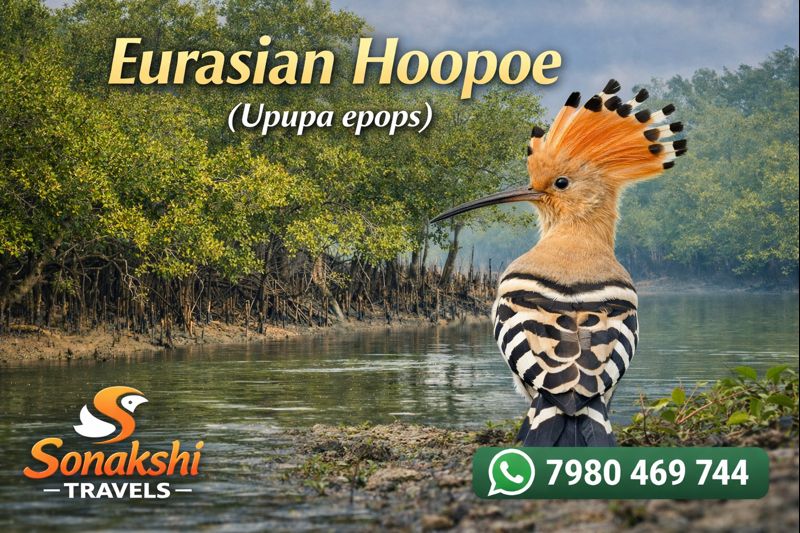
The Eurasian Hoopoe (Upupa epops) is among the most visually striking and culturally symbolic bird species of the Old World. Recognized instantly by its fan-shaped crest, boldly patterned plumage, and undulating flight, the Hoopoe occupies a unique ecological niche across Europe, Asia, and Africa. This species is deeply associated with traditional landscapes, semi-open habitats, and healthy soil ecosystems rich in invertebrate life. In regions such as eastern India and the Sundarbans periphery, the Eurasian Hoopoe represents both avian diversity and the ecological continuity between forest edges, agricultural mosaics, and mangrove-influenced hinterlands.
Taxonomy & Classification
The Eurasian Hoopoe belongs to the order Bucerotiformes and the family Upupidae, a small and distinctive family represented today by a single genus, Upupa. The species Upupa epops has several recognized subspecies distributed across its extensive range, reflecting regional variations in plumage tone and size. Phylogenetic studies place the Hoopoe close to wood-hoopoes and hornbills, highlighting its ancient evolutionary lineage and specialized adaptations.
Morphology & Field Identification
The Eurasian Hoopoe is a medium-sized bird with a slender body, long slightly decurved bill, and broad rounded wings. Its plumage is a harmonious blend of warm buff, cinnamon, black, and white, creating high contrast patterns that are visible both at rest and in flight. The erectile crest, composed of long feathers tipped with black, is the most defining morphological feature and is raised during excitement, alarm, or social interaction.
Male Features
Male Eurasian Hoopoes typically display marginally brighter plumage and a slightly longer crest compared to females. The crest feathers are well-defined, and males often exhibit more assertive posturing during territorial displays. Vocalizations, consisting of the characteristic soft “hoo-poo” calls, are more frequent and pronounced in males during the breeding season.
Female Features
Females closely resemble males but may appear slightly duller in coloration, particularly on the mantle and crest. Behavioral distinctions are subtle, with females investing more time in nest maintenance and incubation duties. Sexual dimorphism is minimal, making field separation challenging without behavioral context.
Size & Wingspan
The Eurasian Hoopoe measures approximately 25–29 cm in length, with a wingspan ranging from 44–48 cm. Despite its moderate size, the bird’s expansive wing surface allows for agile maneuvering and efficient low-altitude flight.
Flight Characteristics
In flight, the Hoopoe displays a distinctive butterfly-like motion characterized by deep, rhythmic wingbeats interspersed with short glides. The bold black-and-white wing bars and tail pattern create a striking visual signal, aiding identification even at considerable distances.
Habitat & Distribution
Global Range
The Eurasian Hoopoe has an extensive distribution covering southern and central Europe, North Africa, the Middle East, Central Asia, South Asia, and parts of Southeast Asia. Some populations are resident, while others undertake seasonal migrations in response to climatic conditions and food availability.
Preferred Habitat
This species favors open and semi-open landscapes with sparse tree cover, including grasslands, agricultural fields, orchards, forest edges, village outskirts, and scrublands. The presence of bare or lightly vegetated soil is crucial, as it supports the invertebrate prey base essential to the Hoopoe’s feeding ecology.
Diet & Feeding Ecology
The Eurasian Hoopoe is predominantly insectivorous, relying heavily on ground-dwelling invertebrates. Its diet includes beetles, ants, grasshoppers, crickets, caterpillars, termites, and larvae, along with occasional small vertebrates and seeds. This feeding specialization links the species closely to soil health and sustainable land use.
Foraging Technique
Foraging is primarily terrestrial, with the Hoopoe walking deliberately across open ground while probing the soil with its long bill. The bill acts as both a sensory and mechanical tool, capable of detecting and extracting hidden prey from beneath the surface with remarkable precision.
Breeding & Reproduction
Breeding season timing varies across the species’ range but generally coincides with peak insect abundance. Courtship involves vocal displays, crest-raising, and food offerings by the male to the female, reinforcing pair bonds.
Nesting Sites
Eurasian Hoopoes are cavity nesters, utilizing natural tree hollows, rock crevices, old buildings, and abandoned burrows. The nest is typically unlined, and hygiene is maintained through unique chemical defenses rather than physical cleanliness. Clutches usually contain 5–8 eggs, incubated primarily by the female.
Unique Adaptations & Behavioral Ecology
Speed & Agility
While not a fast flier over long distances, the Hoopoe exhibits exceptional maneuverability at low altitudes. Its flight style allows quick escapes from predators and efficient navigation through complex habitats such as hedgerows and forest margins.
Camouflage and Nesting Strategy
One of the most remarkable adaptations of the Eurasian Hoopoe is its chemical defense mechanism. Nestlings and incubating females produce a foul-smelling secretion from the uropygial gland, deterring predators and parasites. This adaptation compensates for the lack of nest sanitation.
Social Behavior
Hoopoes are generally solitary or found in pairs, especially during the breeding season. Outside this period, they may tolerate loose aggregations in favorable feeding areas. Social interactions are subtle, relying more on visual displays than physical confrontation.
Occurrence & Seasonal Movement
In South Asia, the Eurasian Hoopoe is largely resident, with some local movements influenced by rainfall patterns and agricultural cycles. Migratory populations from temperate regions arrive during winter months, increasing regional abundance.
Preferred Habitat in the Sundarbans Region
Within the broader Sundarbans landscape, the Eurasian Hoopoe is more commonly observed along forest fringes, village clearings, embankments, and cultivated lands adjacent to mangrove systems. These transitional zones provide optimal foraging grounds with loose soil and abundant insect life, while nearby trees and structures offer nesting opportunities.
Bird-rich transitional landscapes around mangrove forests can be best experienced through a thoughtfully designed Sundarban Tour, combining wildlife observation with ecological awareness.
Ecological Role
The Eurasian Hoopoe plays a critical role in regulating insect populations, particularly soil-dwelling pests. By controlling larvae and beetles, it contributes to natural pest management and supports agricultural sustainability. Its presence often indicates balanced ecosystems with minimal chemical disturbance.
Habitat Alteration
Habitat loss due to urban expansion, intensive agriculture, pesticide use, and removal of old trees poses localized threats to the species. The decline of traditional farmlands and cavity-bearing trees directly affects nesting success and prey availability.
Conservation Efforts
Globally, the Eurasian Hoopoe is listed as a species of Least Concern; however, regional conservation efforts emphasize habitat preservation, reduced pesticide application, and protection of nesting sites. Promoting agro-ecological practices and maintaining landscape heterogeneity are vital for long-term population stability.
Responsible nature travel helps protect bird habitats. Choosing a well-guided Sundarban Tour supports conservation-focused tourism across diverse ecosystems.
Did You Know?
The Eurasian Hoopoe is the national bird of Israel.
Its crest is raised not only during displays but also as an alarm response.
Hoopoe nestlings can accurately spray defensive secretions at predators.