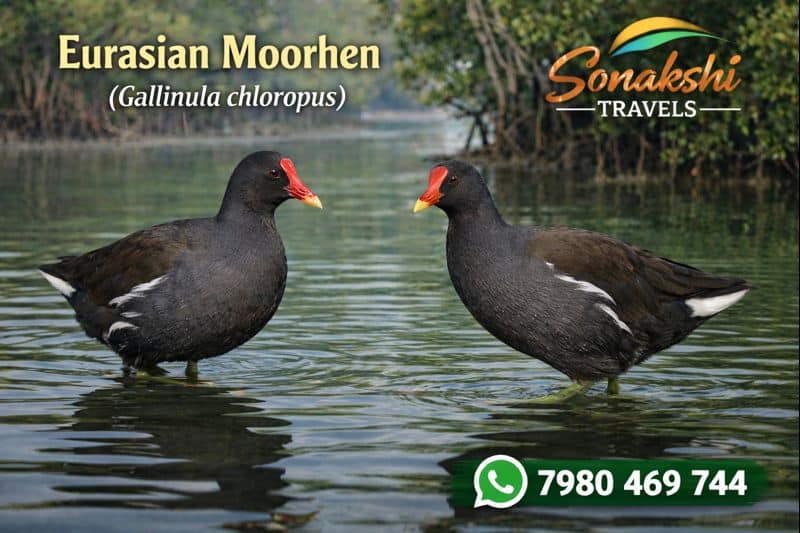
The Eurasian Moorhen (Gallinula chloropus) is a widely distributed and highly adaptable wetland bird, instantly recognizable by its dark plumage, contrasting white flank stripes, and striking red frontal shield. Occupying a broad range of freshwater habitats across Europe, Asia, Africa, and parts of Oceania, the species demonstrates remarkable ecological flexibility. As both a resident and migratory bird depending on region, the Eurasian Moorhen plays a vital role in wetland ecosystems by regulating aquatic vegetation and invertebrate populations. Its presence often reflects the structural complexity and productivity of wetlands.
Taxonomy & Classification
Systematic Position
The Eurasian Moorhen belongs to the family Rallidae, a group that includes rails, crakes, and coots. This family is characterized by laterally compressed bodies, long toes, and strong legs adapted for movement through dense vegetation. The genus Gallinula comprises several species of moorhens, with Gallinula chloropus being the most widespread and well-studied. Advances in molecular genetics have clarified its relationship with closely allied taxa, confirming its distinct evolutionary lineage within the rail family.
Morphology & Field Identification
General Appearance
The Eurasian Moorhen is a medium-sized waterbird with a compact body, short tail often flicked upward, and long greenish legs with elongated toes. Its plumage is predominantly dark brown to black, offset by crisp white streaks along the flanks and undertail.
Male Features
Males are slightly larger and more robust than females, displaying a vivid red frontal shield and bill tipped with yellow. During the breeding season, the shield becomes brighter and more pronounced, serving as a signal of dominance and reproductive fitness.
Female Features
Females closely resemble males but are marginally smaller and possess a slightly duller frontal shield. Outside the breeding season, sexual differences become less obvious, and both sexes adopt a more subdued appearance.
Size & Wingspan
Adults typically measure 30–38 cm in length, with a wingspan ranging from 50 to 55 cm. Body weight varies between 250 and 500 grams, influenced by age, season, and food availability.
Flight Characteristics
The Eurasian Moorhen is capable of sustained flight, although it often prefers to swim or run when disturbed. Takeoff is labored, requiring a rapid pattering run across the water surface. In flight, the legs trail conspicuously behind the body.
Habitat & Distribution
Global Range
This species has an extensive distribution across Europe, Africa, the Middle East, South and Southeast Asia, and Australasia. It is absent only from extreme deserts, polar regions, and heavily urbanized landscapes lacking suitable wetlands.
Preferred Habitat
Eurasian Moorhens inhabit freshwater marshes, lakes, ponds, canals, reservoirs, and slow-flowing rivers. Dense emergent vegetation such as reeds and sedges is essential for nesting and cover.
Diet & Feeding Ecology
Diet Composition
The species is omnivorous, feeding on aquatic plants, seeds, algae, insects, mollusks, crustaceans, small fish, and amphibians. Plant matter forms a substantial portion of the diet, especially during winter.
Foraging Technique
Foraging occurs by walking along the water’s edge, swimming, or climbing onto floating vegetation. The moorhen often plucks food items from the surface or probes shallow water with its bill.
Breeding & Reproduction
Breeding Season
Breeding typically begins in spring and extends into late summer, varying regionally. Pairs establish territories and engage in mutual displays involving head-bobbing and soft vocalizations.
Nesting Sites
Nests are constructed from reeds, grasses, and aquatic vegetation, usually positioned low above water level or floating among dense plants. A typical clutch consists of 5–10 eggs, incubated by both parents.
Unique Adaptations & Behavioral Ecology
Speed & Agility
Eurasian Moorhens are agile runners, capable of moving swiftly through tangled vegetation. Their long toes distribute weight efficiently, allowing them to walk on floating plants.
Camouflage and Nesting Strategy
The dark plumage blends seamlessly with shaded wetland vegetation. Nests are well concealed, and adults may aggressively defend them against intruders.
Social Behavior
During the breeding season, moorhens are highly territorial. Outside this period, they may form loose groups, particularly in favorable feeding areas.
Occurrence & Seasonal Movement
Populations in temperate regions often migrate short distances to avoid freezing conditions, while tropical populations remain resident year-round.
Preferred Habitat in the Sundarbans Region
In the Sundarbans, Eurasian Moorhens are most frequently observed in freshwater ponds, rain-fed wetlands, village tanks, and inland marshes adjacent to mangrove forests. They avoid highly saline tidal creeks but thrive in low-salinity zones with abundant vegetation.
Wetlands surrounding the mangrove delta shelter diverse waterbirds. Discover these habitats through a guided Sundarban Tour and observe native species in their natural settings.
Ecological Role
The Eurasian Moorhen contributes to nutrient cycling, controls aquatic vegetation growth, and supports food web dynamics by serving as prey for raptors, reptiles, and mammals.
Habitat Alteration
Threats include wetland drainage, pollution, invasive plant species, and fluctuating water levels. Urban expansion and agricultural runoff pose increasing challenges.
Conservation Efforts
The species benefits from wetland conservation programs and legal protection in many regions. Maintaining freshwater habitats is essential for its long-term stability.
Did You Know?
Eurasian Moorhens can swim, dive short distances, and run across floating vegetation.
Chicks have bright red and blue facial skin, making them highly distinctive.
The species often flicks its tail to reveal white undertail feathers.