Updated: March 18, 2026
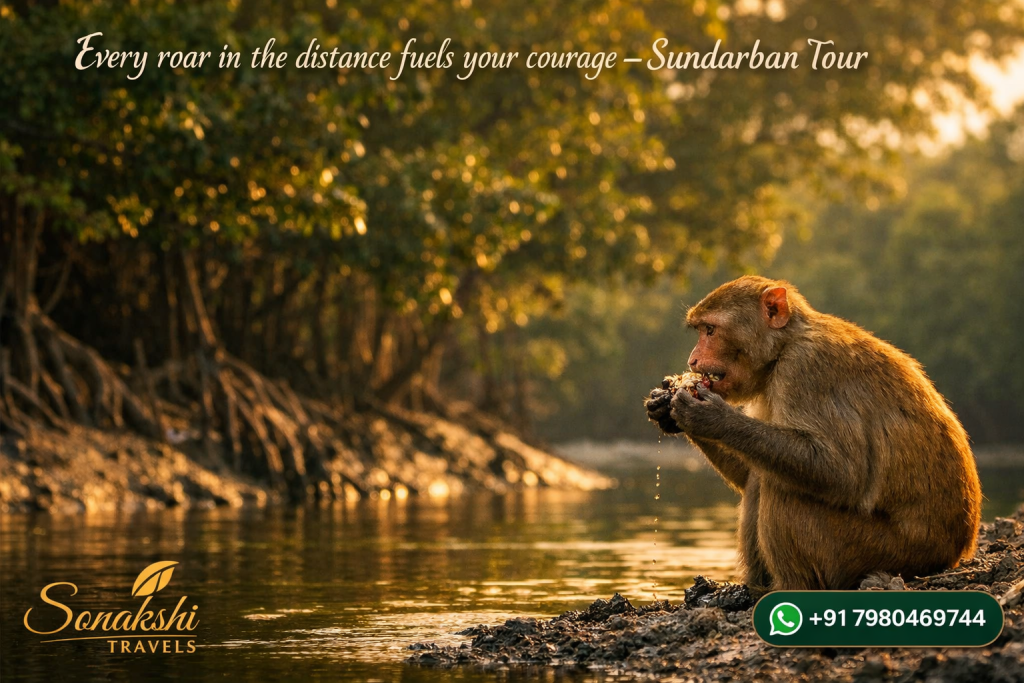
Every roar in the distance fuels your courage – Sundarban Tour
There are landscapes that entertain the eye, and there are landscapes that examine the mind. A serious Sundarban tour belongs to the second kind. In this tidal forest, beauty is never separate from alertness. The river appears calm, the mangroves stand in layered silence, and the sky often opens with deceptive softness, yet somewhere beyond the visible edge of the creek there remains the idea of power. That power is not always seen. Often it is only imagined through signs, through sudden stillness, through the changed behavior of birds, through the tightened attention of the human body. The title of this experience is courage, and that courage is shaped by distance. A roar heard or half-heard across water does not merely create fear. It compels the mind to become more awake, more honest, and more alive.
What makes this experience remarkable is that courage here is not the dramatic courage of confrontation. It is quieter, deeper, and more disciplined. It is the courage to remain attentive without panic. It is the courage to feel small without feeling broken. It is the courage to accept that the forest is not arranged for human comfort. A distant roar, whether actual, interpreted, remembered, or carried through local imagination, becomes part of the emotional architecture of the journey. It teaches the traveler that wildness is not decoration. It is authority. In that recognition, the human visitor does not become weaker. The visitor becomes clearer.
The Sound That Changes the Mind
In most urban settings, sound is excess. It crowds thought and weakens perception. In the mangrove delta, sound works differently. Every call, rustle, splash, wingbeat, and interval of silence acquires meaning. This is one reason a thoughtful Sundarban travel experience remains unforgettable. The environment trains attention. A distant roar does not function only as a physical sound. It becomes a field of interpretation. Was it carried through wind? Was it another animal movement misread by the ear? Was it a remembered story rising inside the mind because the forest has already altered one’s senses? These questions matter because the forest teaches that listening is not passive. Listening is a form of participation.
Researchers who study predator landscapes often note that large carnivores influence ecosystems not only through direct predation but also through what is called the ecology of fear. The presence of a top predator changes movement, feeding patterns, resting behavior, and alertness in other animals. Human beings entering such a landscape are not outside that principle. The mind responds to possibility. It becomes more careful. Vision sharpens. Casual talking lowers. Even posture can change. In that sense, the distant roar is not simply a dramatic detail in a wilderness setting. It is a force that reorganizes awareness.
That reorganization can feel uncomfortable at first. Modern life rewards constant distraction, but the forest rewards concentration. The traveler who enters this environment learns quickly that courage is not the absence of unease. It is the ability to hold unease without surrendering to confusion. A well-designed Sundarban tourism experience becomes meaningful when it allows that psychological shift to happen slowly and truthfully.
Why Distance Matters More Than Display
There is a reason the distant roar is more powerful than a simple spectacle. Distance activates imagination, and imagination is often stronger than sight. When something remains beyond the frame, the mind begins to measure itself differently. The unseen carries authority. In the Sundarbans, this is especially important because the landscape is made of concealment. Creeks turn sharply. Roots interrupt the bank. foliage layers itself in dense patterns. Mud records movement without fully explaining it. Nothing is offered all at once.
This condition produces a special kind of emotional intelligence. The traveler learns to respect partial knowledge. One does not need complete visibility to understand that the forest is alive with hidden intention. A roar from afar, or even the felt possibility of one, enters this landscape as a reminder that the delta possesses its own order. The visitor is not at the center of that order. Yet paradoxically, this decentering can feel liberating. Many forms of anxiety in daily life grow from the illusion that everything must be controlled. The forest removes that illusion. What remains is presence.
That is why a serious Sundarban eco tourism narrative should not reduce the place to sightings alone. The deeper experience lies in relationship: the relationship between sound and silence, power and restraint, fear and steadiness. Courage is formed not by mastery over the forest, but by learning how to be ethically small within it.
The Mangrove as a School of Courage
The mangrove landscape teaches courage through structure. Everything in it resists straight lines and easy conclusions. Water shifts with the channels. Banks soften and collapse. Exposed roots rise like questions from the mud. The eye does not move through this world in the same way it moves through open ground. Instead, perception becomes layered. One must notice shadow, edge, interruption, and pattern. This complexity is not decorative. It creates a setting in which alertness becomes natural.
Within such a setting, courage grows through repeated acts of observation. A traveler notices how the boat falls quiet when entering a narrow stretch. One becomes aware of how even ordinary gestures start to feel louder. A bird lifting suddenly from the bank feels significant. A deer alarm call in the distance alters the emotional temperature of the moment. The mind begins to understand that the forest is constantly communicating, though not in human language. To remain calm inside that communication is itself a disciplined achievement.
This is why the finest accounts in any thoughtful Sundarban travel guide should speak about emotional perception as much as visual scenery. The delta is not experienced by the eye alone. It is read through the nerves, the breath, the ear, and the moral imagination. A roar in the distance becomes part of that reading. It tells the traveler that the landscape is not empty between visible events. It is continuously occupied by life, by caution, by instinct, and by hidden movement.
Fear Becomes Respect
One of the most important changes that happens in the forest is the transformation of fear. At the beginning of a journey, fear may be vague and self-centered. It may arise from stories, from reputation, or from a simple human discomfort with the unknown. But as observation deepens, that fear often becomes more intelligent. It turns into respect. Respect is more stable than fear because it is based on recognition rather than exaggeration.
A distant roar contributes to that transformation. It reminds the traveler that strength exists here independently of human opinion. The response then shifts. Instead of wanting the forest to feel safe in a domestic sense, the traveler begins to value the forest for being fully itself. This marks the beginning of mature courage. Mature courage does not ask the wild to imitate civilization. It accepts difference without romantic confusion.
The Psychology of Silence After the Roar
Equally important as the roar itself is the silence that follows it. In ordinary life, silence is often treated as absence. In the mangrove world, silence can feel dense, active, almost architectural. After a strong sound or a moment of collective attention, the stillness that returns does not feel empty. It feels charged. The ear remains open. The body continues listening. Even the river seems to carry a slower gravity.
This silence has psychological value. It reveals how courage is built not only in moments of impact but also in moments of waiting. Waiting without collapse is a rare skill. The forest teaches it naturally. One learns to remain inside uncertainty without forcing quick meaning. Was the sound near or far? Was it singular or echoed? Should the moment be read as warning, memory, rumor, or presence? The disciplined traveler does not rush. That patience is part of the inner education of a meaningful Sundarban private tour, where the quieter setting often allows deeper concentration and a more intimate reading of the landscape.
In this sense, courage is not only about responding to threat. It is about refusing mental noise. The forest reduces unnecessary thought. When the mind is properly engaged by real surroundings, it stops creating many of the false urgencies that dominate modern routines. A distant roar may quicken the pulse, but it can also clear the mind with surprising force. One becomes exact. One lives in the present tense.
Animal Presence and Human Humility
The Sundarbans hold one of the world’s most serious mangrove ecologies, and that ecological seriousness must shape the traveler’s attitude. Apex predators in such systems are not symbolic ornaments. They are regulators within a dense chain of relationships involving prey, habitat use, movement patterns, and territorial behavior. Even when unseen, their presence contributes to the logic of the environment. This is one reason the emotional response of human visitors matters. The correct response is not domination, and not thrill-seeking display. It is humility sharpened by awareness.
Humility does not reduce the grandeur of the experience. It enlarges it. When the traveler accepts that the forest contains lives organized around needs and powers beyond human convenience, the journey becomes ethically stronger. That is why descriptions of a refined Sundarban luxury tour should still preserve the dignity of the wild. Comfort may refine the human frame of travel, but it must never reduce the autonomy of the ecosystem. The true richness of the experience lies in witnessing a world that is not arranged for performance.
A distant roar therefore works as an ethical correction. It reminds the traveler that the forest is not a stage. It is a living territory. That recognition deepens gratitude. It also deepens courage, because gratitude and courage often grow together. When a person feels privileged rather than entitled, the senses become more honest and more receptive.
The Body Learns Before the Mind Explains
One of the most interesting features of wild environments is that the body often reacts before thought becomes language. Shoulders narrow. Breathing changes. The eye moves more carefully across the bank. Attention gathers almost automatically. Only later does the mind interpret what happened. This bodily intelligence should not be dismissed. It is part of how human beings evolved within living landscapes.
In the Sundarbans, that bodily intelligence is refined by the environment. The layered banks, tidal channels, suspended roots, and sudden openings all require perception that is both broad and precise. A distant roar can trigger this physical awareness instantly. The body remembers that it is an animal among animals, vulnerable but also capable of alertness, restraint, and learning. That memory is humbling, but it is also empowering. It reconnects courage with reality.
Courage as Inner Expansion
The title of this article suggests that every roar in the distance fuels courage, and that idea is true because courage expands through contact with real scale. Many people move through daily life trapped in small cycles of irritation, routine pressure, and fragmented attention. A true wilderness setting interrupts that pattern. It replaces trivial pressure with meaningful seriousness. Suddenly the mind is engaged by things that cannot be solved by speed: silence, instinct, territory, hidden life, and ecological power.
Under those conditions, the self often becomes simpler and stronger. Petty concerns lose authority. The traveler rediscovers fundamental capacities: observation, patience, restraint, and wonder. This is one of the deepest values of a well-conceived Sundarban luxury private tour. When the setting is calm, focused, and respectful, the inner transformations of the landscape can be felt more clearly. Courage does not arrive as noise. It arrives as steadiness.
This steadiness is not temporary entertainment. It can remain after the journey ends. A person who has listened to the charged silence of a mangrove creek after a distant roar may carry home a different understanding of fear. Not every uncertainty needs to be escaped. Some uncertainties need to be inhabited with intelligence. The forest demonstrates this with rare force.
The Emotional Truth of the Journey
Many travel experiences are remembered through photographs, but some are remembered through altered states of mind. The Sundarbans often belong to the second category. The most lasting memory may not be a single visual moment. It may be the feeling of heightened awareness when the landscape became suddenly serious. It may be the instant when conversation faded, when the ear strained across water, when the body sensed that the forest was communicating through distance and restraint. In that instant, courage was not performed. It was formed.
This is why the finest expressions of Sundarban tourism should preserve emotional truth rather than rely on noise. The place does not need exaggeration. Its power is already complete. The mangrove delta is one of those rare environments where beauty and danger are not opposites. They coexist, and each intensifies the meaning of the other. The river becomes more beautiful because it carries possibility. Silence becomes more beautiful because it may contain hidden life. Human courage becomes more beautiful because it is earned in humility.
To travel here well is to accept that courage does not always rise from victory. Sometimes it rises from listening. Sometimes it rises from remaining calm before the unknown. Sometimes it rises from understanding that distance itself can teach. When every unseen movement beyond the bank reminds you that life is larger than your immediate understanding, the mind becomes both quieter and stronger.
That is the lasting gift of a meaningful Sundarban tour. The distant roar, whether heard through the ear, the nerves, or the imagination shaped by the forest, becomes more than a sound. It becomes a moral and psychological event. It tells you that courage is not the denial of fear. Courage is the decision to remain present before the immense reality of the living world. In the Sundarbans, that decision feels natural, necessary, and unforgettable.