Botanical Profile, Ecology, and Regional Significance
Ficus hispida, commonly known as Kakdumur, Hairy Fig, or Rough-leaved Fig, is a medium-sized deciduous to semi-evergreen tree belonging to the fig-bearing group of plants that hold exceptional ecological importance across tropical Asia. Recognized for its coarse foliage, cauliflorous fruits, and close association with riparian and moist habitats, this species forms an integral component of forest edges, village groves, and wetland-adjacent landscapes. In regions like eastern India and the Sundarbans periphery, Ficus hispida functions not merely as a tree but as a biological hub supporting birds, insects, mammals, and traditional rural livelihoods.
This article presents a comprehensive, research-based examination of Ficus hispida (Kakdumur), focusing on its taxonomy, morphology, habitat preferences, ecological role, occurrence patterns, and conservation relevance, with special emphasis on its relationship with the Sundarbans ecosystem.
Taxonomy & Classification
The genus Ficus is one of the largest genera of flowering plants, renowned for its unique reproductive biology and obligate mutualism with fig wasps. Ficus hispida is a distinctive member of this genus, characterized by its hairy vegetative parts and trunk-borne fruits.
Scientific Classification
Kingdom: Plantae
Clade: Angiosperms
Clade: Eudicots
Order: Rosales
Family: Moraceae
Genus: Ficus
Species: Ficus hispida L.f.
The species name hispida is derived from Latin, meaning “bristly” or “hairy,” accurately describing the texture of its leaves, young shoots, and fruits.
Morphology & Field Identification
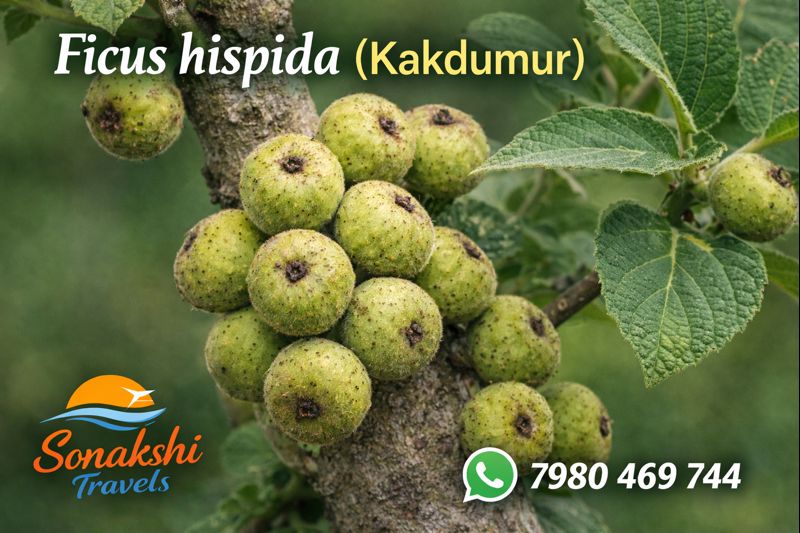
Ficus hispida is a fast-growing tree, typically attaining a height of 8–15 meters under favorable conditions. Its rugged appearance, coupled with its distinctive fruiting habit, allows for easy identification in natural and semi-natural habitats.
Trunk and Bark
The trunk is short to moderately tall, often irregular, with greyish-brown bark that becomes rough and fissured with age. Young branches are thick, brittle, and densely covered with coarse hairs. The tree frequently produces low branches, giving it a spreading crown.
Leaves
Leaves are large, broadly ovate to elliptic, measuring 15–30 cm in length. The upper surface is dark green and rough to the touch, while the underside is paler and densely hairy. Prominent lateral veins radiate from the midrib, contributing to the leaf’s coarse texture.
Figs (Syconia)
The figs are globose to pear-shaped, borne directly on the trunk and older branches (cauliflory). Initially green, they mature into yellowish or dull red fruits, densely covered with stiff hairs. Each fig houses numerous tiny flowers internally, a defining feature of the genus.
Latex
Like most figs, Ficus hispida exudes a milky latex when injured. This latex acts as a defense mechanism against herbivores and pathogens.
Habitat & Distribution
Ficus hispida exhibits strong affinity for moist environments, frequently occurring along watercourses, wetlands, and lowland forest margins. Its tolerance of periodic flooding allows it to colonize riverbanks and floodplains.
Global Range
The natural distribution of Ficus hispida spans:
Indian subcontinent, including eastern and northeastern India
Bangladesh and Sri Lanka
Myanmar and Thailand
Southeast Asia, extending to southern China and Indonesia
Across this range, the species adapts to diverse rainfall regimes but consistently favors areas with reliable soil moisture.
Preferred Habitat
Typical habitats include:
Riverbanks and stream edges
Lowland moist deciduous forests
Village groves and homestead gardens
Wetland margins and seasonal flood zones
Occurrence
Ficus hispida is commonly encountered as scattered individuals or small clusters rather than dense stands. It often establishes naturally from seeds dispersed by birds and mammals, especially in open or semi-open areas with minimal canopy cover.
Preferred Habitat in the Sundarbans Region
Within the greater Sundarbans landscape, Ficus hispida is predominantly found along the fringe zones—village edges, freshwater channels, embankments, and reclaimed lands adjacent to mangrove forests. Although it is not a true mangrove species, it thrives in areas where salinity is diluted by freshwater inflow.
These fringe populations play a critical role in buffering mangrove ecosystems by stabilizing soils, moderating microclimates, and providing transitional habitat for wildlife moving between terrestrial and mangrove environments.
Exploring forest edges and riverine landscapes? Discover curated Sundarban Tour itineraries designed around nature and biodiversity.
Ecological Role
Ficus hispida is widely regarded as a keystone species due to its year-round or staggered fruiting habit. This ensures a continuous food supply for a broad range of fauna, especially during lean seasons.
Wildlife Interactions
The figs are consumed by birds, bats, monkeys, and small mammals. These animals act as effective seed dispersers, enabling the species to colonize new habitats. Insects, particularly fig wasps, play a crucial role in pollination, maintaining the reproductive cycle of the species.
Ecosystem Services
The extensive root system helps prevent soil erosion along riverbanks. The tree’s canopy provides shade and shelter, while leaf litter contributes to nutrient cycling and soil enrichment.
Habitat Alteration
Habitat modification poses both challenges and opportunities for Ficus hispida. While moderate disturbance can facilitate its establishment, large-scale deforestation, embankment concretization, and wetland drainage reduce suitable habitats.
In the Sundarbans fringe, embankment reinforcement and land-use change have altered hydrological patterns, sometimes limiting natural regeneration of moisture-dependent tree species such as Ficus hispida.
Conservation Efforts
Ficus hispida is not currently listed as threatened, owing to its wide distribution and adaptability. However, conservation of riparian vegetation and mixed native groves is essential for sustaining its populations.
Encouraging the retention of native fig trees in village landscapes and along waterways can significantly enhance biodiversity resilience, particularly in climate-sensitive regions like the Sundarbans.
Did You Know?
Ficus hispida bears fruits directly on its trunk, a phenomenon known as cauliflory.
It is considered a keystone species due to its importance as a wildlife food source.
The rough texture of its leaves discourages excessive grazing.
Traditional communities have long recognized its ecological and medicinal value.
Experience the living interface of forests and rivers with an immersive Sundarban Tour focused on natural history and local ecology.