Botanical Characteristics, Habitat Ecology, and Conservation Importance
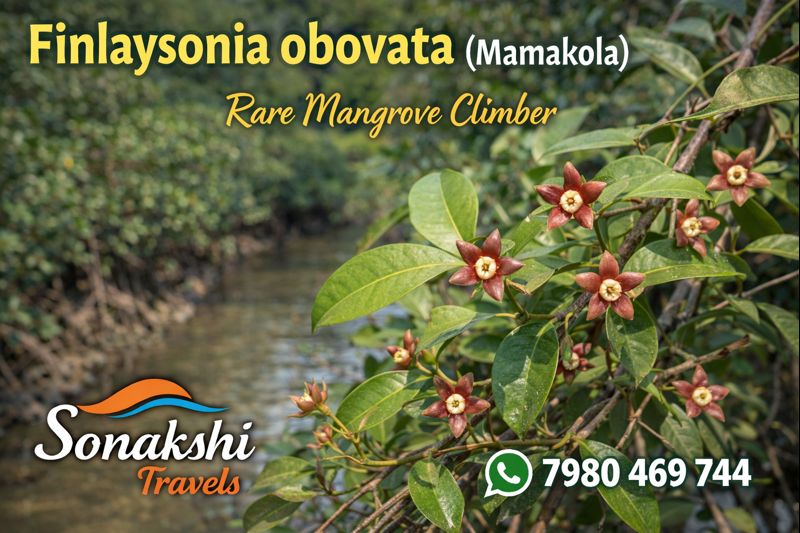
Finlaysonia obovata, locally known as Mamakola, is a rare and ecologically significant mangrove-associated climber found in tropical estuarine forests of South and Southeast Asia. Unlike dominant mangrove trees that shape the forest skyline, this species occupies a quieter but equally vital niche within the understorey and peripheral zones of mangrove ecosystems. Its presence reflects the health and structural complexity of tidal forests, particularly in the Sundarbans.
The Sundarbans, as the world’s largest contiguous mangrove system, host not only iconic tree species but also lesser-known climbers, shrubs, and herbs that contribute to ecosystem resilience. Finlaysonia obovata stands out among these for its specialized adaptations to saline, waterlogged conditions and its role in strengthening vegetation networks along creek margins and forest edges.
Taxonomy & Classification
Systematic Position
Finlaysonia obovata belongs to the family Apocynaceae, a diverse plant family characterized by latex-bearing tissues and a wide range of growth forms, including trees, shrubs, and climbers. The genus Finlaysonia comprises climbing or scrambling plants adapted to tropical lowland forests.
The species epithet obovata refers to the characteristic obovate shape of its leaves, which is a key feature used in field identification. Botanically, the plant is categorized as a mangrove associate, as it thrives in tidal environments without possessing specialized aerial roots.
Morphology & Field Identification
Growth Habit
Finlaysonia obovata is a woody climber or scrambling shrub that often uses neighboring vegetation for support. Its stems are slender but tough, allowing the plant to weave through mangrove branches and shrubs. The presence of milky latex is typical of the Apocynaceae family and can be observed when plant tissues are damaged.
Leaves
The leaves are simple, opposite, and distinctly obovate to elliptic in shape. They possess a smooth, leathery texture with entire margins and a glossy upper surface. This leaf morphology reduces transpiration and protects against salt spray, making it well suited for coastal environments.
Flowers
The flowers are small to moderately sized, tubular, and typically pale in color, ranging from creamy white to light yellow. They are borne in axillary or terminal clusters and exhibit a subtle fragrance that attracts insect pollinators. The floral structure reflects the typical characteristics of the Apocynaceae family.
Fruits and Seeds
The fruit consists of paired follicles, a common feature among apocynaceous plants. These follicles contain numerous seeds, often equipped with fine hairs that aid in wind dispersal once released. In tidal environments, seeds may also be dispersed by water currents.
Habitat & Distribution
Natural Habitat
Finlaysonia obovata is typically found in mangrove-adjacent forests, estuarine thickets, and tidal woodland margins. It favors areas that experience periodic flooding but are not subjected to constant submergence. Such habitats provide a balance between moisture availability and root aeration.
Environmental Adaptations
The species demonstrates a high tolerance for salinity and waterlogged soils. Its climbing habit allows it to access sunlight in densely vegetated mangrove environments while avoiding prolonged root inundation.
Global Range
The global distribution of Finlaysonia obovata extends across parts of South and Southeast Asia. It has been recorded in eastern India, Bangladesh, Myanmar, Thailand, and neighboring regions with suitable estuarine and coastal forest habitats.
Within India, the species is considered uncommon and localized, with confirmed occurrences primarily in mangrove systems such as the Sundarbans. Its restricted distribution underscores the importance of habitat-specific conservation.
Preferred Habitat
Soil Conditions
The plant prefers silty to clayey soils enriched with organic matter. These soils are typically moist and mildly saline, reflecting the influence of tidal waters. The species shows limited tolerance for dry or highly compacted soils.
Light Availability
Finlaysonia obovata thrives in semi-shaded environments, often beneath the canopy of mangrove trees or along forest edges where filtered sunlight is available throughout the day.
Occurrence
The occurrence of Finlaysonia obovata is generally sparse and scattered. It rarely forms dense populations and is usually encountered as individual plants or small clusters. In the Sundarbans, its presence often indicates relatively undisturbed forest patches with intact hydrological regimes.
Preferred Habitat in the Sundarbans Region
In the Sundarbans, Mamakola is most commonly found along creek banks, forest fringes, and transitional zones between core mangrove stands and terrestrial vegetation. These microhabitats experience regular tidal flushing without prolonged submergence.
Such zones provide structural support from surrounding vegetation, enabling the climber to grow vertically while maintaining access to sunlight and air circulation.
To observe rare mangrove climbers like Mamakola in their natural setting, consider an expertly guided Sundarban Tour Package that focuses on botanical diversity.
Ecological Role
Vegetation Connectivity
Finlaysonia obovata contributes to vertical and horizontal vegetation connectivity within mangrove ecosystems. As a climber, it links understorey and canopy layers, enhancing habitat complexity.
Support for Fauna
The flowers provide nectar for insects, while the dense foliage offers shelter for small birds and invertebrates. Seed dispersal mechanisms support regeneration across suitable habitats.
Soil and Bank Stability
By intertwining with other plants along creek margins, the species indirectly aids in soil stabilization, reducing erosion caused by tidal currents.
Habitat Alteration
Habitat alteration poses a significant threat to Finlaysonia obovata. Mangrove clearance, embankment construction, altered tidal flow, and pollution reduce suitable microhabitats required for its survival.
Climate change-driven sea-level rise and increased salinity may further restrict the already limited distribution of this species within the Sundarbans.
Conservation Efforts
Although not widely assessed in conservation status listings, Finlaysonia obovata benefits indirectly from mangrove protection initiatives. Conservation of intact mangrove ecosystems remains the most effective strategy for preserving this species.
Inclusion of climbers and understory plants in mangrove restoration and biodiversity monitoring programs is essential to ensure holistic ecosystem management.
For deeper insight into the hidden botanical layers of the delta, a curated Sundarban Private Tour offers focused exploration with experienced naturalists.
Did You Know?
Finlaysonia obovata produces milky latex, a characteristic feature of the Apocynaceae family.
The species is considered a mangrove associate rather than a true mangrove.
Its climbing habit helps it survive in densely vegetated tidal forests.
The plant is rarely noticed due to its understated appearance and scattered distribution.