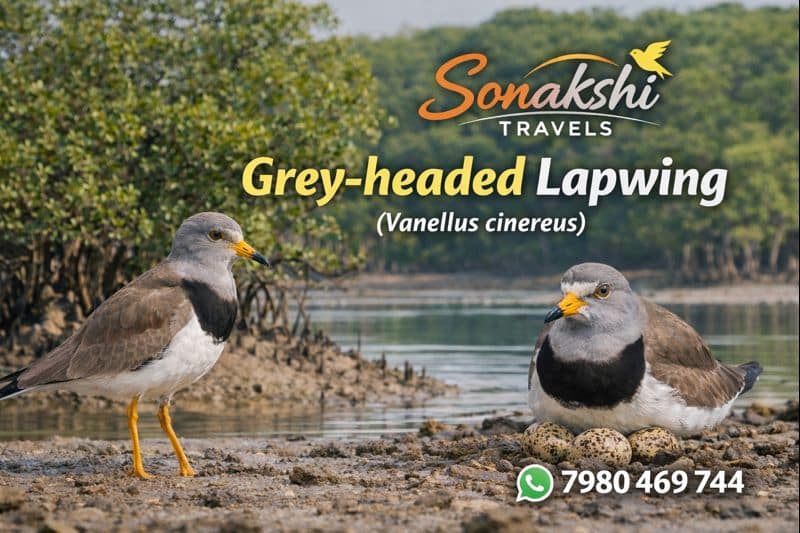
The Grey-headed Lapwing (Vanellus cinereus) is a distinctive medium-sized wader belonging to the plover and lapwing family. Recognized for its elegant posture, pale grey head, long yellow legs, and contrasting black breast, this species occupies a unique ecological niche across wetlands, riverbanks, agricultural floodplains, and seasonal marshes of Asia. Though often understated in comparison to more flamboyant lapwings, the Grey-headed Lapwing is of considerable scientific interest due to its migratory behavior, habitat adaptability, and ecological role within wetland ecosystems. This article presents a thoroughly researched and descriptive account of the species, integrating morphology, behavior, breeding ecology, and conservation aspects, with special emphasis on its relevance to the Sundarbans region.
Taxonomy & Classification
The Grey-headed Lapwing is classified within the order Charadriiformes, a diverse group of birds adapted primarily to aquatic and semi-aquatic environments. Within this order, it belongs to the family Charadriidae, which includes plovers and lapwings characterized by strong legs, keen eyesight, and ground-nesting habits.
The genus Vanellus comprises several lapwing species, most of which display bold plumage contrasts and pronounced territorial behavior. Vanellus cinereus is distinct within the genus due to its subdued coloration and elongated silhouette.
Morphology & Field Identification
The Grey-headed Lapwing presents a refined and streamlined appearance. The head and neck are pale ash-grey, sharply contrasting with the black breast and throat. The upperparts are brownish-olive, while the underparts are predominantly white. Its long yellow legs and upright stance give it a graceful presence in open wetlands.
Male Features
Adult males exhibit a clearly demarcated black throat and breast patch extending from the chin to the upper chest. The grey head is smooth and uniform, lacking crests or ornamental feathers. During the breeding season, males may appear slightly more vivid in contrast, particularly in the sharpness of the black breast area.
Female Features
Females closely resemble males in overall plumage and size, with only subtle differences. The black breast patch may appear marginally less intense, and facial contrast slightly softer. Sexual dimorphism is minimal, making field differentiation challenging without behavioral cues.
Size & Wingspan
The Grey-headed Lapwing measures approximately 33–36 cm in body length. Its wingspan ranges from 70–85 cm, allowing efficient long-distance flight. The species typically weighs between 200 and 300 grams, with seasonal variation influenced by migratory demands.
Flight Characteristics
In flight, the species appears strong and steady, with deliberate wingbeats. The wings are broad and rounded, displaying contrasting patterns of white and dark feathers. Flight is often direct and purposeful, especially during migration or when moving between feeding grounds.
Habitat & Distribution
Global Range
The Grey-headed Lapwing breeds primarily in East Asia, including parts of northeastern China, Korea, and Japan. During the non-breeding season, it migrates southward to Southeast Asia and South Asia, with wintering populations recorded in Bangladesh, eastern India, Myanmar, Thailand, Vietnam, and southern China.
Preferred Habitat
This species favors open freshwater habitats such as riverbanks, floodplains, wet grasslands, irrigated fields, reservoirs, and seasonal marshes. It avoids dense vegetation, preferring expansive open ground that allows clear visibility and early predator detection.
Diet & Feeding Ecology
The Grey-headed Lapwing is primarily carnivorous, feeding on a wide range of invertebrates. Its diet includes insects, beetles, grasshoppers, earthworms, crustaceans, and occasionally small mollusks. Seasonal changes in prey availability influence dietary composition.
Foraging Technique
The species employs a deliberate walking foraging strategy. Individuals move steadily across shallow water or damp ground, pausing frequently to visually locate prey before making swift pecks. This method is highly effective in floodplain and wet agricultural landscapes.
Breeding & Reproduction
Breeding occurs during late spring and early summer in northern parts of its range. Grey-headed Lapwings are typically monogamous within a breeding season and exhibit strong site fidelity. Both parents actively participate in nest defense and chick rearing.
Nesting Sites
Nests are simple ground scrapes located in open areas near water, often on gravel bars, dry mudflats, or grassy floodplains. The clutch usually consists of three to four eggs, which are olive-brown with dark speckling, providing excellent camouflage against the substrate.
Unique Adaptations & Behavioral Ecology
Speed & Agility
Although not known for rapid bursts of speed, the Grey-headed Lapwing demonstrates impressive endurance and agility during flight. On the ground, it relies more on vigilance and early detection than outright speed to avoid threats.
Camouflage and Nesting Strategy
Egg coloration closely mimics surrounding soil and gravel, reducing visibility to predators. Adults employ distraction displays, including alarm calls and mock injury behaviors, to draw attention away from nests and chicks.
Social Behavior
Outside the breeding season, the species is moderately gregarious, often forming small flocks in suitable feeding areas. During breeding, however, individuals become highly territorial and aggressively defend nesting sites.
Occurrence & Seasonal Movement
The Grey-headed Lapwing is a partial to full migrant. Northern populations undertake long-distance migrations to warmer regions during winter, while some southern populations may be resident or locally migratory. Seasonal movements are closely tied to water availability and agricultural cycles.
Preferred Habitat in the Sundarbans Region
In the Sundarbans, the Grey-headed Lapwing is primarily observed during the winter months. It frequents open mudflats, riverbanks, reclaimed agricultural fields, and freshwater edges within the mangrove landscape. The region’s seasonal wetlands provide abundant foraging opportunities and relative safety from human disturbance.
Observing wintering lapwings across riverine flats becomes more insightful with a thoughtfully planned Sundarban Tour, offering access to diverse wetland habitats.
Ecological Role
The Grey-headed Lapwing plays a crucial role in regulating invertebrate populations within wetland and floodplain ecosystems. As both predator and prey, it contributes to food web stability and serves as a bioindicator of wetland health.
Habitat Alteration
Wetland drainage, agricultural intensification, river regulation, and urban expansion pose increasing threats to the species. Alteration of floodplain dynamics and loss of open nesting grounds can negatively impact breeding success and winter survival.
Responsible exploration through a guided Sundarban Tour supports awareness of migratory birds and the conservation of fragile wetland ecosystems.
Conservation Efforts
The Grey-headed Lapwing is currently listed as a species of Least Concern at the global level. Nonetheless, localized declines highlight the importance of wetland conservation, sustainable agriculture, and long-term population monitoring. Protection of breeding and wintering habitats remains essential for its continued stability.
Did You Know?
The Grey-headed Lapwing often chooses agricultural floodplains as wintering grounds due to high invertebrate availability.
Its alarm calls are sharp and loud, serving as early warnings for other wetland birds.
Despite its size, it can undertake migrations spanning thousands of kilometers.