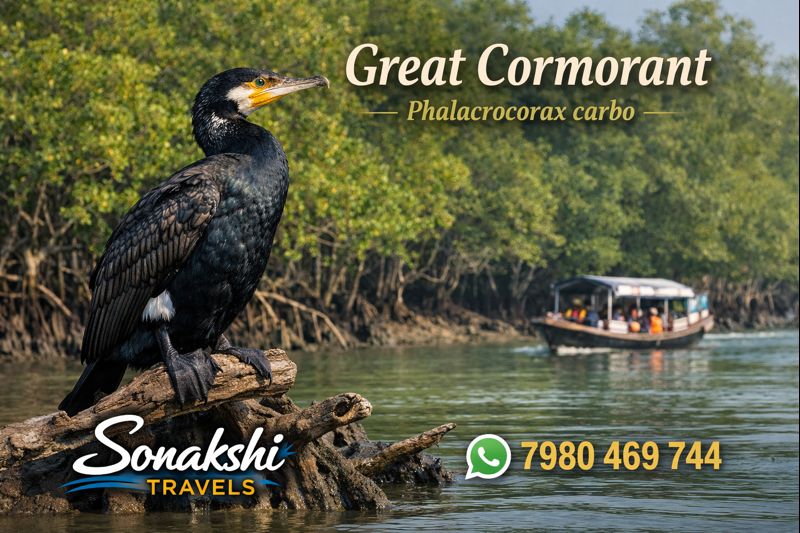
A Comprehensive Study of Biology, Ecology, and Sundarbans Occurrence
The Great Cormorant (Phalacrocorax carbo) stands among the most widely distributed and ecologically influential piscivorous waterbirds of the world. Renowned for its powerful diving ability, elongated silhouette, and colonial nesting habits, this species has successfully adapted to an extraordinary range of aquatic environments—from icy northern coasts to tropical mangrove estuaries. Within the Indian subcontinent, and particularly in the intricate waterways of the Sundarbans, the Great Cormorant represents both an apex avian predator and a sensitive indicator of aquatic ecosystem health.
Taxonomy & Classification
The Great Cormorant belongs to the family Phalacrocoracidae, a lineage of diving birds specialized for underwater foraging. Its scientific name reflects its ecological role: Phalacrocorax derives from Greek terms meaning “sea raven,” while carbo refers to charcoal, alluding to the bird’s dark plumage.
Kingdom: Animalia
Phylum: Chordata
Class: Aves
Order: Suliformes
Family: Phalacrocoracidae
Genus: Phalacrocorax
Species: Phalacrocorax carbo
Several subspecies are recognized globally, each adapted to regional climatic and ecological conditions, ranging from marine-dominated forms to inland freshwater populations.
Morphology & Field Identification
The Great Cormorant is a large, robust waterbird with a commanding presence. Its elongated neck, heavy body, and strong bill provide clear visual cues even at considerable distances. In flight, it appears cross-shaped, with extended wings and neck projecting forward.
Male Features
Adult males are marginally larger and heavier than females. During the breeding season, males develop conspicuous white thigh patches and a subtle crest on the head and nape. Their bill appears thick and strongly hooked at the tip, designed for gripping slippery prey.
Female Features
Females closely resemble males in plumage coloration but tend to have a slightly slimmer build. The seasonal white patches may be less pronounced, and overall body mass is generally lower, especially outside the breeding period.
Size & Wingspan
Adult Great Cormorants measure approximately 80–100 cm in length. Wingspans range from 130 to 160 cm, enabling powerful, sustained flight over large water bodies. Body weight varies between 2.0 and 3.5 kilograms depending on region and season.
Flight Characteristics
Flight is strong and direct, characterized by steady wingbeats interspersed with brief glides. Unlike many waterbirds, the Great Cormorant often flies at low altitudes over water, maintaining visual contact with feeding grounds.
Habitat & Distribution
Global Range
The Great Cormorant has one of the widest distributions of any seabird. It occupies coastal and inland waters across Europe, Asia, Africa, Australia, and parts of North America. Both resident and migratory populations exist, depending on latitude and climatic severity.
Preferred Habitat
This species thrives in lakes, rivers, reservoirs, estuaries, lagoons, mangroves, and sheltered coastal zones. Availability of fish and suitable roosting or nesting sites are the primary determinants of habitat selection.
Diet & Feeding Ecology
The Great Cormorant is an obligate piscivore, feeding predominantly on medium-sized fish. Its diet may also include crustaceans, amphibians, and occasionally aquatic invertebrates when fish availability is low.
Foraging Technique
Cormorants are pursuit divers. They propel themselves underwater using powerful webbed feet, steering with partially folded wings. Dives typically last 20–60 seconds, reaching depths of up to 10 meters in shallow waters, and considerably deeper in marine environments.
Exploring bird-rich mangrove waterways becomes far more immersive with expert guidance. Discover curated Sundarban Tour itineraries designed for nature and wildlife enthusiasts.
Breeding & Reproduction
Breeding typically occurs in large colonies, often shared with other waterbird species. The timing varies geographically, influenced by rainfall, food abundance, and temperature.
Nesting Sites
Nests are constructed from sticks, reeds, and mangrove twigs, placed in trees, on cliffs, or on ground islands free from terrestrial predators. Mangrove forests provide ideal nesting platforms in tropical regions.
Unique Adaptations & Behavioral Ecology
Speed & Agility
Underwater, the Great Cormorant demonstrates remarkable agility, executing sharp turns while chasing fish. Its dense bones reduce buoyancy, allowing efficient submersion.
Camouflage and Nesting Strategy
Dark plumage provides visual concealment against murky waters, reducing detectability by prey. Colonial nesting further enhances protection through collective vigilance.
Social Behavior
Cormorants are highly social birds. They roost, nest, and forage in groups, often engaging in synchronized diving. Social learning plays a significant role in foraging efficiency.
Occurrence & Seasonal Movement
Northern populations migrate southward during winter, while tropical populations remain largely sedentary. Seasonal movements are closely linked to fish availability and water levels.
Preferred Habitat in the Sundarbans Region
Within the Sundarbans, the Great Cormorant favors wide tidal rivers, creeks, and estuarine channels. Mangrove-lined banks offer secure roosting sites, while nutrient-rich waters support abundant fish populations.
Ecological Role
As a top-level avian predator, the Great Cormorant regulates fish populations and contributes to nutrient cycling through guano deposition. Its presence reflects the overall productivity and balance of aquatic ecosystems.
Habitat Alteration
Threats include wetland drainage, overfishing, water pollution, and disturbance at nesting colonies. Alterations in river flow and salinity can significantly impact local populations.
Conservation Efforts
Although globally listed as Least Concern, localized conservation measures are essential. Protection of wetlands, sustainable fisheries management, and monitoring of breeding colonies play critical roles in long-term population stability.
Did You Know?
Great Cormorants must dry their wings after diving because their feathers absorb water.
They have been historically trained for fishing in parts of Asia and Europe.
A single adult can consume over 500 grams of fish per day.
Experience the dynamic world of mangrove birdlife through thoughtfully planned Sundarban Tour packages tailored for wildlife observation and ecological exploration.