An In-depth Botanical, Ecological and Conservation Study
Hygrophila erecta, locally known in parts of eastern India as Filareck, is a moisture-loving herbaceous plant belonging to the family Acanthaceae. Although often overlooked due to its modest stature and inconspicuous appearance, this species plays an important ecological role within wetland systems, floodplains, and mangrove-associated freshwater habitats. In regions such as the lower Gangetic delta and the Sundarbans, Hygrophila erecta contributes quietly but significantly to habitat stability, nutrient cycling, and biodiversity support.
This article presents a comprehensive, research-oriented overview of Hygrophila erecta, covering its taxonomy, morphology, habitat preferences, global and regional distribution, ecological importance, conservation concerns, and interesting botanical insights. Special attention is given to its occurrence and adaptation within the Sundarbans ecosystem, where freshwater and brackish influences intersect.
Taxonomy & Classification
The scientific classification of Hygrophila erecta reflects its evolutionary placement within a group of plants highly adapted to aquatic and semi-aquatic environments. The genus Hygrophila is well known for species that thrive in waterlogged soils, seasonal wetlands, and slow-flowing freshwater systems.
Kingdom: Plantae
Clade: Angiosperms
Clade: Eudicots
Order: Lamiales
Family: Acanthaceae
Genus: Hygrophila
Species:Hygrophila erecta
Members of the Acanthaceae family are characterized by opposite leaves, bilaterally symmetrical flowers, and a strong ecological association with tropical and subtropical climates. Hygrophila erecta fits this profile well, exhibiting structural and physiological traits that enable survival in periodically inundated habitats.
Morphology & Field Identification
Growth Habit and Stem Characteristics
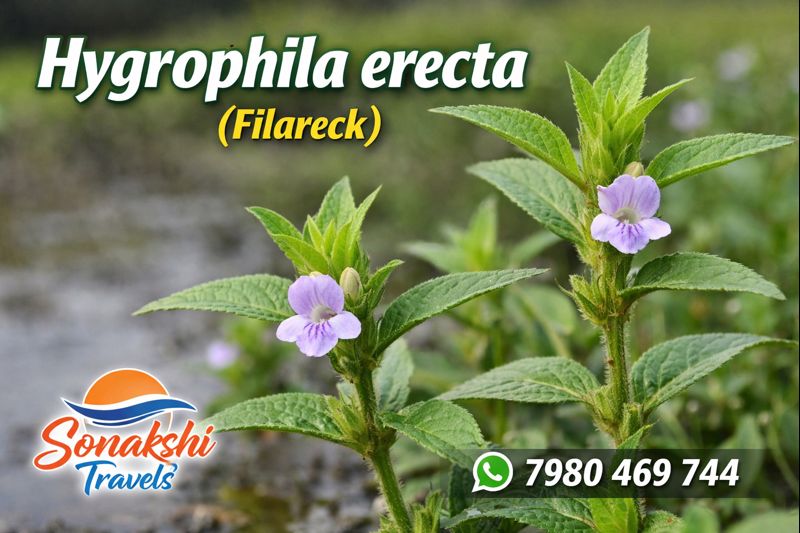
Hygrophila erecta is an erect or semi-erect herb, typically reaching heights of 30 to 80 centimeters under favorable conditions. The stems are soft yet firm, often quadrangular in cross-section, and may exhibit slight pubescence. The erect growth form distinguishes it from some creeping or trailing congeners within the same genus.
Leaves
The leaves are arranged oppositely along the stem and are simple, lanceolate to narrowly elliptic in shape. Leaf margins are generally entire, with a smooth texture and prominent midrib. The leaf surface is deep green, reflecting efficient photosynthetic capacity, particularly in shaded or semi-shaded wetland environments.
Leaf length commonly ranges from 6 to 12 centimeters, depending on moisture availability and nutrient status of the soil. In water-rich conditions, leaves may appear broader and more succulent.
Flowers and Reproductive Structures
The flowers of Hygrophila erecta are typically small but botanically distinctive. They are borne singly or in small clusters in the leaf axils. The corolla is tubular and bilabiate, usually pale bluish, lavender, or whitish in coloration, with subtle markings that guide pollinators.
Flowering generally occurs during the monsoon and post-monsoon months, coinciding with peak water availability. The plant produces capsule-type fruits containing multiple small seeds, which are dispersed by water movement and surface runoff.
Habitat & Distribution
Hygrophila erecta is primarily associated with freshwater and semi-aquatic habitats. It thrives in areas where soil moisture remains consistently high for extended periods, particularly during the rainy season.
Typical Habitat Types
Seasonal wetlands and marshes
Edges of ponds, lakes, and slow-flowing streams
Floodplains and low-lying agricultural fields
Freshwater pockets within mangrove-dominated landscapes
The species shows a remarkable ability to tolerate temporary submergence, making it well suited to flood-prone environments common in deltaic regions.
Global Range
The natural distribution of Hygrophila erecta extends across tropical and subtropical regions of South and Southeast Asia. It has been recorded in parts of India, Bangladesh, Sri Lanka, Myanmar, Thailand, and neighboring countries where monsoon-driven hydrology creates favorable wetland habitats.
While not considered globally rare, the species is often locally restricted to suitable microhabitats, which can be fragmented due to land-use changes and hydrological modifications.
Preferred Habitat
Hygrophila erecta demonstrates a clear preference for:
Moist to waterlogged alluvial soils
Neutral to slightly acidic soil pH
Areas with partial sunlight or diffused shade
Habitats experiencing periodic flooding rather than permanent deep submergence
The plant’s physiological tolerance to fluctuating water levels allows it to colonize transitional zones between fully aquatic and terrestrial ecosystems.
Planning a guided mangrove adventure? Explore our Sundarban Tour
Packages and choose the best itinerary for your dates.
Occurrence
In eastern India and Bangladesh, Hygrophila erecta is a familiar component of rural wetland vegetation. It frequently appears along irrigation channels, rice field margins, and freshwater depressions that retain water after the monsoon.
Its occurrence is often seasonal, with robust vegetative growth during wet months and partial dieback during extended dry periods. However, underground root systems enable rapid regeneration when favorable conditions return.
Preferred Habitat in the Sundarbans Region
Within the Sundarbans, Hygrophila erecta is primarily restricted to freshwater and low-salinity zones. Although the Sundarbans are globally renowned for their mangrove forests, numerous inland creeks, rain-fed pools, and village-adjacent wetlands provide suitable niches for freshwater herbs.
Here, Hygrophila erecta commonly grows:
Along the banks of freshwater canals
In seasonally flooded village wetlands
At the interface of agricultural land and forest edges
The plant benefits from nutrient-rich alluvial sediments deposited by tidal backflow and monsoon runoff, contributing to its healthy growth during the wet season.
Ecological Role
Despite its unassuming appearance, Hygrophila erecta plays several important ecological functions:
Soil Stabilization
The fibrous root system helps bind soft, waterlogged soils, reducing erosion along wetland margins and canal banks.
Habitat Support
Dense stands provide shelter for small aquatic organisms, amphibians, and insect larvae, forming part of the lower trophic structure of wetland ecosystems.
Nutrient Cycling
As a fast-growing herb, the species contributes organic matter to the soil upon decay, enhancing nutrient availability and microbial activity.
Habitat Alteration
The primary threats to Hygrophila erecta arise from habitat alteration rather than direct exploitation. Key pressures include:
Drainage of wetlands for agriculture and settlement
Conversion of natural floodplains into intensive farmland
Pollution from agricultural runoff and domestic waste
Alteration of natural water flow due to embankments and sluice gates
In the Sundarbans, increasing salinity intrusion linked to climate change and sea-level rise may further reduce suitable freshwater habitats for this species.
Conservation Efforts
Currently, Hygrophila erecta does not feature prominently in species-specific conservation programs. However, its survival is closely tied to broader wetland conservation initiatives.
Effective conservation measures include:
Protection and restoration of freshwater wetlands
Sustainable water management practices
Community awareness about the ecological value of wetland plants
Integration of native flora into wetland restoration projects
By safeguarding wetland ecosystems as a whole, associated species such as Hygrophila erecta are indirectly conserved.
Did You Know?
The genus name Hygrophila literally means “water-loving,” reflecting the plant’s strong association with moist habitats.
Several species within the genus are used in traditional medicinal systems, although local applications of Hygrophila erecta vary regionally.
The plant’s seeds are capable of dispersing over considerable distances during monsoon floods.
Its presence often indicates relatively unpolluted freshwater conditions.
External Reference
For additional botanical background and taxonomic context, readers may consult the general genus overview available on Wikipedia: