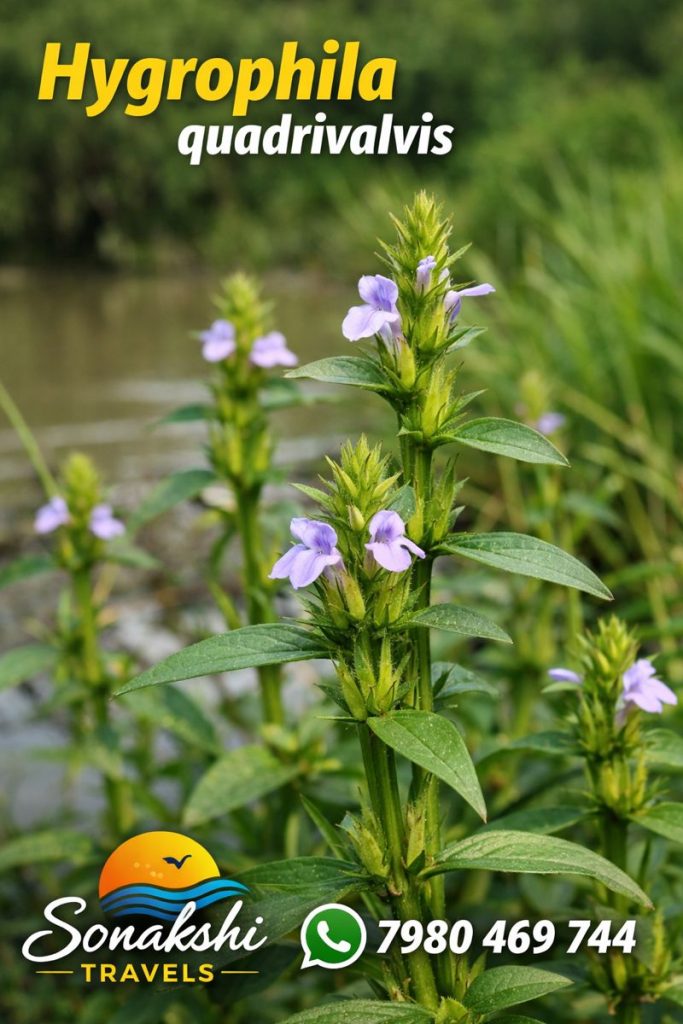
Hygrophila quadrivalvis is a semi-aquatic herbaceous plant widely distributed across tropical and subtropical wetland ecosystems of South and Southeast Asia. This species is particularly valued for its ecological adaptability, rapid growth in waterlogged soils, and its long-recognized importance in traditional medicinal practices. Flourishing in marshes, floodplains, riverbanks, and freshwater-influenced mangrove fringes, the plant plays a subtle yet vital role in stabilizing wetland environments.
In deltaic regions such as the Sundarbans, where seasonal flooding, nutrient-rich alluvium, and fluctuating salinity define the landscape, Hygrophila quadrivalvis emerges as a resilient botanical component. The following article offers a detailed, research-oriented examination of the species, encompassing taxonomy, morphology, habitat preferences, ecological significance, and conservation considerations.
Taxonomy & Classification
Hygrophila quadrivalvis belongs to the family Acanthaceae, a taxonomic group comprising numerous moisture-loving herbs and shrubs adapted to tropical and subtropical climates.
Kingdom: Plantae
Clade: Angiosperms
Clade: Eudicots
Order: Lamiales
Family: Acanthaceae
Genus: Hygrophila
Species:Hygrophila quadrivalvis (Buch.-Ham.)
The genus Hygrophila is characterized by its affinity for aquatic and semi-aquatic habitats, opposite leaf arrangement, and tubular flowers. The species epithet quadrivalvis refers to the plant’s distinctive structural features, particularly the angular stem morphology that aids in field identification.
Morphology & Field Identification
Growth Habit and Stem
Hygrophila quadrivalvis is an erect to spreading annual or short-lived perennial herb. The stems are conspicuously quadrangular, often hollow, and capable of producing adventitious roots at lower nodes when submerged or in contact with saturated soil. This structural adaptation enhances anchorage and nutrient absorption in unstable substrates.
Leaves
The leaves are opposite, simple, and lanceolate to oblong-lanceolate in shape. Margins are entire, with a smooth surface and a pronounced midrib. The leaf arrangement allows efficient photosynthesis even under partial submergence, while the reduced petiole length minimizes damage from flowing water.
Flowers
The flowers are borne singly or in axillary whorls, exhibiting a tubular, bilabiate corolla typical of the Acanthaceae family. Floral coloration generally ranges from pale blue to violet. Rigid bracts surround the flowers, offering protection against excess moisture and herbivory while facilitating insect-mediated pollination.
Fruit and Seeds
The fruit is a dehiscent capsule containing multiple flattened seeds. These seeds are adapted for hydrochorous dispersal, allowing the species to colonize newly formed or disturbed wetland habitats following floods.
Habitat & Distribution
Global Range
Hygrophila quadrivalvis is widely distributed across South Asia and Southeast Asia, including India, Bangladesh, Sri Lanka, Myanmar, Thailand, Cambodia, Vietnam, and parts of southern China. The species has also been recorded in other tropical regions where suitable freshwater or mildly brackish wetlands exist.
Preferred Habitat
The species thrives in seasonally inundated lowlands such as marshes, floodplains, irrigation canals, pond margins, and rice fields. It prefers clayey to silty soils rich in organic matter and demonstrates optimal growth under full sunlight or light shade. Periodic flooding is essential for maintaining habitat suitability by reducing competition from terrestrial plants.
Occurrence
The occurrence of Hygrophila quadrivalvis is closely linked to monsoonal rainfall patterns. Germination typically begins with the onset of rains, followed by rapid vegetative growth during peak flooding. Flowering and seed production coincide with receding water levels, ensuring effective dispersal and regeneration.
The species frequently acts as an early colonizer in disturbed wetlands, contributing to habitat recovery and stabilization.
Preferred Habitat in the Sundarbans Region
In the Sundarbans, Hygrophila quadrivalvis is primarily associated with freshwater-influenced microhabitats such as inland creeks, seasonal ponds, and low-salinity marshes away from dominant tidal channels. These zones experience regular sediment deposition and nutrient enrichment, creating favorable growth conditions.
The plant often forms dense stands that help bind loose alluvial soils, reducing erosion during monsoonal flooding. Its presence serves as an ecological indicator of relatively low salinity within the mangrove-dominated landscape.
Interested in exploring freshwater zones within the mangrove delta? Choose a thoughtfully curated Sundarban Tour and observe wetland flora in its natural setting.
Ecological Role
Hygrophila quadrivalvis contributes significantly to wetland ecosystem functioning. Its root systems stabilize sediments, reduce turbidity, and enhance nutrient retention. The plant provides shelter for aquatic invertebrates and juvenile fish, while its flowers supply nectar to pollinating insects.
As plant material decomposes, it enriches the detrital food web, supporting a wide range of organisms and reinforcing the productivity of floodplain environments.
Habitat Alteration
Habitat alteration poses a growing threat to Hygrophila quadrivalvis. Wetland drainage, land reclamation, excessive use of agrochemicals, and disruption of natural flooding regimes reduce suitable habitats. In deltaic systems, increasing salinity intrusion further limits its distribution.
Such changes can lead to local population declines, particularly in ecologically sensitive regions like the Sundarbans.
Conservation Efforts
Although Hygrophila quadrivalvis is not currently listed as a threatened species, its conservation is inherently linked to wetland protection. Preservation of freshwater inflows, sustainable land-use planning, and protection of seasonal wetlands are essential for maintaining stable populations.
Community-based conservation and awareness initiatives can further support the long-term survival of this ecologically valuable plant.
Learn about wetland conservation through immersive travel. Join an eco-sensitive Sundarban Tour and experience the living delta responsibly.
Did You Know?
The quadrangular stem structure improves resistance to flowing water.
The species is often used as an indicator of freshwater influence in deltaic regions.
Seeds can remain viable after prolonged submergence.
The plant contributes significantly to sediment stabilization in floodplains.