A Comprehensive Study of Biology, Ecology, and Wetland Adaptation
The Indian Pond Heron (Ardeola grayii), commonly known across the Indian subcontinent as the “paddy bird,” is one of the most familiar yet ecologically significant heron species inhabiting South Asian wetlands. Despite its unassuming appearance while at rest, this species transforms dramatically in flight, revealing striking white wings that contrast sharply with its earth-toned body. The Indian Pond Heron plays a crucial role in maintaining wetland balance, particularly in agricultural landscapes, floodplains, and mangrove ecosystems. This detailed article presents an in-depth, research-oriented examination of its taxonomy, morphology, behavior, distribution, and ecological relevance, with special attention to its presence in the Sundarbans.
Taxonomy & Classification
Systematic Position
The Indian Pond Heron belongs to the family Ardeidae, which includes herons, egrets, and bitterns—birds adapted to wading and hunting in shallow water. It is classified under the genus Ardeola, a group of small to medium-sized herons characterized by cryptic resting plumage and sudden flashes of white during flight. The species name grayii honors British zoologist John Edward Gray, reflecting its early documentation in South Asian ornithology.
Morphology & Field Identification
General Appearance
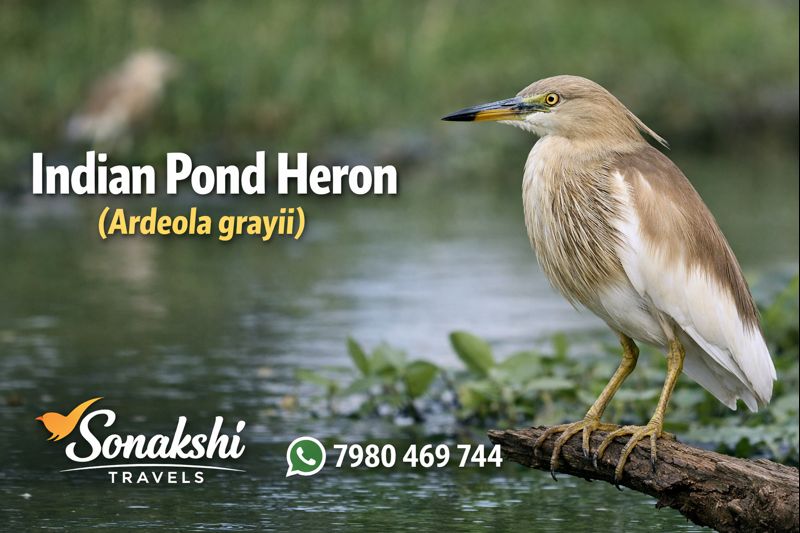
At rest, the Indian Pond Heron appears compact and somewhat hunched, with a short neck and thick body profile. Its plumage is dominated by brown, buff, and streaked tones that blend seamlessly with muddy banks, dried vegetation, and paddy fields. This subdued coloration often causes the bird to be overlooked until it suddenly takes flight. The bill is stout and yellowish, while the legs range from yellow-green to dull brown, depending on season and age.
Male Features
Male Indian Pond Herons exhibit subtle seasonal changes. During the breeding period, males develop rich maroon-brown plumage on the head, neck, and breast, contrasted by elongated white plumes on the back and wings. The bill may deepen in color, and facial skin becomes more vivid, enhancing visual signals during courtship.
Female Features
Females closely resemble males but generally display slightly duller breeding colors and less prominent plumes. Outside the breeding season, both sexes appear nearly identical, making sex differentiation difficult in the field without behavioral cues.
Size & Wingspan
The Indian Pond Heron measures approximately 40–46 cm in body length. Its wingspan typically ranges from 80 to 92 cm, allowing agile, short-distance flight. Adults usually weigh between 300 and 500 grams, with body mass influenced by food availability and seasonal conditions.
Flight Characteristics
Flight is one of the most distinctive features of this species. When flushed, the Indian Pond Heron abruptly reveals brilliant white wings and tail, creating a stark contrast with its otherwise cryptic coloration. Wingbeats are rapid and shallow, suitable for short flights between feeding sites. The neck is partially retracted during flight, while the legs trail behind.
Habitat & Distribution
Global Range
The Indian Pond Heron is widely distributed across South Asia, including India, Bangladesh, Sri Lanka, Nepal, Pakistan, and parts of Myanmar. Its range overlaps extensively with human-dominated landscapes, reflecting a high degree of ecological tolerance.
Preferred Habitat
This species thrives in a variety of shallow-water habitats such as ponds, lakes, marshes, irrigation canals, village tanks, and flooded agricultural fields. Rice paddies are particularly favored, giving rise to its common name. It is also frequently observed along riverbanks and in mangrove fringes.
Wetland birds are best experienced within intact mangrove ecosystems. Discover immersive nature-based itineraries through our Sundarban Tour programs designed for responsible wildlife observation.
Diet & Feeding Ecology
Primary Diet
The Indian Pond Heron is an opportunistic carnivore. Its diet consists mainly of small fish, frogs, tadpoles, aquatic insects, crustaceans, and mollusks. In agricultural landscapes, it also consumes grasshoppers, beetles, and other terrestrial insects, making it beneficial for pest control.
Foraging Technique
Foraging behavior is typically solitary and highly patient. The bird often stands motionless at the water’s edge or in shallow pools, waiting for prey to come within striking distance. Once detected, it delivers a swift, precise jab with its bill. This low-energy hunting strategy allows extended feeding periods with minimal effort.
Breeding & Reproduction
Breeding Season and Courtship
Breeding usually coincides with the monsoon season, when wetlands are replenished and food availability peaks. Courtship displays include head-bobbing, plume erection, and bill-snapping. Pair bonds are generally seasonal.
Nesting Sites
Nests are constructed from twigs and vegetation, often placed in trees, shrubs, or dense reed beds near water. The species frequently nests in mixed heronries alongside egrets and cormorants. Clutches typically contain three to five eggs, which are incubated by both parents.
Unique Adaptations & Behavioral Ecology
Speed & Agility
Although generally slow-moving, the Indian Pond Heron is capable of rapid bursts of speed when capturing prey or evading predators. Its compact body and broad wings support quick takeoff from confined spaces.
Camouflage and Nesting Strategy
Cryptic plumage provides exceptional camouflage against muddy and vegetated backgrounds. This adaptation reduces predation risk while resting and foraging. Nest placement near water further minimizes access by terrestrial predators.
Social Behavior
Outside the breeding season, the species is largely solitary. During nesting, however, it tolerates close proximity to other birds, benefiting from collective vigilance while maintaining individual feeding territories.
Occurrence & Seasonal Movement
The Indian Pond Heron is largely sedentary, with most populations remaining within the same region year-round. Local movements may occur in response to drying wetlands or changes in agricultural water management.
Preferred Habitat in the Sundarbans Region
In the Sundarbans, the Indian Pond Heron is commonly observed along tidal creeks, freshwater pools, village ponds, and mangrove edges. Its ability to exploit both freshwater and slightly brackish environments makes it well-suited to the region’s dynamic hydrology.
Bird-rich wetlands and mangroves create unforgettable travel experiences. A thoughtfully designed Sundarban Tour offers close encounters with native heron species in their natural habitat.
Ecological Role
As a mid-level predator, the Indian Pond Heron contributes significantly to regulating populations of aquatic and terrestrial invertebrates. Its feeding activity helps maintain ecological balance and supports wetland productivity.
Habitat Alteration
Wetland drainage, pollution, and excessive pesticide use threaten the species by reducing prey availability and nesting sites. However, its adaptability to human-modified landscapes has allowed it to persist where more sensitive species decline.
Conservation Efforts
The Indian Pond Heron is currently listed as a species of Least Concern. Continued wetland conservation, sustainable agricultural practices, and protection of nesting colonies remain essential for long-term population stability.
Did You Know?
The Indian Pond Heron appears brown and inconspicuous until it suddenly reveals white wings in flight.
It is one of the most common herons seen near human settlements in South Asia.
The species plays a beneficial role in controlling agricultural pests.