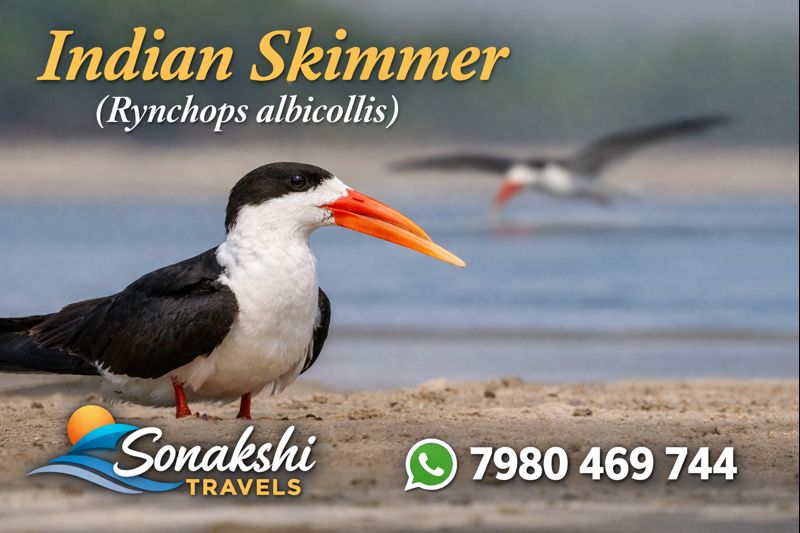
The Indian Skimmer (Rynchops albicollis) is among the most extraordinary waterbirds of the Indian subcontinent, instantly recognizable by its elongated, laterally compressed bill and its highly specialized feeding behavior. This species is intimately associated with large river systems, estuaries, and coastal wetlands, where it functions as an important indicator of ecological integrity. Despite its remarkable adaptations and cultural significance, the Indian Skimmer is currently facing severe population declines, largely due to anthropogenic pressures on riverine habitats.
Taxonomy & Classification
The Indian Skimmer belongs to the order Charadriiformes, a diverse avian group that includes shorebirds, gulls, terns, and allies adapted to aquatic and semi-aquatic environments. Within this order, the species is placed under the family Laridae, traditionally comprising gulls and terns. The genus Rynchops is taxonomically distinctive, as it contains birds uniquely adapted for surface-skimming foraging.
The specific name albicollis, derived from Latin, translates to “white-necked,” a direct reference to the prominent white collar that contrasts sharply with the bird’s darker crown and upperparts. Phylogenetic research suggests that skimmers represent a specialized evolutionary branch within Laridae, diverging to exploit a niche centered on tactile feeding in low-light conditions.
Morphology & Field Identification
The Indian Skimmer exhibits a striking black-and-white plumage pattern that aids quick field identification. The upperparts, including the crown, nape, and wings, are predominantly black, while the underparts are white. A conspicuous white collar separates the dark head from the body, enhancing contrast during flight.
The most defining morphological feature is the bill: bright orange with a black terminal band. The lower mandible is significantly longer than the upper mandible, forming a knife-like structure perfectly adapted for skimming the water surface.
Male Features
Adult males generally possess slightly longer and thicker bills, along with marginally broader wings. During the breeding season, males often appear more robust, with sharply defined plumage contrasts that may play a role in courtship displays.
Female Features
Females closely resemble males in overall appearance, though they are typically marginally smaller in body size. Differences between sexes are subtle, and reliable identification often requires close observation or biometric assessment.
Size & Wingspan
The Indian Skimmer measures approximately 40–43 cm in total length. Its wingspan ranges between 110 and 125 cm, enabling efficient gliding and sustained low-altitude flight over open water surfaces.
Flight Characteristics
In flight, the Indian Skimmer appears graceful and buoyant, characterized by slow, deep wingbeats interspersed with extended glides. While feeding, it flies just centimeters above the water, maintaining exceptional balance as the lower mandible cuts through the surface.
Habitat & Distribution
Global Range
The Indian Skimmer is endemic to South Asia, with its historical range spanning India, Bangladesh, and parts of Myanmar. Once widespread along major river systems such as the Ganga, Brahmaputra, Mahanadi, Godavari, and their tributaries, its current distribution has become fragmented and localized.
Preferred Habitat
This species shows a strong preference for wide, slow-flowing rivers, estuaries, lagoons, and coastal wetlands. Essential habitat features include shallow waters rich in small fish and exposed sandbanks suitable for nesting.
Diet & Feeding Ecology
The Indian Skimmer is primarily piscivorous, feeding almost exclusively on small fish that inhabit surface waters. In estuarine environments, its diet may occasionally include crustaceans and aquatic insects, supplementing its nutritional intake.
Foraging Technique
The species’ iconic feeding method, known as skimming, involves flying low over calm water while dragging the elongated lower mandible through the surface. When prey is detected by touch, the upper mandible snaps shut reflexively. This tactile feeding adaptation allows effective foraging during twilight and nighttime hours.
Planning a guided mangrove adventure? Explore our Sundarban Tour Packages and choose the best itinerary for your dates.
Breeding & Reproduction
Breeding generally coincides with the dry season, when receding water levels expose extensive sandbanks along river channels. The Indian Skimmer nests colonially, often in association with terns and other riverine birds.
Nesting Sites
Nests are shallow scrapes created directly on open sandbanks. Eggs are cryptically colored, blending seamlessly with the sandy substrate to reduce predation risk. Typical clutch size ranges from two to three eggs.
Unique Adaptations & Behavioral Ecology
Speed & Agility
Although not a fast flier, the Indian Skimmer exhibits remarkable agility and control at low altitudes. Fine adjustments in wing angle and tail position enable precise maneuvering during skimming flights.
Camouflage and Nesting Strategy
The species relies heavily on camouflage rather than nest concealment. Eggs and chicks closely resemble surrounding sand, while adults employ distraction displays to divert predators away from nesting areas.
Social Behavior
Indian Skimmers are highly social birds, forming loose flocks outside the breeding season and dense colonies during nesting. Group living enhances predator detection and facilitates communal vigilance.
Occurrence & Seasonal Movement
The species is largely resident within its range but may undertake short-distance seasonal movements in response to changing water levels and prey availability. Post-breeding dispersal often brings individuals into estuarine and coastal habitats.
Preferred Habitat in the Sundarbans Region
In the Sundarbans, the Indian Skimmer frequents broad tidal channels, estuarine mouths, and exposed mudflats. The region’s dynamic tidal system supports rich fish populations, making it a vital seasonal refuge for the species.
Ecological Role
As a specialized surface-feeding predator, the Indian Skimmer plays a crucial role in regulating small fish populations. Its presence reflects healthy riverine and estuarine ecosystems with intact hydrological processes.
Habitat Alteration
Large-scale river regulation, sand mining, pollution, and human disturbance of nesting sites have dramatically reduced suitable habitat for the Indian Skimmer. Unregulated tourism and river traffic pose additional threats.
Conservation Efforts
The Indian Skimmer is globally recognized as an endangered species. Conservation strategies emphasize protection of nesting sandbanks, regulation of riverine activities, community engagement, and long-term monitoring of breeding colonies.
Did You Know?
The Indian Skimmer can successfully feed in near-total darkness using touch rather than sight.
The lower mandible grows longer than the upper shortly after fledging.
Only three skimmer species exist worldwide, making this group exceptionally rare.
Planning a guided mangrove adventure? Explore our Sundarban Tour Packages and choose the best itinerary for your dates.
External Reference
For additional taxonomic and historical information, readers may consult the detailed article available on Wikipedia:
Indian Skimmer (Rynchops albicollis) .