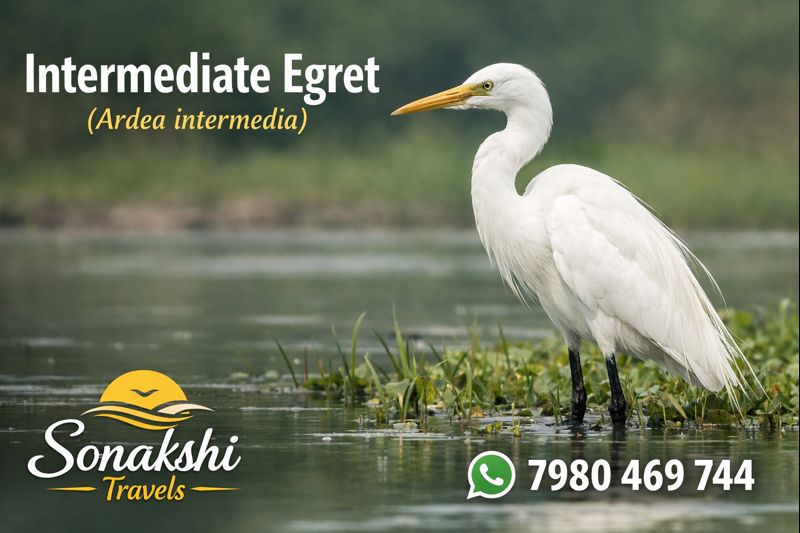
The Intermediate Egret (Ardea intermedia) is a graceful, medium-sized heron species that occupies a vital ecological niche within freshwater and coastal wetland ecosystems. Often positioned visually between the Great Egret and the Little Egret, this species combines elegance with remarkable adaptability. Its presence across tropical and subtropical wetlands reflects both ecological resilience and the continued availability of healthy aquatic habitats. This comprehensive article examines the taxonomy, morphology, behavior, distribution, and ecological role of the Intermediate Egret, with special emphasis on its occurrence within the Sundarbans mangrove landscape.
Taxonomy & Classification
Scientific Placement
The Intermediate Egret belongs to the family Ardeidae, a diverse assemblage of herons, egrets, and bitterns characterized by long legs, elongated necks, and a predatory lifestyle centered on aquatic prey. It is classified under the genus Ardea, which also includes larger heron species. Historically, the species was placed in the genus Egretta due to its egret-like appearance, but molecular and morphological evidence has firmly established its closer evolutionary relationship with larger herons.
Morphology & Field Identification
General Appearance
The Intermediate Egret exhibits a clean, white plumage that appears luminous in sunlight. It possesses a proportionately shorter neck and bill than the Great Egret, yet is distinctly larger and more robust than the Little Egret. The bill is thick, straight, and yellow during the non-breeding season, becoming darker during breeding. Legs are black with contrasting yellow feet, a feature that aids in field identification when observed at close range.
Male Features
Male Intermediate Egrets are marginally larger than females, particularly noticeable during the breeding season. Males develop elongated ornamental plumes on the neck and back, which are displayed during courtship rituals. Facial skin may acquire a greenish or bluish hue, signaling reproductive readiness and playing a role in mate selection.
Female Features
Females closely resemble males in coloration and structure, though their ornamental plumes are often slightly shorter. During nesting, females play a significant role in egg incubation and chick rearing, demonstrating strong parental investment alongside their male counterparts.
Size & Wingspan
The Intermediate Egret measures approximately 65–72 cm in body length, placing it between its larger and smaller relatives. Its wingspan typically ranges from 105 to 115 cm, allowing efficient flight across wetlands and open floodplains. Body mass generally varies between 400 and 700 grams, depending on habitat quality and seasonal food availability.
Flight Characteristics
In flight, the Intermediate Egret exhibits slow, rhythmic wingbeats. Like other herons, it retracts its neck into a compact S-shaped curve while flying, with legs trailing straight behind. The broad wings enable stable, energy-efficient flight, particularly useful during short-distance seasonal movements and daily commutes between feeding and roosting sites.
Habitat & Distribution
Global Range
The species has a wide distribution across South and Southeast Asia, parts of East Asia, Australia, and Sub-Saharan Africa. In many regions, it is a resident species, while in others it exhibits localized seasonal dispersal influenced by rainfall patterns and wetland availability.
Preferred Habitat
Intermediate Egrets favor shallow freshwater wetlands such as marshes, ponds, lakes, rice paddies, irrigation canals, and slow-flowing rivers. They are also frequently observed in brackish environments, including estuaries and mangrove creeks, provided shallow water and abundant prey are present.
Wetland birdwatching reaches its finest expression within mangrove landscapes. Explore carefully curated itineraries through our Sundarban Tour programs designed for nature enthusiasts.
Diet & Feeding Ecology
Primary Diet
The Intermediate Egret is a carnivorous feeder, relying primarily on small fish. Its diet also includes amphibians, aquatic insects, crustaceans, mollusks, and occasionally small reptiles. The composition of prey varies according to seasonal water conditions and habitat type.
Foraging Technique
Foraging behavior is deliberate and methodical. The bird typically stands motionless in shallow water before executing a swift, precise strike. It may also employ slow stalking movements, carefully placing each step to avoid alerting prey. This energy-efficient hunting strategy allows prolonged feeding with minimal exertion.
Breeding & Reproduction
Courtship Behavior
Breeding is closely linked to seasonal rainfall and increased food availability. Courtship displays include plume erection, bill clattering, and ritualized postures. Pair bonds generally persist for a single breeding season.
Nesting Sites
The Intermediate Egret nests colonially, often in mixed-species heronries. Nests are constructed from twigs and reeds and placed in trees, shrubs, or dense reed beds near water. Clutches typically contain two to four eggs, which are incubated by both parents.
Unique Adaptations & Behavioral Ecology
Speed & Agility
Despite its calm demeanor, the Intermediate Egret can move with remarkable speed when striking prey or evading threats. Its long legs facilitate rapid wading, while powerful wings enable swift takeoff.
Camouflage and Nesting Strategy
White plumage provides effective visual blending against reflective water surfaces and bright skies. Nest placement above water reduces predation risk, enhancing chick survival rates.
Social Behavior
Outside the breeding season, the species is largely solitary or loosely gregarious. During nesting, however, it tolerates close proximity to other birds, reflecting a balance between social cooperation and individual foraging independence.
Occurrence & Seasonal Movement
In tropical regions, Intermediate Egrets are mostly resident, while in subtropical areas they may exhibit short-distance seasonal movements. These movements are closely tied to monsoon cycles, water levels, and prey abundance.
Preferred Habitat in the Sundarbans Region
Within the Sundarbans, the Intermediate Egret is frequently observed along tidal channels, mudflats, freshwater pools, and mangrove fringes. The region’s dynamic hydrology supports abundant fish and invertebrates, making it an ideal feeding and roosting environment.
Nature-focused travel allows close observation of wetland birds in pristine settings. A thoughtfully planned Sundarban Tour offers meaningful engagement with mangrove biodiversity.
Ecological Role
As a mid-level predator, the Intermediate Egret plays a critical role in regulating aquatic prey populations. Its feeding activity contributes to maintaining ecological balance within wetlands, making it a valuable indicator of environmental health.
Habitat Alteration
Wetland degradation, pollution, and changes in water management practices pose significant threats to the species. Loss of shallow feeding grounds can directly impact foraging efficiency and breeding success.
Conservation Efforts
The Intermediate Egret is currently listed as a species of Least Concern, reflecting stable global populations. Continued wetland conservation, legal protection, and sustainable water management are essential to ensure its long-term survival.
Did You Know?
The Intermediate Egret was long confused with other egret species due to its intermediate size.
Its breeding plumage was historically prized in the fashion industry.
The species is highly sensitive to changes in wetland water levels.