Botanical Characteristics, Ecological Role, and Regional Importance
Justicia adhatoda, commonly known as Bashak, Malabar nut, or Vasaka, is a perennial evergreen shrub belonging to the family Acanthaceae. The plant is deeply embedded in traditional medicinal systems of South Asia and is particularly valued for its respiratory therapeutic properties. Beyond its medicinal relevance, Justicia adhatoda represents an ecologically adaptable species capable of thriving in diverse tropical landscapes, including disturbed and semi-natural habitats.
In eastern India and the lower Gangetic delta, Bashak is frequently encountered in village margins, hedgerows, roadsides, and forest edges. Its presence in areas adjacent to the Sundarbans reflects its tolerance of humid climates, fluctuating soil moisture, and anthropogenic disturbance. This article presents a comprehensive, research-based overview of Justicia adhatoda, focusing on its taxonomy, morphology, habitat preferences, ecological function, and relevance within the Sundarbans landscape.
Taxonomy & Classification
The taxonomic placement of Justicia adhatoda highlights its evolutionary association with flowering plants adapted to warm climates and seasonal rainfall.
Kingdom: Plantae
Clade: Angiosperms
Clade: Eudicots
Order: Lamiales
Family: Acanthaceae
Genus: Justicia
Species:Justicia adhatoda L.
The genus Justicia includes numerous medicinally significant species characterized by bioactive alkaloids and secondary metabolites that play important roles in plant defense and human pharmacology.
Morphology & Field Identification
Growth Habit
Justicia adhatoda is a dense, woody shrub that typically reaches heights of 1.5 to 3 meters. The plant exhibits an upright, bushy growth form with multiple branching stems arising from a woody base. Its evergreen nature allows year-round foliage retention under favorable conditions.
Stem and Bark
The stems are green when young, gradually becoming brown and woody with age. They are quadrangular in cross-section, a characteristic feature of many members of the Acanthaceae family. The bark is relatively smooth and does not exude latex.
Leaves
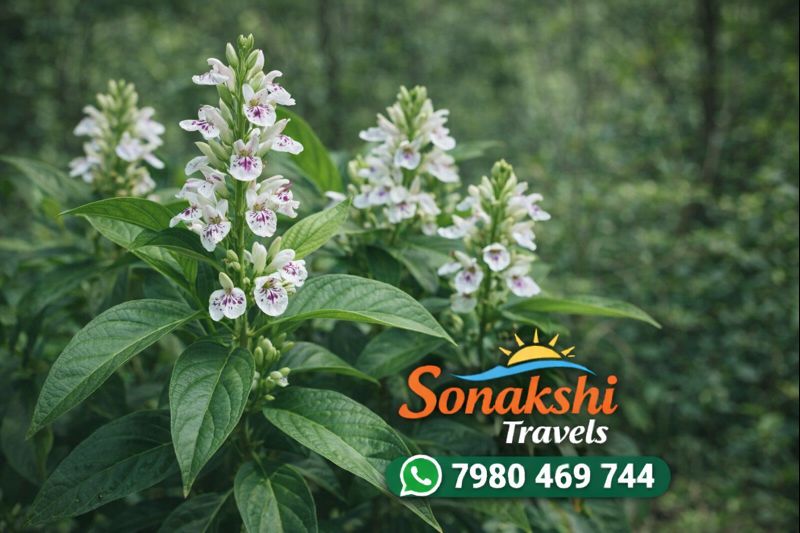
Leaves are opposite, large, elliptic to lanceolate, and measure between 10 and 20 cm in length. The leaf surface is smooth, glossy, and dark green, with prominent venation. The leaves emit a characteristic odor when crushed, aiding field identification.
Flowers
The flowers are borne in dense axillary or terminal spikes. Each flower is tubular, creamy white with purple or maroon markings on the lower lip. Flowering generally occurs during cooler months, although sporadic flowering may occur year-round in humid regions.
Fruits and Seeds
The fruit is a small, oblong capsule containing four seeds. Upon maturity, the capsule dehisces explosively, dispersing seeds into the surrounding soil and facilitating natural regeneration.
Habitat & Distribution
Global Range
Justicia adhatoda is native to South Asia but has been widely distributed across tropical and subtropical regions. Its range includes:
India
Bangladesh
Sri Lanka
Nepal
Pakistan
Southeast Asia
The species has also been introduced to other tropical regions due to its medicinal importance.
Preferred Habitat
The species thrives in warm, humid climates with moderate rainfall. It prefers well-drained loamy soils but demonstrates adaptability to clayey and slightly degraded soils. Partial shade to full sunlight supports optimal growth, making it suitable for both open and semi-shaded environments.
Occurrence
In eastern India, Justicia adhatoda commonly occurs along village boundaries, roadside verges, abandoned homesteads, and forest margins. It is frequently cultivated in household gardens for medicinal use and also grows wild in disturbed habitats.
Preferred Habitat in the Sundarbans Region
Within the Sundarbans landscape, Bashak does not grow inside core saline mangrove forests. Instead, it is found in:
Inhabited islands with freshwater influence
Village hedgerows and homestead gardens
Raised embankments and inland clearings
Transition zones between mangrove forests and agricultural land
Its tolerance of high humidity and seasonal rainfall allows it to persist in deltaic environments where soil salinity remains low.
Exploring medicinal plants in deltaic villages reveals the link between nature and traditional knowledge. Discover this living heritage through a guided Sundarban Tour that blends ecology, culture, and community life.
Ecological Role
Justicia adhatoda plays an important ecological role as a flowering shrub supporting insect populations, including pollinators such as bees and butterflies. Its dense foliage provides shelter for small fauna, while leaf litter contributes to soil organic matter.
As a semi-wild species, it functions as part of understory vegetation in secondary forests and disturbed landscapes, aiding ecological succession.
Habitat Alteration
Habitat alteration through urban expansion, land-use change, and embankment construction affects natural populations of Bashak in some regions. However, its widespread cultivation for medicinal purposes has helped maintain stable populations in human-dominated landscapes.
Conservation Efforts
Justicia adhatoda is not considered threatened due to its adaptability and extensive cultivation. Conservation efforts focus on promoting sustainable harvesting practices and encouraging cultivation within home gardens and agroforestry systems to preserve genetic diversity.
Witness how medicinal shrubs coexist with deltaic life through an immersive Sundarban Tour designed for deeper ecological and cultural understanding.
Did You Know?
Bashak has been used for centuries in traditional medicine for respiratory ailments.
The plant contains alkaloids such as vasicine and vasicinone.
Leaves are often harvested fresh for medicinal preparations.
The species is frequently grown as a living hedge in rural areas.