Botanical Characteristics, Ecological Importance, and Conservation Insights
Kalanchoe pinnata, widely known in eastern India as Pathorkuchi, is a perennial succulent plant recognized for its exceptional medicinal value, remarkable regenerative capacity, and ecological adaptability. Belonging to the family Crassulaceae, this species is distinguished by its fleshy leaves, rapid vegetative propagation, and ability to thrive in marginal environments where water availability fluctuates. Across tropical and subtropical regions, Kalanchoe pinnata has long been integrated into traditional healing systems and domestic gardens, reflecting a close relationship between humans and resilient plant species.
Beyond its ethnobotanical relevance, Kalanchoe pinnata holds considerable ecological importance. Its physiological adaptations enable survival in nutrient-poor soils, rocky substrates, and disturbed habitats. These traits make the species a valuable component of secondary vegetation, contributing to soil stabilization and microhabitat formation. In deltaic and coastal regions such as the Sundarbans, where environmental stressors are intense and dynamic, Pathorkuchi represents a successful model of plant resilience.
This article provides a detailed, research-based examination of Kalanchoe pinnata, encompassing its taxonomy, morphology, habitat preferences, distribution patterns, ecological roles, and conservation considerations, with particular emphasis on its occurrence in the Sundarbans region.
Taxonomy & Classification
The taxonomic placement of Kalanchoe pinnata reflects its evolutionary association with succulent plants adapted to water conservation and stress tolerance. Its classification is outlined below.
Taxonomic Hierarchy
Kingdom: Plantae
Clade: Angiosperms
Clade: Eudicots
Order: Saxifragales
Family: Crassulaceae
Genus: Kalanchoe
Species: Kalanchoe pinnata (Lam.) Pers.
The family Crassulaceae is renowned for its succulent members, many of which employ Crassulacean Acid Metabolism (CAM) photosynthesis to minimize water loss. Within this family, the genus Kalanchoe comprises species that exhibit remarkable vegetative reproduction. Kalanchoe pinnata is particularly notable for producing plantlets along leaf margins, a feature that has fascinated botanists for centuries.
Morphology & Field Identification
Kalanchoe pinnata is easily identifiable in the field due to its distinctive succulent form, leaf morphology, and reproductive strategy. These traits allow reliable recognition even by non-specialists.
Growth Habit and Stems
The plant is an erect to semi-erect perennial herb or subshrub, typically reaching heights of 60 to 120 centimeters. Stems are thick, smooth, and succulent, often green to light brown in color. The stem structure allows efficient water storage and provides mechanical support under dry conditions.
Leaves
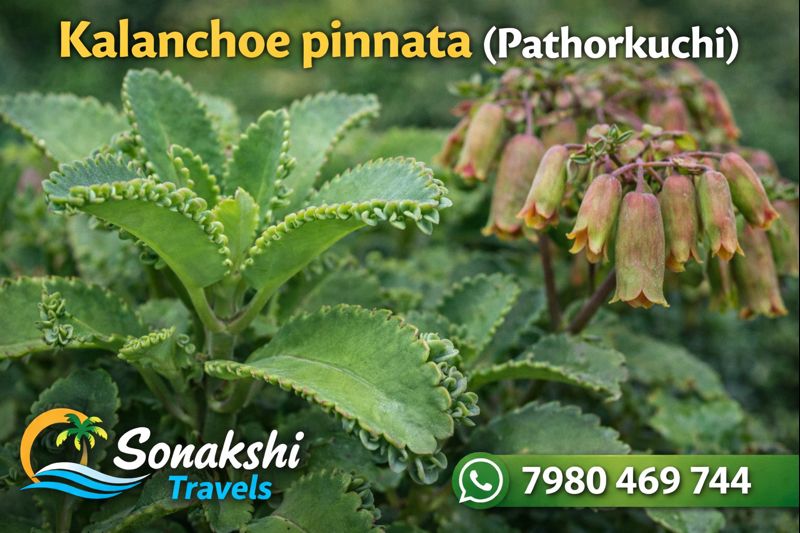
Leaves are opposite, fleshy, and broadly ovate to elliptic, with crenate or scalloped margins. A defining characteristic of Kalanchoe pinnata is the development of small adventitious plantlets along the leaf margins. These plantlets detach easily and root upon contact with soil, enabling rapid vegetative propagation. The leaf surface is smooth and waxy, reducing transpiration and enhancing drought tolerance.
Flowers and Inflorescence
Flowering occurs seasonally, with the plant producing terminal panicles of tubular, pendulous flowers. The flowers are typically greenish-yellow to pinkish-red, with a waxy texture. Pollination is primarily facilitated by insects, although vegetative reproduction remains the dominant mode of propagation.
Habitat & Distribution
Kalanchoe pinnata demonstrates a broad ecological amplitude, thriving across a wide range of habitats from cultivated gardens to wild, disturbed landscapes.
Global Range
The species is believed to have originated in Madagascar but is now widely distributed across tropical and subtropical regions worldwide. It is naturalized in South Asia, Southeast Asia, Africa, the Americas, and various Pacific islands. Its global spread has been facilitated by human cultivation and its exceptional capacity for vegetative reproduction.
In the Indian subcontinent, Kalanchoe pinnata is commonly found in home gardens, temple premises, roadsides, and fallow lands. Its adaptability has allowed it to persist in both urban and rural environments.
Preferred Habitat
The preferred habitat of Kalanchoe pinnata includes well-drained soils, rocky outcrops, garden beds, and semi-shaded locations. While the plant tolerates a range of soil types, it performs best in sandy or loamy substrates with moderate organic content. It is highly drought-tolerant but does not thrive in waterlogged conditions.
Occurrence
In natural and semi-natural landscapes, Kalanchoe pinnata often occurs as a scattered or clustered species, particularly in disturbed sites. It is frequently observed colonizing abandoned land, embankments, and the margins of agricultural fields. Its ability to reproduce vegetatively ensures rapid establishment even where seed germination conditions are unfavorable.
Preferred Habitat in the Sundarbans Region
Within the Sundarbans region, Kalanchoe pinnata is primarily found in human-modified landscapes rather than deep mangrove forests. It commonly grows near village settlements, embankments, elevated grounds, and household gardens where salinity levels are relatively low. These areas provide the well-drained substrates and reduced tidal influence required for optimal growth.
Although not a true mangrove species, Pathorkuchi contributes to the peripheral vegetation mosaic of the Sundarbans. Its presence reflects transitional ecological zones where terrestrial and estuarine influences overlap. The plant’s drought tolerance is particularly advantageous during dry seasons when freshwater availability is limited.
Exploring village-edge flora offers deeper insight into delta ecosystems. A thoughtfully curated Sundarban Tour introduces visitors to both mangrove and terrestrial plant diversity.
Ecological Role
The ecological role of Kalanchoe pinnata lies primarily in its function as a pioneer and stabilizing species. Its fleshy stems and leaves contribute organic matter to the soil, improving microhabitat conditions for other plants and soil organisms. By colonizing exposed or degraded areas, it helps reduce soil erosion and enhances ground cover.
The flowers provide nectar resources for insects, while the dense foliage creates shelter for small invertebrates. Although it does not form complex ecological associations like mangrove trees, Kalanchoe pinnata plays a supportive role in maintaining local biodiversity, particularly in disturbed environments.
Habitat Alteration
Habitat alteration affects Kalanchoe pinnata primarily through changes in land use and urban expansion. While the species is highly adaptable, excessive soil compaction, chemical pollution, and prolonged waterlogging can limit its growth. In coastal regions, rising salinity levels may restrict its distribution to elevated or protected areas.
In the Sundarbans, embankment construction and settlement expansion have altered natural vegetation patterns. However, these same modifications often create niches where Kalanchoe pinnata can establish, highlighting its dual role as both a beneficiary and indicator of habitat change.
Conservation Efforts
Kalanchoe pinnata is not currently considered threatened due to its widespread distribution and robust reproductive capacity. Conservation efforts therefore focus less on species preservation and more on habitat management and sustainable use. Protecting diverse vegetation zones ensures that resilient species like Pathorkuchi continue to support ecosystem stability.
In traditional landscapes, promoting indigenous plant knowledge and sustainable gardening practices helps maintain populations of medicinal plants. Integrating such species into community-based conservation initiatives strengthens both ecological and cultural resilience.
Understanding plant resilience adds depth to any nature journey. Join a guided Sundarban Tour to observe how flora adapts to deltaic conditions.
Did You Know?
Kalanchoe pinnata can reproduce from tiny plantlets growing along leaf margins.
The plant uses CAM photosynthesis to conserve water.
It is widely used in traditional medicine across South Asia.
Its succulent leaves store water, allowing survival during drought.
The species is often among the first to colonize disturbed land.
External Reference
For additional botanical and taxonomic details, consult the following external source: