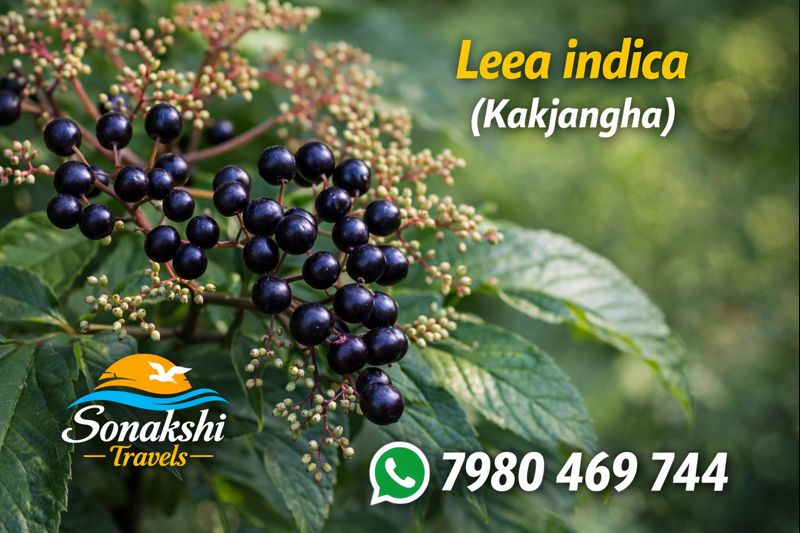
Leea indica, locally known as Kakjangha, is a remarkable understorey shrub of tropical and subtropical forests, valued for its ecological importance, medicinal relevance, and resilience within diverse forest ecosystems. Widely distributed across South and Southeast Asia, this species occupies an essential niche in forest margins, secondary woodlands, and humid lowland forests. In the eastern Indian landscape, particularly in and around the Sundarbans biosphere fringe, Leea indica functions as a stabilizing component of forest undergrowth and transitional vegetation.
This detailed article presents an in-depth, research-based overview of Leea indica, covering its taxonomy, morphology, habitat preferences, global distribution, ecological functions, conservation status, and its specific relevance to the Sundarbans region. The narrative emphasizes scientific accuracy, field-based identification features, and ecological relationships critical to long-term habitat sustainability.
Taxonomy & Classification
Systematic Position
Leea indica belongs to the family Vitaceae, a family best known for climbers and shrubs adapted to humid tropical environments. Unlike many members of Vitaceae that exhibit climbing habits, the genus Leea consists primarily of erect shrubs and small trees, occupying shaded forest strata.
Kingdom: Plantae
Clade: Angiosperms
Clade: Eudicots
Order: Vitales
Family: Vitaceae
Genus: Leea
Species: Leea indica (Burm. f.) Merr.
The taxonomic identity of Leea indica has remained stable in modern botanical literature, and the species is often cited as a representative example of non-climbing Vitaceae adapted to forest understorey conditions.
Morphology & Field Identification
Growth Form and Habit
Leea indica is a perennial, erect shrub that typically reaches heights of 2 to 4 meters, though under optimal forest conditions it may grow taller. The plant exhibits a bushy architecture with multiple stems arising from a woody base. Young stems are green and smooth, gradually becoming woody with age.
Leaves
The leaves are large, compound, and imparipinnate, imparting a distinctly lush appearance. Each leaf may measure up to 60 centimeters in length, with ovate to elliptic leaflets arranged oppositely along the rachis. The leaf surface is dark green, glossy above, and paler beneath. Margins are serrated, and venation is prominent, making the plant easily recognizable during field surveys.
Inflorescence and Flowers
The inflorescences are terminal or axillary cymes, bearing numerous small, greenish-white to pale pink flowers. Although individually inconspicuous, the collective floral display attracts a variety of insects, contributing to local pollination networks. Flowering typically occurs during the monsoon and early post-monsoon seasons.
Fruits and Seeds
The fruits are small, globose berries that ripen to a deep purplish-black color. Each berry contains several seeds embedded in soft pulp. The fruits are consumed by birds and small mammals, making Leea indica an important agent of seed dispersal within forest ecosystems.
Habitat & Distribution
Natural Habitat
Leea indica thrives in moist deciduous forests, evergreen forests, forest edges, and shaded ravines. It prefers humid microclimates with filtered sunlight, often forming dense patches in the understorey. The species shows moderate tolerance to disturbance, enabling it to persist in secondary forests and regenerating landscapes.
Altitudinal Range
The plant occurs from sea level up to approximately 1200 meters above mean sea level. Its adaptability across elevation gradients reflects physiological resilience to varying moisture and temperature regimes.
Global Range
Leea indica is widely distributed across the Indian subcontinent, including India, Bangladesh, Nepal, Bhutan, and Sri Lanka. Beyond South Asia, it extends into Southeast Asia, encompassing Myanmar, Thailand, Malaysia, Indonesia, and parts of southern China. This broad distribution underscores its ecological flexibility and evolutionary success in tropical climates.
In many regions, the species is recognized as a native component of forest undergrowth rather than a cultivated plant, reflecting its long-standing association with natural ecosystems.
Preferred Habitat
Soil and Moisture Requirements
Leea indica prefers well-drained, humus-rich soils with consistent moisture availability. Loamy and lateritic soils enriched with organic matter support optimal growth. The species is sensitive to prolonged waterlogging but tolerates seasonal flooding if drainage improves during drier months.
Light Conditions
As an understorey shrub, Kakjangha favors partial shade. Excessive exposure to direct sunlight can reduce leaf size and overall vigor, while deep shade may limit flowering and fruiting.
Occurrence
In eastern India, Leea indica commonly occurs along forest margins, village woodlands, canal banks, and degraded forest patches. Its persistence in semi-natural habitats reflects ecological resilience and compatibility with traditional land-use practices.
Exploring forest biodiversity enhances any nature journey. Discover curated itineraries through our
Sundarban Tour Package options designed for immersive mangrove experiences.
Preferred Habitat in the Sundarbans Region
Ecological Niche in the Delta
Within the Sundarbans region, Leea indica is primarily found in non-saline or mildly saline zones along forest fringes, village embankments, and elevated ground near freshwater channels. It does not occur in core mangrove zones but plays a vital role in transitional habitats linking mangroves with terrestrial forests.
Its dense foliage contributes to soil moisture retention and microhabitat creation, supporting insects, amphibians, and small reptiles. The species thus enhances ecological connectivity in a highly fragmented deltaic landscape.
Ecological Role
Food Web Contribution
The fruits of Leea indica serve as an important food source for frugivorous birds, which in turn facilitate seed dispersal across forest patches. The flowers attract pollinators, strengthening trophic interactions within the forest understorey.
Soil and Microclimate Regulation
The extensive leaf surface and root system aid in reducing soil erosion, enhancing nutrient cycling, and maintaining understorey humidity. These functions are particularly valuable in ecotonal zones of the Sundarbans, where climatic stressors are pronounced.
Habitat Alteration
Anthropogenic Pressures
Deforestation, land conversion, and infrastructure development pose localized threats to Leea indica populations. In the Sundarbans, increasing soil salinity, embankment construction, and altered freshwater flow patterns affect suitable habitats.
Despite these pressures, the species demonstrates moderate tolerance to disturbance, allowing it to persist in secondary vegetation where complete forest cover has been reduced.
Conservation Efforts
Community and Habitat-Based Approaches
Although Leea indica is not classified as threatened on a global scale, local conservation is essential for maintaining understorey biodiversity. Protecting forest edges, promoting native vegetation regeneration, and integrating the species into agroforestry systems can enhance long-term population stability.
In the Sundarbans context, conservation strategies that preserve freshwater influence and reduce habitat fragmentation indirectly support the persistence of Kakjangha.
For a deeper, personalized exploration of delta ecology, consider our
Sundarban Private Tour experiences curated for nature-focused travelers.
Did You Know?
Ethnobotanical Significance
In traditional medicine systems, various parts of Leea indica are used for their purported anti-inflammatory, digestive, and tonic properties. The plant is also valued in folk traditions as a symbol of forest vitality and resilience.
The deep purple fruits are rich in natural pigments and antioxidants, contributing to the plant’s medicinal reputation across different cultural landscapes.
External Reference
For additional botanical and taxonomic details, readers may consult: