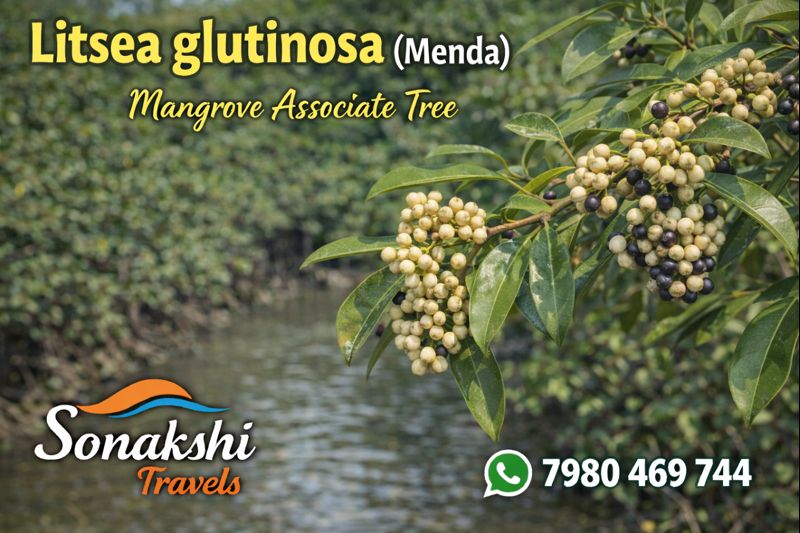
Botanical Characteristics, Ecological Role, and Distribution in Deltaic Forests
Litsea glutinosa, commonly known as Menda, is a medium-sized evergreen to semi-evergreen tree belonging to the laurel family. Widely distributed across tropical Asia, this species holds both ecological and ethnobotanical importance. In coastal and deltaic landscapes such as the Sundarbans, Litsea glutinosa functions as a resilient forest associate, adapting to fluctuating moisture regimes, periodic inundation, and varying soil conditions.
Although not classified as a true mangrove, Menda plays a meaningful role in transitional forest zones where mangrove vegetation merges with inland woodland. Its adaptability, aromatic foliage, and capacity to stabilize soil contribute to ecosystem health and biodiversity conservation in fragile estuarine environments.
Taxonomy & Classification
Systematic Position
Litsea glutinosa is a member of the family Lauraceae, a family known for aromatic trees and shrubs such as cinnamon, bay laurel, and avocado. The genus Litsea comprises numerous species distributed across Asia and Australasia, many of which are ecologically significant components of tropical forests.
The species epithet glutinosa refers to the mucilaginous or sticky properties found in the bark and leaves, a feature that has long been recognized in traditional practices.
Morphology & Field Identification
General Growth Form
Litsea glutinosa is a medium-sized tree, typically attaining heights of 10 to 20 meters. The trunk is straight to slightly crooked, supporting a spreading crown. The bark is greyish-brown and often exfoliates in thin flakes, revealing lighter inner layers.
Leaves
Leaves are simple, alternate, and elliptic to obovate in shape. They are thick, leathery, and aromatic when crushed. The upper surface is glossy green, while the underside appears paler. This leathery texture helps reduce water loss and protects against saline spray in coastal environments.
Flowers
The flowers are small, yellowish-green, and borne in clustered umbels. They are generally inconspicuous but play an important role in supporting insect pollinators. The species is usually dioecious, with male and female flowers occurring on separate trees.
Fruits and Seeds
The fruit is a small, rounded drupe that turns dark purple to black upon maturity. Each fruit contains a single seed and is seated on a shallow cup-like structure. These fruits are consumed by birds, facilitating seed dispersal across forested landscapes.
Habitat & Distribution
Natural Habitat
Litsea glutinosa is found in tropical evergreen and semi-evergreen forests, riverine woodlands, coastal plains, and hill forests at lower elevations. It thrives in humid environments with consistent rainfall and moderate temperatures.
Environmental Adaptability
The species exhibits notable tolerance to periodic waterlogging and can grow in soils with moderate salinity. This adaptability enables its survival in deltaic ecosystems influenced by both freshwater and tidal processes.
Global Range
The global distribution of Litsea glutinosa spans South Asia, Southeast Asia, and parts of East Asia. It is recorded in India, Bangladesh, Sri Lanka, Nepal, Myanmar, Thailand, Malaysia, Indonesia, southern China, and Taiwan.
Within India, the species is widely distributed across eastern, northeastern, and southern states, occurring both in natural forests and semi-managed landscapes.
Preferred Habitat
Soil Requirements
Litsea glutinosa prefers moist, well-drained loamy to clay-loam soils enriched with organic matter. It can tolerate seasonal waterlogging but does not thrive in permanently submerged conditions.
Climatic Conditions
The species grows best under warm tropical climates with high humidity and annual rainfall ranging from moderate to high. Extended drought conditions can adversely affect growth and regeneration.
Occurrence
The occurrence of Litsea glutinosa is generally scattered to moderately frequent, depending on habitat quality. It often appears as an associated species rather than forming dominant stands. In deltaic regions, it is commonly found along forest margins and slightly elevated ground.
Preferred Habitat in the Sundarbans Region
In the Sundarbans, Menda is typically found in buffer zones, elevated islands, and transitional forests where tidal influence is reduced by freshwater inflow. These areas experience less salinity stress compared to core mangrove zones.
Such habitats allow Litsea glutinosa to coexist with mangrove associates, contributing to the gradual ecological transition between saline and terrestrial forest systems.
Explore the layered vegetation of deltaic forests through an immersive Sundarban Tour Package guided by experienced naturalists.
Ecological Role
Soil Stabilization
The root system of Litsea glutinosa helps bind soil in forest margins and riverbanks, reducing erosion during monsoon floods and tidal surges.
Biodiversity Support
Flowers provide nectar for insects, while fruits serve as a food source for birds and small mammals. This interaction supports seed dispersal and forest regeneration.
Microhabitat Formation
The tree’s canopy moderates ground-level temperature and moisture, creating favorable microhabitats for understory plants and soil organisms.
Habitat Alteration
Habitat alteration due to deforestation, land conversion, and infrastructure development poses challenges to Litsea glutinosa populations. Altered freshwater flow and increased soil salinity can reduce seedling survival.
In the Sundarbans, climate change-driven sea-level rise and cyclonic disturbances further impact suitable habitats for this species.
Conservation Efforts
Litsea glutinosa is not currently categorized as threatened, but its long-term survival depends on the conservation of mixed forest ecosystems. Protection of buffer zones and maintenance of natural hydrological regimes are essential.
Incorporating mangrove associates like Menda into coastal afforestation and restoration programs can strengthen ecosystem resilience and biodiversity.
Gain deeper insight into forest ecology through a specialized Sundarban Private Tour focused on plant diversity and habitat dynamics.
Did You Know?
Litsea glutinosa belongs to the same family as cinnamon and bay leaf.
The bark and leaves contain aromatic compounds characteristic of Lauraceae.
Birds play a major role in dispersing its seeds.
The species often indicates relatively stable and less saline forest margins.