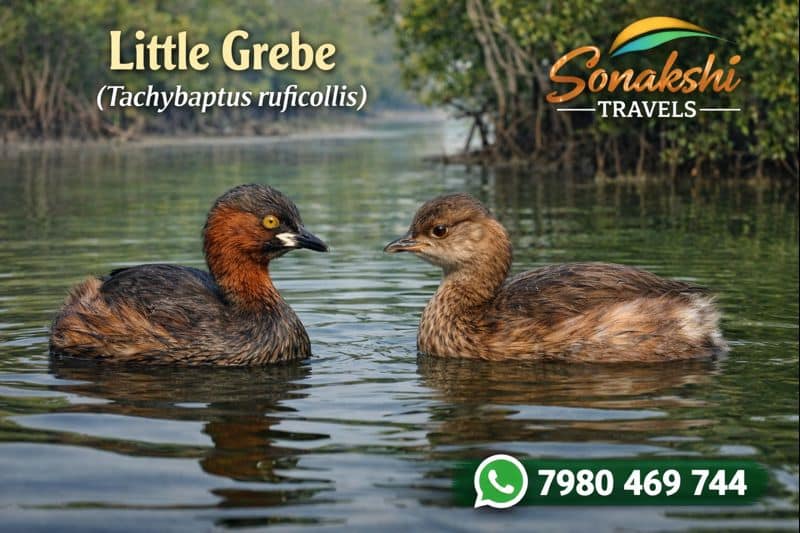
The Little Grebe (Tachybaptus ruficollis), also widely known as the Dabchick, is one of the smallest and most agile members of the grebe family. Despite its modest size, this freshwater diving bird is biologically sophisticated, ecologically important, and behaviorally intriguing. Found across vast regions of Europe, Asia, Africa, and Australasia, the Little Grebe is a master of concealment and underwater foraging. Its presence in wetlands, ponds, lakes, and estuarine backwaters reflects the overall health of aquatic ecosystems, making it an important indicator species.
Taxonomy & Classification
Scientific Classification
The Little Grebe belongs to the family Podicipedidae, a group of highly specialized aquatic birds adapted for diving rather than flight. The genus Tachybaptus distinguishes smaller grebes with rapid diving abilities. Molecular phylogenetic studies suggest that grebes evolved independently from other waterbirds, developing unique skeletal and muscular adaptations suited for underwater propulsion.
Morphology & Field Identification
General Appearance
The Little Grebe has a compact, rounded body, short neck, and a blunt, pointed bill. Its plumage changes noticeably between breeding and non-breeding seasons. The species often appears as a floating, low-profile bird, with much of its body submerged.
Male Features
During the breeding season, males develop striking chestnut-brown patches on the cheeks and sides of the neck, contrasted by a dark brown to black crown. A pale yellow gape spot becomes prominent at the base of the bill, serving as a visual cue during courtship and territorial interactions.
Female Features
Females closely resemble males but are generally slightly smaller and less vividly colored. Outside the breeding season, both sexes adopt duller brown and grey plumage, enhancing camouflage in winter wetlands.
Size & Wingspan
Adults typically measure 23–29 cm in length, with a wingspan ranging between 40 and 45 cm. Body weight varies from 120 to 250 grams, depending on season and food availability.
Flight Characteristics
Although capable of flight, the Little Grebe is reluctant to take to the air. Takeoff requires a rapid running start across the water surface. Flight is direct but short-lived, usually undertaken at night during seasonal dispersal.
Habitat & Distribution
Global Range
The species has one of the widest distributions among grebes, occurring across Europe, Africa, the Middle East, South and Southeast Asia, China, Japan, and parts of Australasia. Several subspecies are recognized, reflecting regional ecological adaptations.
Preferred Habitat
Little Grebes favor freshwater bodies such as ponds, lakes, marshes, reservoirs, irrigation canals, and slow-flowing rivers. During winter, they may also occupy brackish lagoons and sheltered coastal waters.
Diet & Feeding Ecology
Diet Composition
The diet consists primarily of aquatic insects, insect larvae, small fish, tadpoles, crustaceans, and mollusks. Seasonal shifts in diet reflect prey availability and water depth.
Foraging Technique
Little Grebes are expert divers, using powerful hind legs positioned far back on the body. Dives are brief but frequent, often lasting less than 30 seconds. Prey is captured underwater and swallowed upon resurfacing.
Breeding & Reproduction
Breeding Season
Breeding typically occurs during the warmer months, coinciding with increased aquatic productivity. Courtship involves synchronized swimming, head-shaking displays, and soft trilling calls.
Nesting Sites
Nests are floating platforms constructed from aquatic vegetation and anchored to reeds or submerged plants. Eggs are initially white but quickly become stained brown due to wet nesting material.
Unique Adaptations & Behavioral Ecology
Speed & Agility
The species exhibits remarkable underwater agility, using alternating leg strokes to maneuver with precision. On water, it can vanish instantly by diving, leaving barely a ripple.
Camouflage and Nesting Strategy
Nesting materials blend seamlessly with surrounding vegetation. Adults often cover eggs with plant matter when leaving the nest, reducing visibility to predators.
Social Behavior
Little Grebes are generally solitary or occur in pairs during breeding. In winter, loose aggregations may form in favorable feeding areas, though individuals remain territorially spaced.
Occurrence & Seasonal Movement
Populations exhibit partial migration. Birds breeding in colder regions move southward during winter, while tropical populations remain largely resident with local dispersal.
Preferred Habitat in the Sundarbans Region
Within the Sundarbans, Little Grebes are primarily found in freshwater ponds, village wetlands, rain-fed marshes, and inland water bodies adjacent to mangrove forests. They are uncommon within saline tidal creeks but thrive in low-salinity zones.
Freshwater wetlands around the mangrove landscape support fascinating birdlife. Explore these hidden habitats through a guided Sundarban Tour and observe aquatic birds in their natural surroundings.
Ecological Role
Little Grebes play a vital role in controlling aquatic insect populations and maintaining balanced freshwater food webs. Their presence reflects good water quality and healthy invertebrate communities.
Habitat Alteration
Major threats include wetland drainage, water pollution, invasive aquatic plants, and fluctuating water levels due to unregulated development. Climate variability further impacts breeding success.
Conservation Efforts
The species is currently widespread and stable, benefiting from wetland conservation initiatives. Protection of small ponds and village wetlands is particularly important for long-term population sustainability.
Did You Know?
The name “Dabchick” comes from its habit of repeatedly dipping underwater.
Little Grebes can sink slowly into water without diving to avoid detection.
Chicks are often seen riding on the backs of adults.