Comprehensive Biology, Ecology, and Seasonal Occurrence in Eastern Indian Wetlands
The Little Stint (Calidris minuta) is among the smallest migratory shorebirds of the Old World, yet its ecological importance far outweighs its diminutive size. This species is a remarkable example of endurance and adaptability, undertaking long-distance migrations between Arctic breeding grounds and temperate to tropical wintering habitats. Across inland wetlands, estuaries, and coastal flats, the Little Stint plays a subtle but essential role in maintaining ecological balance. In regions such as eastern India, including the peripheral wetland systems of the Sundarbans, it represents a familiar seasonal visitor whose presence reflects the health and productivity of intertidal and freshwater habitats.
Taxonomy & Classification
The Little Stint belongs to the order Charadriiformes and the family Scolopacidae, a diverse assemblage of waders adapted to foraging along shorelines and wetlands. Within this family, it is placed in the genus Calidris, which comprises small to medium-sized sandpipers characterized by probing bills and migratory lifestyles. The species was formally described in the eighteenth century and is taxonomically well defined, with no recognized subspecies. Its genetic affinity with other stints highlights evolutionary adaptations linked to Arctic breeding and long-range migration.
Morphology & Field Identification
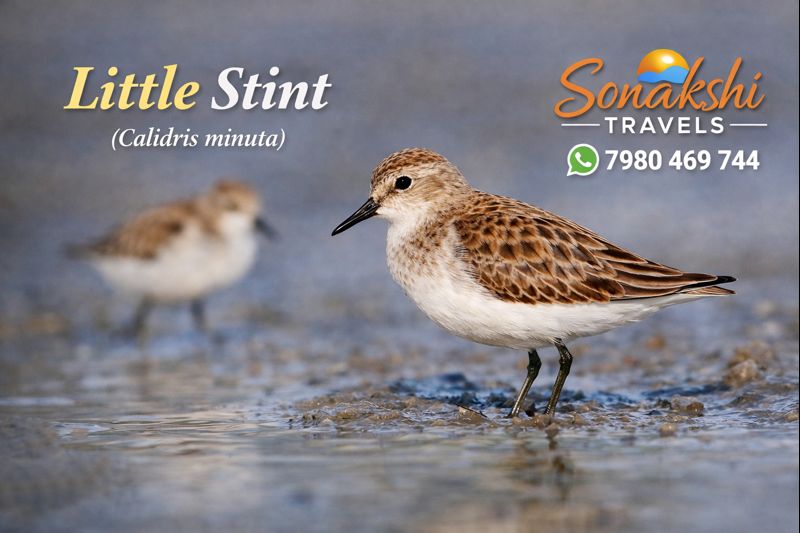
The Little Stint is a compact, delicately built bird with short black legs, a fine straight bill, and a rounded head profile. In non-breeding plumage, the upperparts are pale gray-brown, while the underparts appear clean white. During the breeding season, the bird develops warmer tones, including rufous-edged feathers on the mantle and scapulars, giving it a more textured appearance. In the field, its small size, active feeding behavior, and tendency to associate with other small sandpipers assist in identification.
Male Features
Male Little Stints show slightly richer coloration during the breeding season, with more pronounced rufous and buff tones along the upperparts. These subtle enhancements are most visible under good light conditions and play a role in breeding displays and territory establishment on Arctic tundra.
Female Features
Females closely resemble males but are generally marginally paler and less contrasting in breeding plumage. Sexual dimorphism is minimal, and field separation of sexes is often impractical outside the breeding grounds.
Size & Wingspan
The Little Stint typically measures between 13 and 15 centimeters in length, with a wingspan ranging from 30 to 34 centimeters. Its lightweight body structure enables efficient flight and rapid takeoff, essential traits for a species exposed to frequent predation and long migratory journeys.
Flight Characteristics
In flight, the Little Stint exhibits rapid wingbeats and agile maneuvering. Flocks often move in tight, coordinated formations, changing direction almost simultaneously. The narrow wings and streamlined body allow swift acceleration, aiding both predator avoidance and sustained migratory travel.
Habitat & Distribution
Global Range
The breeding range of the Little Stint extends across the high Arctic regions of northern Europe and Siberia. During the non-breeding season, it migrates southward to Africa, the Middle East, South Asia, and parts of Southeast Asia. This extensive distribution reflects exceptional migratory capability and broad ecological tolerance.
Preferred Habitat
Throughout its annual cycle, the Little Stint favors open, low-vegetation habitats. During migration and wintering, it commonly occupies mudflats, shallow lagoons, estuarine margins, salt pans, and freshwater marsh edges. The species shows flexibility in habitat use, provided suitable foraging substrates are available.
Diet & Feeding Ecology
The diet of the Little Stint consists primarily of small invertebrates, including insect larvae, tiny crustaceans, mollusks, and annelid worms. Seasonal shifts in prey availability influence feeding intensity and habitat selection, particularly during migratory stopovers when rapid energy accumulation is critical.
Foraging Technique
Foraging behavior is characterized by quick, repetitive pecking and shallow probing of soft substrates. The bird often feeds actively while walking, pausing briefly to extract prey before moving on. This energetic feeding style allows efficient exploitation of dense invertebrate populations in intertidal and wetland environments.
Breeding & Reproduction
Breeding occurs during the short Arctic summer, where the Little Stint takes advantage of extended daylight and abundant insect life. The breeding season is brief but intense, with rapid pair formation, nesting, and chick rearing completed within a narrow time window.
Nesting Sites
Nests are shallow ground scrapes lined with fine plant material and typically situated on open tundra with sparse vegetation. Site selection emphasizes visibility and camouflage, enabling adults to detect predators early while blending into the surrounding landscape.
Unique Adaptations & Behavioral Ecology
Speed & Agility
Despite its small stature, the Little Stint is remarkably agile. Quick reflexes, rapid takeoff, and coordinated flock movements reduce predation risk and enhance survival across diverse habitats.
Camouflage and Nesting Strategy
Plumage coloration closely matches the tones of mud, sand, and tundra vegetation. This natural camouflage is particularly effective during nesting, when both eggs and incubating adults are vulnerable to predators.
Social Behavior
Outside the breeding season, the Little Stint is highly social, often forming large mixed-species flocks with other small sandpipers. This gregarious behavior enhances foraging efficiency and predator detection through collective vigilance.
Occurrence & Seasonal Movement
In South Asia, the Little Stint is primarily a winter visitor and passage migrant. Arrival typically begins after the monsoon, with peak numbers observed during late autumn and winter months. Spring departure occurs as birds return northward to breeding grounds.
Preferred Habitat in the Sundarbans Region
Within the broader Sundarbans landscape, the Little Stint is most frequently encountered along exposed mudflats, shallow creeks, and open wetland margins adjacent to mangrove forests. These areas provide rich foraging opportunities, particularly during low tide, while offering relative safety from human disturbance.
For travelers eager to witness migratory shorebirds within dynamic mangrove-fringed wetlands, a carefully curated Sundarban Tour can provide immersive access to these unique ecosystems.
Ecological Role
The Little Stint contributes to wetland ecosystem balance by regulating populations of small invertebrates. Through its feeding activity, it participates in nutrient cycling and energy transfer within aquatic and intertidal food webs.
Habitat Alteration
Habitat degradation poses a significant threat to the species, particularly along migratory stopover sites. Coastal development, wetland drainage, pollution, and altered hydrological regimes can reduce food availability and disrupt traditional migratory routes.
Conservation Efforts
Conservation initiatives focusing on wetland protection, sustainable coastal management, and international migratory bird agreements are essential for safeguarding the Little Stint. Long-term monitoring and habitat preservation across flyways remain key priorities.
Nature-focused visitors interested in exploring bird-rich tidal landscapes may also consider a responsibly planned Sundarban Tour, designed to highlight the region’s remarkable biodiversity.
Did You Know?
Despite weighing only a few tens of grams, the Little Stint is capable of migrating thousands of kilometers annually, relying on precise timing and rich stopover habitats to complete its journey successfully.
External Reference
For additional taxonomic and ecological information, visit: