Mangrove Species Found in Sundarban:
A Living Atlas of the Tidal Forest
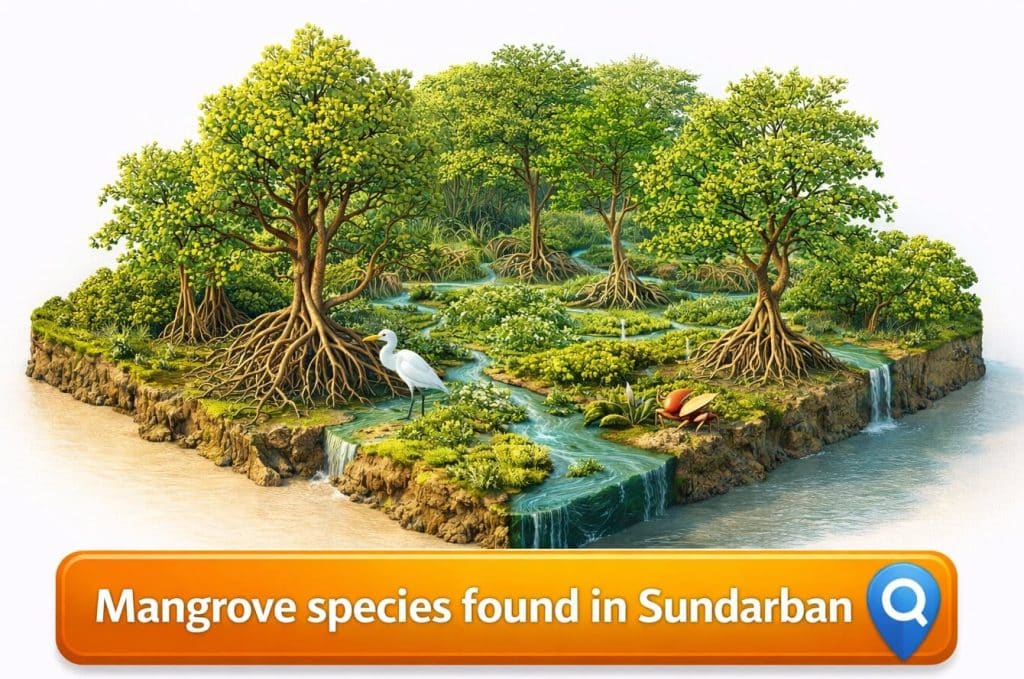
The first impression of the Sundarban is not silence, nor even wilderness—it is texture. The land here breathes through roots. The soil glistens with brackish moisture. The rivers bend and unbend as tides dictate. To travel through this delta is to enter a botanical universe shaped by salt, sediment, and centuries of adaptation. The mangrove species found in Sundarban are not merely trees; they are engineers of survival, guardians of coastlines, and silent witnesses to human resilience.
Spread across the lower delta of the Ganges–Brahmaputra–Meghna system, the Indian portion of the Sundarban forms part of the larger Sundarbans mangrove forest, a UNESCO-recognized biosphere reserve. Within this shifting terrain grows one of the richest mangrove assemblages in the world. Understanding these species is essential for anyone seeking to interpret the landscape during a forest safari or river cruise.
The Ecological Setting of the Sundarban
The Sundarban lies at the confluence of freshwater rivers and the saline waters of the Bay of Bengal. This tidal interplay creates varying salinity gradients, influencing which mangrove species thrive in specific zones. The forest is divided broadly into high salinity, moderate salinity, and low salinity areas. Each zone hosts a distinct botanical community.
Mangroves here are not a single species but a collective term for halophytic (salt-tolerant) trees and shrubs. Their survival strategies include aerial roots, salt-excreting leaves, and viviparous seeds that germinate while still attached to the parent tree. Observing these features during a Sundarban Tour from Kolkata reveals how deeply evolution has shaped this forest.
Dominant Mangrove Species of the Sundarban
1. Sundari (Heritiera fomes)
The very name “Sundarban” is believed to derive from the Sundari tree. Scientifically known as Heritiera fomes, this species dominates comparatively less saline zones. It possesses buttressed trunks and pneumatophores—vertical breathing roots that rise from the mud like clustered fingers.
Sundari wood is durable and once heavily exploited. Today, conservation measures restrict extraction. The tree’s decline in certain pockets due to increasing salinity is an ecological indicator of climate stress.
2. Gewa (Excoecaria agallocha)
Commonly called “Gewa,” this species tolerates higher salinity. Its milky latex can cause temporary blindness if it comes into contact with eyes, giving it the colloquial name “blind-your-eye mangrove.” Despite this defensive trait, Gewa plays a significant role in shoreline stabilization.
During low tide, clusters of Gewa roots form labyrinths that shelter juvenile fish and crustaceans, forming the base of a complex estuarine food web.
3. Goran (Ceriops decandra)
Goran forms dense thickets, especially in moderately saline zones. Shorter than Sundari, it has stilt-like roots that anchor firmly in shifting mud. In many creeks, Goran stands create almost impenetrable green walls along narrow channels.
Its presence often indicates compact soil and stable embankments. For visitors navigating smaller waterways under experienced guides from Sundarban Travel, identifying Goran forests adds depth to the journey.
4. Keora (Sonneratia apetala)
Keora is frequently spotted along riverbanks exposed to direct tidal currents. It is a pioneer species, colonizing newly formed mudflats. Its tall, straight trunks and dense foliage offer perching sites for kingfishers and herons.
The fruit of Keora is edible and occasionally used locally. Ecologically, it acts as the first line of defense against erosion.
5. Dhundul (Xylocarpus granatum)
Dhundul trees are known for their distinctive cannonball-like fruits. Found in less saline regions, their plank-like buttresses rise dramatically from the soil. The seeds disperse through tidal currents, ensuring regeneration across distant creeks.
These trees contribute significantly to the structural complexity of the forest canopy.
6. Passur (Xylocarpus mekongensis)
Closely related to Dhundul, Passur is valued for its timber. It thrives in lower salinity belts and supports a variety of epiphytic organisms. In ecological surveys, Passur density is often studied as a marker of habitat stability.
7. Kankra (Bruguiera gymnorhiza)
Kankra possesses knee-shaped roots that arch out of the mud before re-entering it. These “knee roots” improve oxygen exchange. The species is crucial in mid-intertidal zones where prolonged inundation would suffocate ordinary trees.
8. Baen (Avicennia officinalis)
Avicennia species are among the most salt-tolerant mangroves. Baen trees exhibit numerous pencil-like pneumatophores emerging vertically from the soil surface. These roots are often visible during low tide and create a surreal landscape.
The leaves have salt glands that excrete excess salt, which sometimes crystallizes visibly on the surface.
Adaptation Mechanisms: Survival in a Saline World
The mangrove species found in Sundarban demonstrate three major adaptive strategies:
- Pneumatophores and aerial roots for respiration in oxygen-poor mud.
- Salt filtration or excretion mechanisms to manage salinity stress.
- Vivipary, where seeds germinate on the parent tree before dispersal.
These mechanisms allow mangroves to colonize areas where terrestrial vegetation cannot survive. For travelers on a Sundarban Luxury Tour, guides often demonstrate how these adaptations define the rhythm of life in the delta.
Associated Flora Beyond True Mangroves
Besides true mangrove species, the Sundarban hosts mangrove associates such as:
- Acanthus ilicifolius (Hargoza)
- Clerodendrum inerme
- Porteresia coarctata (salt-tolerant grass)
These plants occupy transitional zones and enrich biodiversity. Their presence ensures soil binding and habitat diversity for insects and reptiles.
Mangroves and Wildlife Interdependence
The mangrove ecosystem supports iconic fauna including the Royal Bengal Tiger, estuarine crocodiles, spotted deer, mudskippers, and migratory birds. Each species depends directly or indirectly on mangrove vegetation.
Leaf litter decomposes into detritus, feeding plankton. Plankton sustains fish. Fish nourish birds and mammals. The cycle begins with trees rooted in tidal mud.
During seasonal events such as the Sundarban Hilsa Festival 2026, discussions often highlight how mangrove estuaries serve as breeding and nursery grounds for Hilsa and other fish species.
Seasonal Variations in Mangrove Landscapes
Winter months reveal clearer skies and improved visibility of canopy structure. Summer intensifies evaporation, increasing salinity in upper soil layers. The monsoon rejuvenates freshwater input, altering species dominance temporarily.
Observing these seasonal transitions during a Sundarban Single Day Package can provide a snapshot of how rapidly the ecosystem transforms.
Conservation Challenges
Despite their resilience, mangroves face threats from:
- Rising sea levels and increased salinity intrusion
- Cyclonic disturbances
- Anthropogenic pressure and embankment modification
Post-cyclone regeneration studies show that pioneer species such as Keora recolonize exposed mudflats first, followed by secondary species like Goran and Sundari.
Practical Insights for Travelers
Understanding the Tidal Clock
Boat safaris operate according to tidal schedules. Low tide exposes root systems dramatically, offering better botanical observation opportunities. High tide allows deeper penetration into narrow creeks.
Best Observation Practices
- Carry binoculars for canopy-level birdwatching.
- Observe root structures during ebb tide.
- Listen to naturalist explanations regarding zonation patterns.
Responsible Conduct
Do not attempt to step onto mudflats. Mangrove roots are fragile, and the substrate can be dangerously unstable. Avoid littering; plastic waste can choke tidal channels.
Reading the Forest Through Its Roots
The mangrove species found in Sundarban form a living archive of adaptation. Each trunk, root, and leaf reflects centuries of negotiation between land and sea. To journey through this delta without understanding its vegetation is to overlook the foundation of its existence.
Whether explored over multiple days or during a carefully planned excursion, the botanical richness of the Sundarban reveals itself gradually. The forest does not announce its secrets loudly. It requires observation, patience, and respect.
In the end, the mangroves are not merely background scenery to wildlife sightings—they are the very architecture of life in this tidal world.