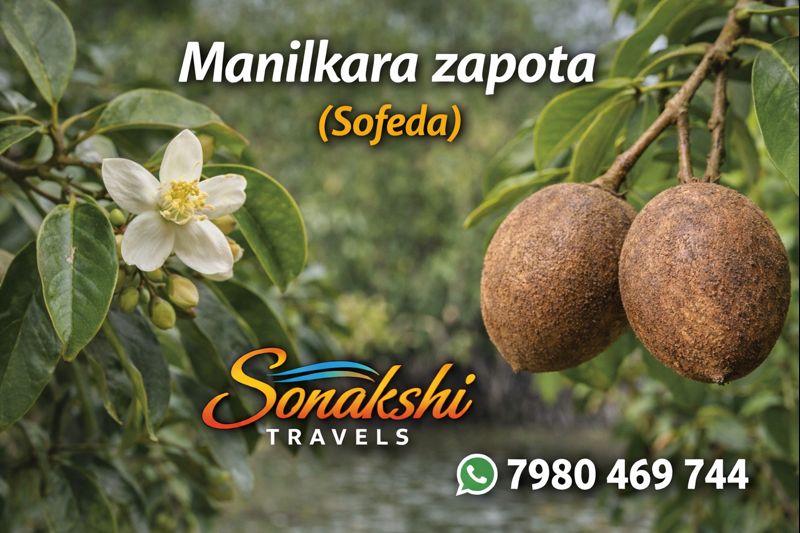
Manilkara zapota, commonly known as Sofeda or sapodilla, is a slow-growing evergreen tree of immense botanical, ecological, and socio-economic importance. Native to tropical regions, this species is best known for its sweet edible fruits; however, beyond horticulture, Manilkara zapota plays a meaningful role in forest ecosystems, particularly in coastal and semi-evergreen landscapes. In eastern India, including the peripheral zones of the Sundarbans, the species occurs in human-modified landscapes and transitional forest belts, where it contributes to biodiversity support and ecological stability.
Belonging to the family Sapotaceae, Manilkara zapota is characterized by dense foliage, latex-producing tissues, and remarkable adaptability to warm, humid climates. This article presents an in-depth, research-oriented overview of the species, covering its taxonomy, morphology, habitat preferences, ecological role, conservation context, and its relevance within the Sundarbans region.
Taxonomy & Classification
Systematic Position
Manilkara zapota is a member of the Sapotaceae family, a group of tropical trees and shrubs known for latex production and durable wood. Its taxonomic classification is as follows:
Kingdom: Plantae
Clade: Angiosperms
Clade: Eudicots
Order: Ericales
Family: Sapotaceae
Genus: Manilkara
Species: Manilkara zapota (L.) P. Royen
The species was historically classified under the genus Achras, and the name Achras zapota is still encountered in older botanical literature. Modern taxonomic revisions, supported by morphological and molecular evidence, have firmly placed the species within the genus Manilkara.
Morphology & Field Identification
Growth Habit and Trunk
Manilkara zapota is a medium-sized evergreen tree, typically attaining heights of 10–20 meters under favorable conditions. The trunk is straight and cylindrical, often branching at a moderate height. Bark is dark brown to greyish, rough, and fissured in mature trees, exuding a milky latex when injured.
Leaves
The leaves are simple, alternate, and clustered toward the ends of branches. They are elliptic to oblong, thick, leathery, and glossy on the upper surface, with entire margins and an obtuse to slightly pointed apex. The tough, coriaceous texture of the leaves reduces water loss and provides resistance to strong sunlight and coastal winds.
Flowers
Flowers are small, inconspicuous, and solitary or borne in small clusters in leaf axils. They are bell-shaped, pale yellow to creamy white, and possess a characteristic six-lobed corolla. Flowering may occur multiple times a year in favorable climates, enhancing reproductive success.
Fruits and Seeds
The fruit is a large berry, round to oval in shape, with a rough brown outer skin. The pulp is sweet, granular, and aromatic when ripe. Each fruit contains one to several hard, glossy black seeds with a distinctive hooked projection. The fruits serve as an important food source for wildlife and humans alike.
Habitat & Distribution
Ecological Adaptability
Manilkara zapota thrives in tropical and subtropical climates with warm temperatures and moderate to high rainfall. While it is widely cultivated, the species also grows in semi-natural forest margins, coastal plains, and riverine belts, particularly where soils are well-drained and rich in organic matter.
Global Range
Geographical Spread
The species is native to southern Mexico, Central America, and the Caribbean. Through centuries of cultivation and trade, it has been introduced and naturalized across South Asia, Southeast Asia, parts of Africa, and tropical regions worldwide. In India and Bangladesh, it is now a familiar component of rural landscapes and homestead gardens.
Preferred Habitat
Environmental Requirements
Manilkara zapota prefers deep, well-drained loamy soils but can tolerate sandy and lateritic substrates. It performs best in areas with ample sunlight and moderate humidity. Although not a true mangrove species, it exhibits tolerance to mild salinity and occasional waterlogging.
Understanding coastal and mangrove-adjacent vegetation is best achieved through guided exploration. Discover immersive Sundarban Tour experiences focused on nature, forests, and biodiversity.
Occurrence
Population Characteristics
The species commonly occurs as cultivated or semi-naturalized individuals rather than forming continuous forest stands. In eastern India, Manilkara zapota is frequently encountered along village boundaries, embankments, orchards, and mixed tree groves.
Preferred Habitat in the Sundarbans Region
Regional Distribution
In the Sundarbans region, Manilkara zapota is primarily found in peripheral zones, including elevated islands, human settlements, and embankment-protected areas. These zones experience reduced salinity compared to core mangrove forests, enabling the species to grow without physiological stress. Its presence reflects human–forest interaction and adaptive land use.
Ecological Role
Ecosystem Contributions
Manilkara zapota contributes to ecosystem functioning by providing food resources for birds, bats, and small mammals. Its dense canopy offers shade and microhabitats, while fallen leaves and fruits enrich soil organic matter. The species also plays a role in stabilizing soils in cultivated coastal landscapes.
Habitat Alteration
Environmental Pressures
Habitat alteration due to urban expansion, agricultural intensification, and changing hydrological regimes affects the natural regeneration of Manilkara zapota. In coastal regions, increasing salinity and soil erosion pose long-term challenges, particularly in low-lying areas vulnerable to climate change.
Conservation Efforts
Management and Sustainability
Although not considered threatened, conservation of Manilkara zapota depends on sustainable land-use practices and the preservation of mixed tree cover in rural and coastal zones. Its continued cultivation supports both ecological stability and livelihood resilience in tropical regions.
Experience the interplay between human settlements and forest landscapes through a guided Sundarban Tour that highlights native trees, wildlife, and conservation stories.
Did You Know?
Interesting Facts
The tree produces chicle, a natural latex historically used in chewing gum.
Its wood is extremely hard and durable.
Fruits are rich in natural sugars and dietary fiber.
The species can live and produce fruit for several decades.
External Reference
For detailed botanical and taxonomic information, refer to the following external source: Manilkara zapota – Wikipedia