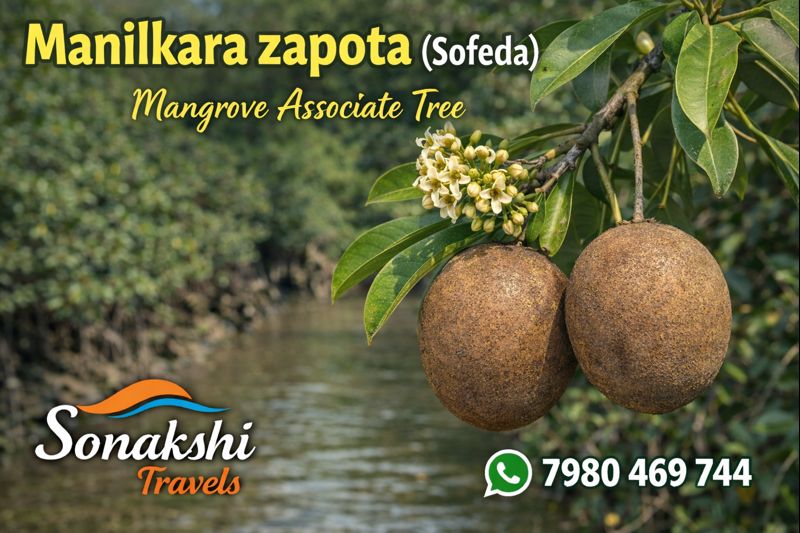
Botanical Characteristics, Ecological Functions, and Presence in the Sundarbans
Manilkara zapota, commonly known as Sofeda or Sapodilla, is a long-lived evergreen tree valued for its hardy nature, dense timber, and ecologically adaptable growth. Native to tropical regions, this species has become an integral component of coastal and semi-coastal landscapes, particularly in regions where freshwater and saline influences coexist. Although widely recognized for its edible fruit in cultivated settings, Manilkara zapota also plays a subtle yet meaningful ecological role when occurring in natural or semi-natural habitats.
Within the Sundarbans region and its adjoining transitional landscapes, Sofeda is regarded as a mangrove associate rather than a true mangrove. Its tolerance to mildly saline soils, seasonal inundation, and humid tropical climate allows it to survive along forest edges, embankments, and elevated ground near estuarine systems. The species demonstrates how cultivated and natural ecosystems can intersect within fragile deltaic environments.
Taxonomy & Classification
Systematic Placement
Manilkara zapota belongs to the family Sapotaceae, a family characterized by latex-producing trees and shrubs with leathery leaves and durable wood. The genus Manilkara includes numerous tropical species, many of which are valued for timber, fruit, or ecological resilience.
The species epithet zapota is derived from indigenous terminology of Central America, reflecting the tree’s original native range before its global dissemination.
Morphology & Field Identification
General Growth Form
Manilkara zapota is a medium to large evergreen tree, often reaching heights of 12 to 20 meters under favorable conditions. The trunk is straight and robust, supporting a dense, rounded canopy. The bark is dark brown to greyish and exudes a milky latex when injured, a defining feature of the Sapotaceae family.
Leaves
Leaves are simple, alternate, and elliptic to oblong in shape, with a glossy dark-green upper surface. The leathery texture minimizes moisture loss and provides resistance against strong coastal winds. Leaf margins are entire, and venation is clearly visible on the underside.
Flowers
The flowers are small, inconspicuous, and bell-shaped, usually pale white to greenish in color. They are borne singly or in small clusters in leaf axils. Pollination is primarily carried out by insects attracted to the subtle floral scent.
Fruits and Seeds
The fruit is a round to oval berry with a rough brown exterior and sweet, granular pulp. Inside the fruit are glossy black seeds with a characteristic hooked tip. While fruits are widely consumed in cultivated landscapes, fallen fruits in semi-wild areas contribute organic matter to the forest floor.
Habitat & Distribution
Natural and Semi-Natural Habitats
In natural contexts, Manilkara zapota occurs in tropical evergreen and semi-evergreen forests, coastal plains, and riverine landscapes. It thrives in areas with high humidity, warm temperatures, and well-drained soils, but it also exhibits tolerance for periodic waterlogging.
Adaptability
The species is remarkably adaptable, capable of growing in mildly saline soils and resisting short-term flooding. This adaptability has facilitated its establishment in transitional zones near mangrove ecosystems.
Global Range
Originally native to Central America and southern Mexico, Manilkara zapota has been widely introduced across tropical regions of Asia, Africa, and the Pacific. It is now firmly naturalized in many countries, including India, Bangladesh, Sri Lanka, Thailand, and Indonesia.
In the Indian subcontinent, the species is commonly found in eastern and southern states, both as a cultivated fruit tree and as a semi-wild species in suitable ecological niches.
Preferred Habitat
Soil Preferences
Manilkara zapota prefers deep, well-drained loamy soils rich in organic matter. However, it can tolerate clayey and slightly saline soils, particularly in deltaic regions where freshwater influence periodically reduces salinity.
Climatic Conditions
The species thrives in tropical climates with consistent warmth and moderate to high rainfall. High humidity enhances vegetative growth and fruit development.
Occurrence
The occurrence of Manilkara zapota in natural ecosystems is generally scattered. It is more frequently observed along forest edges, village boundaries, and elevated embankments rather than deep forest interiors. In the Sundarbans region, it appears in buffer zones and human-modified landscapes adjacent to mangrove forests.
Preferred Habitat in the Sundarbans Region
Within the Sundarbans, Sofeda is typically found in less saline zones where tidal influence is moderated by freshwater inflow. These areas include embankments, raised islands, and village peripheries bordering reserve forests.
Such habitats provide sufficient soil stability and reduced salinity, allowing the species to coexist alongside mangrove associates and terrestrial vegetation.
Discover the diverse plant life of deltaic landscapes through a carefully curated Sundarban Tour Package designed for nature and botany enthusiasts.
Ecological Role
Soil Stabilization
The extensive root system of Manilkara zapota helps bind soil particles, reducing erosion along embankments and forest margins. This function is particularly valuable in deltaic regions prone to monsoon flooding.
Biodiversity Support
Flowers attract pollinating insects, while fruits provide food for birds and small mammals. Leaf litter contributes to nutrient cycling within the soil.
Microclimatic Regulation
The dense canopy provides shade and reduces ground-level temperature fluctuations, supporting understory vegetation and soil organisms.
Habitat Alteration
Habitat alteration due to land reclamation, urban expansion, and changing agricultural practices affects the natural occurrence of Manilkara zapota. In coastal regions, increasing soil salinity and altered hydrological regimes may limit seedling establishment.
In the Sundarbans, climate change-induced sea-level rise and embankment failure can further reduce suitable habitats for this species.
Conservation Efforts
Although not considered threatened globally, Manilkara zapota benefits from conservation measures aimed at preserving mixed coastal forests and agroforestry systems. Encouraging the integration of native and naturalized trees within buffer zones enhances landscape resilience.
Sustainable land management and protection of freshwater inflow channels are crucial for maintaining suitable habitats in deltaic regions.
For a closer look at how cultivated and wild plant species coexist, a guided Sundarban Private Tour offers in-depth ecological interpretation.
Did You Know?
Manilkara zapota produces a milky latex historically used in the manufacture of chewing gum.
The tree can live for several decades, making it a long-term stabilizing element in landscapes.
Its dense wood is resistant to pests and decay.
Although widely cultivated, the species can survive in semi-wild coastal environments.