A Detailed Botanical and Ecological Study of a Creeping Wetland Herb
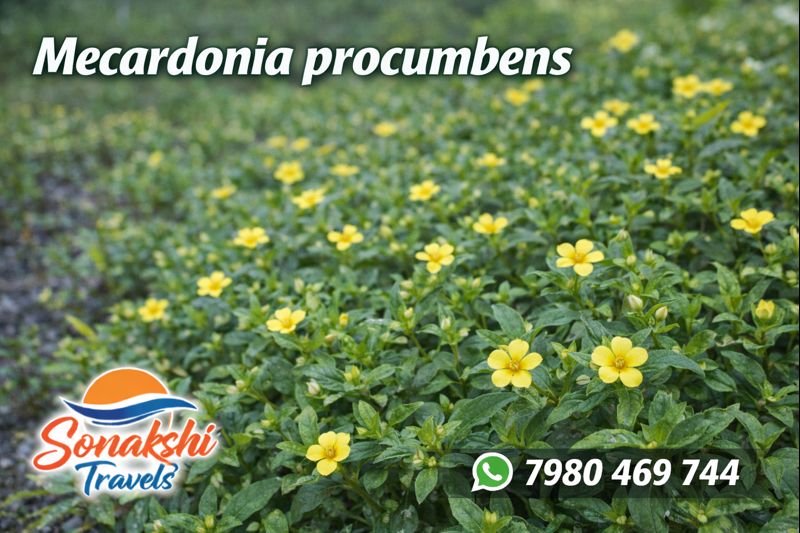
Mecardonia procumbens is a low-growing, creeping perennial herb widely distributed across tropical and subtropical regions. Although small in stature, this species is ecologically significant due to its adaptability, ground-covering habit, and close association with moist and seasonally waterlogged environments. The plant is particularly common in grasslands, wetlands, agricultural margins, and open disturbed habitats, where it plays a quiet yet important role in soil stabilization and ecosystem resilience.
In eastern India and the lower Gangetic delta, including areas surrounding the Sundarbans, Mecardonia procumbens is frequently observed carpeting damp ground during the monsoon and post-monsoon seasons. Its bright yellow flowers, creeping stems, and ability to colonize bare soil make it an easily recognizable component of lowland herbaceous vegetation. This article provides a comprehensive, research-based overview of Mecardonia procumbens, covering its taxonomy, morphology, habitat preferences, global distribution, ecological role, and conservation considerations, with special reference to its occurrence in the Sundarbans region.
Taxonomy & Classification
The taxonomic placement of Mecardonia procumbens reflects its evolutionary adaptation to open, moist habitats and its close relationship with other creeping or low-growing herbs. The genus Mecardonia includes several species adapted to tropical environments, often characterized by prostrate growth and showy yellow flowers.
Kingdom: Plantae
Clade: Angiosperms
Clade: Eudicots
Order: Lamiales
Family: Plantaginaceae
Genus: Mecardonia
Species:Mecardonia procumbens
The species epithet procumbens refers to the plant’s prostrate or trailing growth habit, which allows it to spread horizontally across the ground surface.
Morphology & Field Identification
Growth Habit
Mecardonia procumbens is a perennial or sometimes annual creeping herb with stems that trail along the ground and root at the nodes. The plant typically forms dense mats, rarely exceeding 10 to 15 centimeters in height. This growth form enables rapid colonization of open spaces and provides effective ground cover.
Stem Characteristics
The stems are slender, green, and often slightly pubescent. They spread radially from the central root system and readily produce adventitious roots where nodes come into contact with moist soil. This vegetative propagation greatly enhances the plant’s ability to persist and expand in favorable habitats.
Leaves
Leaves are opposite, simple, and ovate to elliptic in shape, usually measuring 1 to 3 centimeters in length. The margins are entire or slightly toothed, and the leaf surface is smooth to mildly hairy. Leaves are bright green, contributing to the plant’s fresh and vibrant appearance during the growing season.
Flowers and Fruits
One of the most distinctive features of Mecardonia procumbens is its bright yellow, trumpet-shaped flowers. The flowers are solitary, axillary, and borne on slender pedicels. Each flower typically has five rounded lobes and a prominent central throat.
Flowering occurs primarily during the monsoon and post-monsoon months, although sporadic flowering may continue under favorable moisture conditions. The fruit is a small capsule containing numerous tiny seeds, ensuring effective reproduction through seed dispersal.
Habitat & Distribution
Mecardonia procumbens is strongly associated with moist, open habitats. It thrives in environments where periodic water availability and sunlight are abundant.
Typical Habitat Types
Moist grasslands and lawns
Wetland margins and marshy ground
Agricultural field edges
Roadsides and open disturbed areas
The species is particularly successful in habitats that experience seasonal flooding followed by gradual drying.
Global Range
Mecardonia procumbens has a broad distribution across tropical and subtropical regions of the world. It is native to parts of South America but has become widely naturalized in Asia, Africa, and other warm regions.
Today, the species is commonly found across India, Bangladesh, Sri Lanka, Southeast Asia, parts of Africa, and tropical regions of the Americas. Its global spread has been facilitated by its adaptability, rapid growth, and tolerance of disturbed environments.
Preferred Habitat
The plant shows a strong preference for:
Moist to waterlogged soils
Open, sunlit environments
Lowland areas with seasonal rainfall
Soils rich in organic matter
While tolerant of brief dry periods, Mecardonia procumbens performs best in consistently moist conditions.
Curious about wetland plants and delta biodiversity? Explore immersive Sundarban Tour
experiences designed around nature and ecology.
Occurrence
In South Asia, Mecardonia procumbens commonly appears during the rainy season, carpeting moist ground in both rural and semi-urban landscapes. It is frequently seen in paddy field margins, village paths, and open grasslands.
The plant regenerates rapidly through both seed production and vegetative spread, ensuring its annual reappearance in suitable habitats.
Preferred Habitat in the Sundarbans Region
Within the Sundarbans landscape, Mecardonia procumbens is not a true mangrove species but occurs abundantly in freshwater and low-salinity zones adjacent to mangrove forests. Typical habitats include:
Village grasslands and open courtyards
Freshwater embankments and canal banks
Seasonally flooded clearings
Buffer zones between agriculture and mangroves
Its presence highlights the transitional nature of Sundarbans ecology, where terrestrial, freshwater, and mangrove systems intersect.
Ecological Role
Ground Cover and Soil Protection
By forming dense mats, Mecardonia procumbens helps protect soil from erosion, particularly during heavy rainfall and flooding.
Support for Pollinators
The bright yellow flowers attract small insects, including bees and flies, contributing to local pollination networks.
Early Successional Species
The plant acts as an early colonizer of disturbed ground, facilitating ecological succession and habitat recovery.
Habitat Alteration
Despite its adaptability, Mecardonia procumbens is influenced by changes in land use and hydrology, including:
Drainage of wetlands
Urbanization and land reclamation
Excessive trampling or grazing
Altered rainfall patterns
Such changes may reduce suitable habitats in certain areas while creating new opportunities in others.
Conservation Efforts
Mecardonia procumbens is not considered threatened due to its wide distribution and ecological resilience. Conservation focus is therefore indirect, emphasizing:
Protection of wetlands and grasslands
Sustainable land-use practices
Maintenance of freshwater ecosystems
Preserving such common but ecologically important species supports broader ecosystem health.
Did You Know?
Mecardonia procumbens produces bright yellow flowers that open fully in sunlight.
The plant can root at stem nodes, enabling rapid spread.
It is often used as an ornamental ground cover in warm climates.
The species is highly tolerant of seasonal flooding.
External Reference
For general botanical information and taxonomic background, readers may consult: