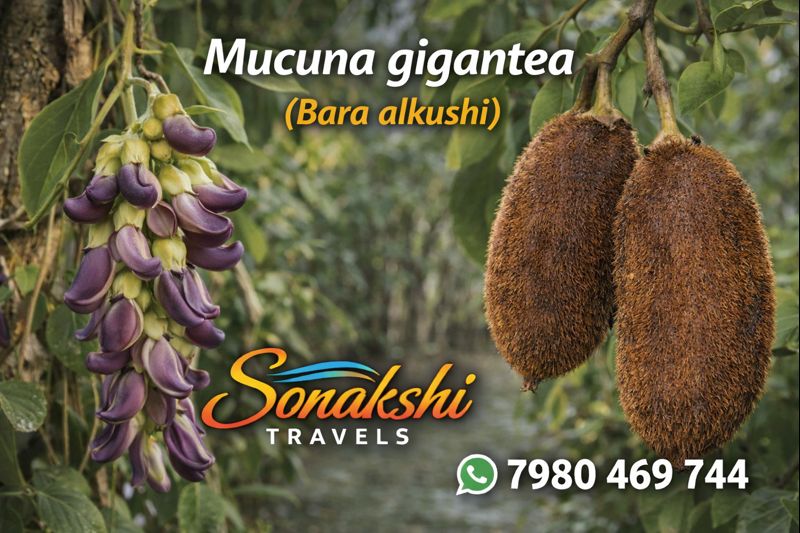
Mucuna gigantea, locally known as Bara Alkushi, is a robust, woody climber belonging to the legume family and is widely recognized for its vigorous growth, ecological resilience, and striking floral display. This species is an important component of tropical coastal forests, riverine thickets, and mangrove-associated landscapes. In the Sundarbans region, Mucuna gigantea plays a significant ecological role by binding vegetation layers, enriching soil nutrients, and supporting wildlife through shelter and food resources.
As a member of the Fabaceae family, Mucuna gigantea exhibits classic leguminous traits such as nitrogen fixation and pod-based reproduction. Its massive vines often dominate forest edges and tidal creek margins, where it thrives under high humidity and seasonal flooding. This article provides a comprehensive, research-based exploration of the species, focusing on its taxonomy, morphology, habitat preferences, ecological functions, conservation considerations, and its specific relevance within the Sundarbans ecosystem.
Taxonomy & Classification
Systematic Position
Mucuna gigantea is classified within the Fabaceae family, one of the most ecologically significant plant families due to its symbiotic relationship with nitrogen-fixing bacteria. The accepted taxonomic hierarchy of the species is outlined below:
Kingdom: Plantae
Clade: Angiosperms
Clade: Eudicots
Order: Fabales
Family: Fabaceae
Subfamily: Faboideae
Genus: Mucuna
Species: Mucuna gigantea (Willd.) DC.
The genus Mucuna comprises several climbing species distributed across tropical regions, many of which are known for their medicinal and ecological importance. Mucuna gigantea is distinguished by its exceptionally large growth form, woody stems, and thick, bristly pods.
Morphology & Field Identification
Growth Habit and Stem
Mucuna gigantea is a massive perennial climber with woody, rope-like stems that can extend several tens of meters, often forming dense tangles over trees and shrubs. The stems are thick, cylindrical, and capable of supporting considerable biomass. Older stems become lignified and highly durable, allowing the plant to persist for many years.
Leaves
Leaves are large, trifoliate, and alternately arranged along the stem. Each leaflet is ovate to elliptic with an entire margin and a pointed apex. The leaf surface is smooth to slightly pubescent, dark green above and paler beneath. The broad leaf area aids in efficient photosynthesis in partially shaded forest environments.
Flowers
The flowers of Mucuna gigantea are showy and borne in long, pendulous racemes. They are typically purplish to dark violet in color and possess the characteristic papilionaceous structure of legumes. Flowering often occurs seasonally and attracts a range of pollinators, including large insects and birds.
Fruits and Seeds
The fruit is a large, woody pod densely covered with stiff, irritating hairs. Each pod contains several hard seeds that are rich in bioactive compounds. The bristly surface acts as a deterrent to herbivores, ensuring seed protection until dispersal.
Habitat & Distribution
Ecological Preferences
Mucuna gigantea thrives in humid tropical environments and is commonly found along forest margins, riverbanks, estuarine thickets, and mangrove fringes. It prefers areas with high rainfall, warm temperatures, and access to structural support for climbing.
Global Range
Geographical Distribution
The species is widely distributed across South Asia, Southeast Asia, northern Australia, and parts of the Pacific Islands. Its natural range includes India, Bangladesh, Sri Lanka, Myanmar, Thailand, Malaysia, Indonesia, and Papua New Guinea. The broad distribution reflects its adaptability to diverse tropical coastal environments.
Preferred Habitat
Environmental Conditions
Mucuna gigantea prefers moist, well-drained soils rich in organic matter. It tolerates periodic flooding and mild salinity, making it particularly well suited to estuarine and mangrove-adjacent habitats. Partial sunlight combined with high humidity provides optimal growth conditions.
Climbing plants like Bara Alkushi are best observed within intact mangrove landscapes. Explore immersive Sundarban Tour experiences focused on native flora and forest ecology.
Occurrence
Population Pattern
Mucuna gigantea typically occurs as scattered but locally abundant populations, often forming dense vegetative masses in suitable habitats. Its aggressive climbing habit allows it to dominate forest edges and gaps created by natural disturbances.
Preferred Habitat in the Sundarbans Region
Regional Distribution
In the Sundarbans, Mucuna gigantea is commonly found along tidal creek margins, embankments, and transitional zones between true mangrove forests and terrestrial vegetation. These areas experience seasonal flooding, nutrient-rich sediments, and moderate salinity, conditions well suited to the species.
Ecological Role
Ecosystem Functions
As a nitrogen-fixing legume, Mucuna gigantea contributes significantly to soil fertility and nutrient cycling. Its dense foliage provides shelter and nesting opportunities for birds and small mammals. The plant also stabilizes soil and reduces erosion along riverbanks and estuarine margins.
Habitat Alteration
Environmental Pressures
Habitat alteration through deforestation, embankment construction, and changes in tidal flow patterns can impact the natural growth of Mucuna gigantea. While the species is resilient, excessive habitat fragmentation may reduce its long-term ecological contribution.
Conservation Efforts
Management and Sustainability
Currently, Mucuna gigantea is not considered threatened. Conservation efforts focus on maintaining intact mangrove and coastal forest systems, ensuring that natural hydrological processes remain undisturbed. Sustainable forest management indirectly supports the persistence of this species.
Experience the diversity of climbers and mangrove vegetation through a guided Sundarban Tour designed around ecology, conservation, and local biodiversity.
Did You Know?
Interesting Facts
The pods of Mucuna gigantea are covered with hairs that can cause intense skin irritation.
The plant can form living bridges across small creeks through its extensive vines.
As a legume, it enriches poor soils by fixing atmospheric nitrogen.
The species plays a key role in binding forest canopy layers in coastal ecosystems.