Botanical Characteristics, Ecological Importance, and Regional Significance
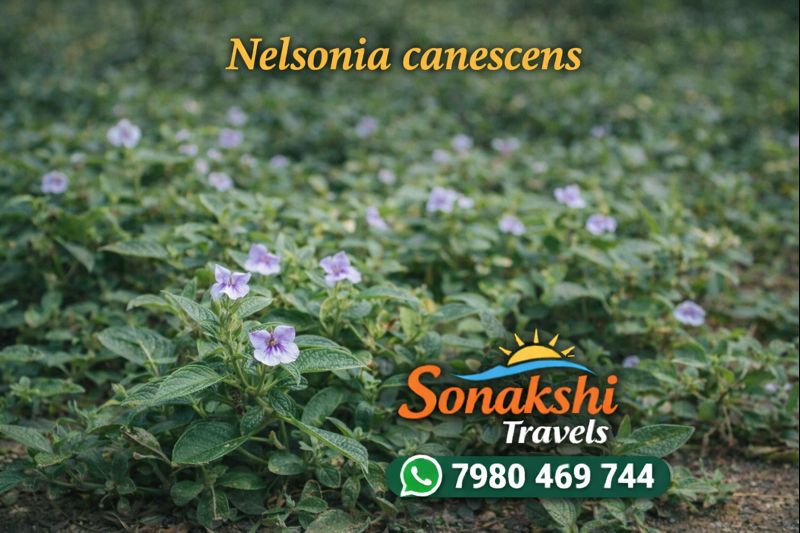
Nelsonia canescens is a low-growing, perennial herbaceous plant belonging to the family Acanthaceae. Often overlooked due to its modest stature, this species plays a subtle yet important role in tropical and subtropical ecosystems. Characterized by its spreading habit, soft pubescence, and pale lavender to bluish flowers, Nelsonia canescens is widely distributed across open grasslands, forest edges, and disturbed habitats.
In eastern India and the lower Gangetic delta, including areas surrounding the Sundarbans, Nelsonia canescens frequently occurs in semi-natural landscapes influenced by seasonal rainfall and human activity. Its ability to colonize open ground, tolerate trampling, and survive fluctuating moisture levels makes it a resilient component of ground-layer vegetation. This article provides a comprehensive, research-based examination of Nelsonia canescens, focusing on its taxonomy, morphology, habitat preferences, ecological role, and relevance to the Sundarbans region.
Taxonomy & Classification
The taxonomic identity of Nelsonia canescens reflects its evolutionary adaptation within a family known for flowering herbs and shrubs adapted to warm climates.
Kingdom: Plantae
Clade: Angiosperms
Clade: Eudicots
Order: Lamiales
Family: Acanthaceae
Genus: Nelsonia
Species:Nelsonia canescens (Lam.) Spreng.
The genus Nelsonia includes herbaceous species adapted to open habitats, many of which exhibit rapid growth and efficient reproductive strategies suited to disturbed environments.
Morphology & Field Identification
Growth Habit
Nelsonia canescens is a creeping to prostrate perennial herb, often forming dense mats across the soil surface. Stems are slender, branching, and spread horizontally, rooting at nodes when in contact with moist soil. This growth form enables rapid lateral expansion and ground coverage.
Stem and Surface Texture
The stems are soft, green to pale brown, and densely covered with fine hairs, giving the plant a slightly greyish or silvery appearance. This pubescence reduces water loss and offers protection against excessive sunlight and grazing pressure.
Leaves
Leaves are opposite, ovate to elliptic, and typically measure 3–7 cm in length. The leaf surface is softly pubescent on both sides, with entire margins and a distinct midrib. The petioles are short, allowing the leaves to lie close to the ground.
Flowers
Flowers are solitary or borne in small clusters in leaf axils. They are tubular, pale lavender to bluish-violet in color, with a slightly expanded limb. Flowering occurs mainly during the monsoon and post-monsoon periods, when moisture availability is high.
Fruits and Seeds
The fruit is a small, oblong capsule containing several minute seeds. Upon maturity, the capsule dehisces to release seeds into the surrounding environment, enabling short-distance dispersal.
Habitat & Distribution
Global Range
Nelsonia canescens is widely distributed across tropical and subtropical regions. Its natural range includes:
Indian subcontinent
Southeast Asia
Parts of Africa
Tropical regions of the Old World
The species has spread primarily through natural dispersal and habitat disturbance rather than intentional cultivation.
Preferred Habitat
The plant prefers open, sunlit to partially shaded habitats with moderate soil moisture. It thrives in grasslands, roadsides, forest margins, fallow fields, and riverbanks. While it favors loamy and sandy soils, it can tolerate compacted and nutrient-poor substrates.
Occurrence
In eastern India, Nelsonia canescens is commonly encountered along village pathways, agricultural field edges, grazing grounds, and low-lying areas that experience seasonal moisture. Its presence often indicates early to mid-stage ecological succession.
Preferred Habitat in the Sundarbans Region
Within the Sundarbans landscape, Nelsonia canescens does not occur in core mangrove forests dominated by saline conditions. Instead, it is found in:
Village outskirts and homestead surroundings
Embankment slopes and pathways
Freshwater-influenced islands
Transition zones between mangrove forests and agricultural land
Its tolerance of high humidity, seasonal rainfall, and mild waterlogging allows it to persist in deltaic environments where soil salinity remains low.
Understanding ground-layer vegetation reveals the subtle dynamics of deltaic ecosystems. Experience these living landscapes through a guided Sundarban Tour
that connects ecology with everyday rural life.
Ecological Role
Nelsonia canescens functions as an important ground-cover species. Its creeping growth habit helps stabilize soil, reduce erosion, and retain surface moisture. The plant provides shelter for small insects and microfauna, contributing to local biodiversity.
During flowering, it serves as a nectar source for small pollinating insects, supporting trophic interactions at the lower levels of the ecosystem.
Habitat Alteration
Habitat alteration through road construction, agricultural intensification, and urban expansion affects populations of Nelsonia canescens. However, the species often benefits from moderate disturbance, allowing it to recolonize exposed soils rapidly.
Conservation Efforts
Nelsonia canescens is not considered threatened due to its wide distribution and adaptability. Conservation considerations focus on maintaining habitat heterogeneity and minimizing excessive chemical use in agricultural landscapes that may affect ground flora.
Observe how small herbaceous plants contribute to deltaic resilience through an immersive Sundarban Tour
designed for deeper ecological awareness.
Did You Know?
Nelsonia canescens spreads efficiently by rooting at stem nodes.
The plant’s fine hairs help reduce water loss in exposed habitats.
It is often one of the first species to colonize open ground after disturbance.