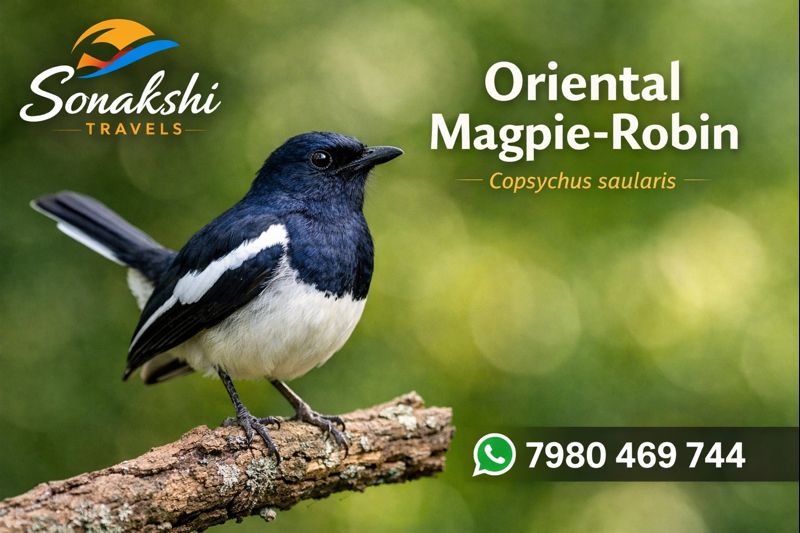
The Oriental Magpie-Robin (Copsychus saularis) is one of the most familiar and culturally significant songbirds of South and Southeast Asia. Revered for its melodious and complex vocalizations, striking black-and-white plumage, and close association with human settlements, this species occupies a unique position at the intersection of natural ecosystems and human-modified landscapes. As the national bird of Bangladesh and a celebrated garden bird across the Indian subcontinent, the Oriental Magpie-Robin is both an ecological indicator and a symbol of avian resilience.
Taxonomy & Classification
Systematic Position
The Oriental Magpie-Robin belongs to the order Passeriformes and the family Muscicapidae, which includes Old World flycatchers and chats. Historically, this species was placed within the thrush family, but advances in molecular phylogenetics have clarified its closer evolutionary relationship with flycatchers.
The Oriental Magpie-Robin is a small to medium-sized passerine with a compact body, upright stance, and relatively long tail often held cocked upward. Its contrasting black-and-white coloration makes it easily recognizable even at a distance, while its confident movements and frequent tail flicking further aid field identification.
Male Features
Adult males display glossy black plumage on the head, upperparts, throat, and breast, contrasted sharply with a white belly, wing patches, and outer tail feathers. The bill and eyes are dark, enhancing the bold facial contrast. Males are highly vocal, producing rich, varied songs composed of whistles, trills, and mimicry.
Female Features
Females are comparatively duller, with greyish-black upperparts and a lighter grey to buff underside. The wing patches remain white but less prominent. Females sing less frequently, though they are capable of producing soft calls and simple song phrases.
Size & Wingspan
The Oriental Magpie-Robin measures approximately 19 to 21 centimeters in length. The wingspan ranges from 28 to 34 centimeters, supporting agile short-distance flight rather than long migratory journeys.
Flight Characteristics
Flight is typically low, direct, and fluttering, with short bursts between perches. The species spends more time hopping and running on the ground than flying, reflecting its adaptation to terrestrial foraging.
Habitat & Distribution
Global Range
The Oriental Magpie-Robin is widely distributed across the Indian subcontinent, Sri Lanka, Bangladesh, Nepal, Bhutan, Myanmar, Thailand, southern China, and parts of Southeast Asia. Introduced populations also exist in regions beyond its native range.
Preferred Habitat
This species thrives in open woodland, gardens, agricultural fields, village groves, forest edges, and urban parks. Its tolerance of human presence has enabled it to flourish in semi-urban and rural environments alike.
Diet & Feeding Ecology
Diet Composition
The Oriental Magpie-Robin is primarily insectivorous, feeding on ants, beetles, grasshoppers, caterpillars, spiders, and other invertebrates. It may also consume small fruits, seeds, and nectar opportunistically.
Foraging Technique
Foraging occurs mainly on the ground, where the bird hops briskly, scanning leaf litter and soil surfaces for prey. It frequently pauses to listen for insect movement before making quick, precise strikes.
Breeding & Reproduction
Breeding Season
The breeding season generally spans from March to July, coinciding with warmer temperatures and increased insect abundance. During this period, males become intensely territorial and vocal.
Nesting Sites
Nests are constructed in cavities, tree hollows, crevices in walls, abandoned containers, or dense shrubs. The nest cup is built from grass, leaves, rootlets, and fine fibers, providing insulation and concealment.
Unique Adaptations & Behavioral Ecology
Speed & Agility
Although not a long-distance flier, the Oriental Magpie-Robin exhibits exceptional agility on the ground. Rapid hops, sudden turns, and precise lunges allow it to capture fast-moving prey efficiently.
Camouflage and Nesting Strategy
Female plumage coloration offers enhanced camouflage during incubation, blending with shaded nesting environments. Nest placement in cavities further reduces exposure to predators and environmental extremes.
Social Behavior
This species is largely solitary or found in pairs, particularly during the breeding season. Strong territorial instincts drive aggressive defense against intruders, including much larger birds.
Occurrence & Seasonal Movement
The Oriental Magpie-Robin is predominantly resident throughout its range. Local movements may occur in response to rainfall patterns and food availability, but true migration is absent.
Preferred Habitat in the Sundarbans Region
In the Sundarbans, the species is commonly observed along village edges, elevated mangrove margins, forest clearings, and human habitations. It favors areas with open ground for foraging and nearby vegetation for nesting.
Planning a nature-rich mangrove journey? Discover curated itineraries through our Sundarban Tour experiences and explore biodiversity responsibly.
Ecological Role
The Oriental Magpie-Robin contributes significantly to controlling insect populations, particularly in agricultural and garden ecosystems. Its presence reflects ecological balance and healthy invertebrate diversity.
Habitat Alteration
Urban expansion, pesticide use, and loss of nesting cavities can negatively affect local populations. However, the species’ adaptability has allowed it to persist in many altered landscapes.
Conservation Efforts
Currently classified as Least Concern, conservation emphasis focuses on habitat protection, reduction of chemical pesticide use, and preservation of nesting sites within both rural and urban settings.
Planning a guided mangrove escape? Browse thoughtfully designed Sundarban Tour programs and choose an itinerary aligned with your travel goals.
Did You Know?
The Oriental Magpie-Robin is renowned for its ability to mimic a wide range of sounds, including other bird calls and environmental noises, making it one of the most accomplished songsters in Asia.