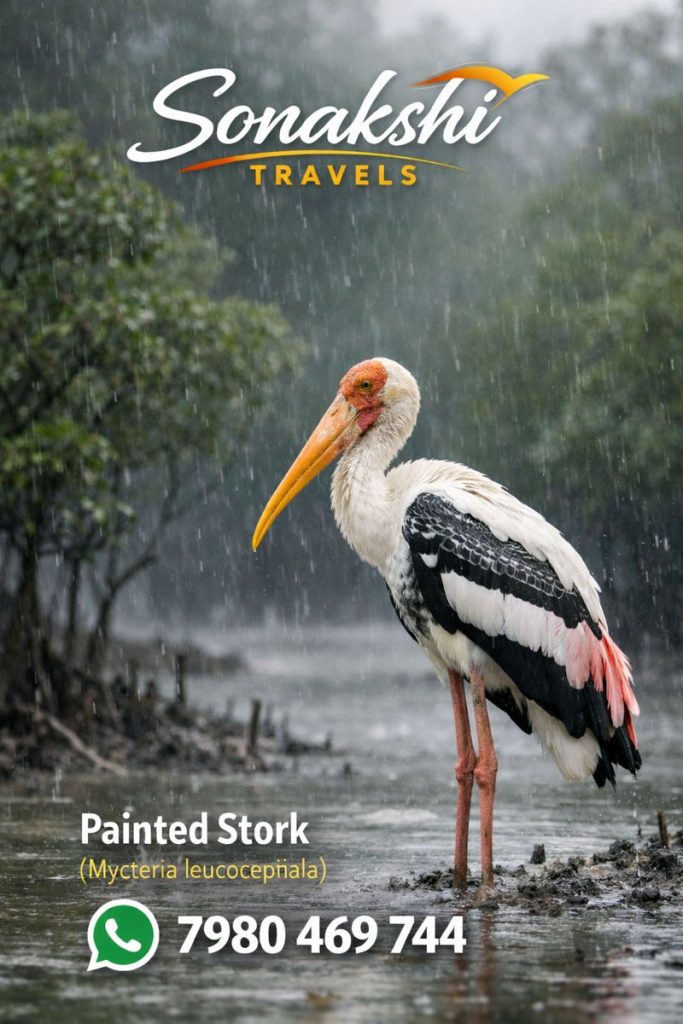
The Painted Stork (Mycteria leucocephala) is one of South Asia’s most iconic large waterbirds, instantly recognizable by its striking plumage, massive stature, and elegant foraging behavior. Frequently associated with wetlands, floodplains, and estuarine systems, this species represents the ecological richness of tropical and subtropical aquatic landscapes. In the Sundarbans, the Painted Stork is both a seasonal visitor and a symbol of healthy wetland ecosystems. This comprehensive article explores the species in depth, covering its taxonomy, morphology, behavior, ecology, and conservation concerns, with particular emphasis on its presence in the Sundarbans region.
Taxonomy & Classification
The Painted Stork belongs to the family Ciconiidae, which includes all true storks. Within this family, the genus Mycteria comprises several large stork species distributed across different continents. Mycteria leucocephala is the only member of the genus native to South and Southeast Asia.
Taxonomically, the Painted Stork is closely related to species such as the Yellow-billed Stork and Wood Stork. These species share similar feeding strategies and morphological traits, reflecting a common evolutionary adaptation to shallow-water foraging in warm climates.
Morphology & Field Identification
The Painted Stork is a large, long-legged bird with a predominantly white body contrasted by bold black flight feathers. Adults display a vividly patterned head and upper neck with bare yellowish-orange skin, giving the bird its “painted” appearance. The long, slightly curved bill is yellow with a darker tip, well suited for tactile feeding.
In the field, the species is easily identified by its size, distinctive coloration, and slow, deliberate movements in shallow water. When perched or feeding, the bird’s upright posture and elongated neck further enhance its imposing presence.
Male Features
Male Painted Storks are marginally larger and heavier than females, though sexual dimorphism is subtle. During the breeding season, males may exhibit brighter facial coloration and more pronounced courtship behavior, including bill clattering and display postures.
Female Features
Females closely resemble males in plumage and structure. They are typically slightly smaller, with less intense facial coloration during the breeding period. Distinguishing between sexes in the field often requires careful observation or behavioral cues.
Size & Wingspan
The Painted Stork stands approximately 93 to 102 cm tall, with a wingspan ranging from 150 to 160 cm. Adults typically weigh between 2 and 3.5 kilograms. These dimensions make it one of the largest wading birds commonly observed in the Indian subcontinent.
Flight Characteristics
In flight, the Painted Stork is a majestic sight, soaring effortlessly on broad wings. Like other storks, it flies with its neck fully extended and legs trailing behind. Slow, powerful wingbeats are interspersed with gliding, especially when exploiting thermal currents during long-distance movements.
Habitat & Distribution
Global Range
The Painted Stork is primarily distributed across South Asia, including India, Sri Lanka, Nepal, Bangladesh, and parts of Southeast Asia. Its range is closely tied to the availability of wetlands, and populations are concentrated in regions with extensive river systems and floodplains.
Preferred Habitat
This species favors shallow freshwater wetlands, including lakes, marshes, flooded agricultural fields, and riverine sandbars. It is also frequently observed in estuarine environments where freshwater mixes with tidal influences, provided prey availability is sufficient.
Diet & Feeding Ecology
The Painted Stork is a carnivorous feeder, relying mainly on fish as its primary food source. Its diet also includes amphibians, crustaceans, aquatic insects, and occasionally small reptiles. Feeding efficiency is closely linked to water depth and prey density.
Foraging Technique
The species employs a tactile foraging strategy, walking slowly through shallow water with its bill partially submerged and open. When prey comes into contact with the sensitive inner surface of the bill, it snaps shut instantly. This method allows effective feeding even in turbid or low-visibility conditions.
Breeding & Reproduction
Breeding typically coincides with the monsoon season, when wetlands expand and food resources become abundant. Painted Storks are colonial breeders, often nesting in large groups alongside other waterbirds.
Nesting Sites
Nests are usually built high in trees near water bodies, constructed from sticks and lined with softer materials. Clutches generally consist of two to five eggs. Both parents share incubation duties and participate in feeding and protecting the chicks.
Unique Adaptations & Behavioral Ecology
Speed & Agility
While not fast-moving on land, the Painted Stork demonstrates remarkable precision and coordination while foraging. Its slow, measured steps minimize water disturbance, enhancing prey detection.
Camouflage and Nesting Strategy
Despite its conspicuous coloration, the species benefits from nesting in tall trees and dense colonies. Elevated nesting sites reduce predation risk, while group nesting increases collective vigilance.
Social Behavior
Painted Storks are highly social, especially outside the breeding season. They often forage in loose groups and roost communally, benefiting from shared information about food availability and predator threats.
Occurrence & Seasonal Movement
The species exhibits partial migratory behavior. While many populations are resident, others undertake seasonal movements in response to changing water levels and food availability. These movements are typically regional rather than long-distance migrations.
Preferred Habitat in the Sundarbans Region
In the Sundarbans, Painted Storks are most commonly observed along tidal creeks, mudflats, and shallow estuarine waters. The dynamic mangrove ecosystem provides abundant prey and relatively undisturbed roosting sites, making it an important seasonal habitat.
Interested in exploring mangrove waterways rich in birdlife? Discover curated Sundarban Tour experiences designed for nature enthusiasts.
Ecological Role
As a top wetland predator, the Painted Stork plays a vital role in regulating fish populations and maintaining ecological balance. Its presence is often considered an indicator of wetland health and productivity.
Habitat Alteration
Wetland drainage, pollution, altered river flows, and human disturbance pose serious threats to Painted Stork habitats. Loss of nesting trees and degradation of feeding grounds can significantly impact local populations.
Conservation Efforts
Although currently classified as Near Threatened in parts of its range, conservation initiatives focus on wetland protection, safeguarding breeding colonies, and raising awareness about the importance of large waterbirds in ecosystem functioning.
Experience the living wetlands of the delta responsibly through immersive Sundarban Tour itineraries crafted around ecology and conservation.
Did You Know?
Painted Storks can feed efficiently even in muddy waters using tactile sensing.
Large breeding colonies may contain hundreds of nests in a single tree cluster.
The species often shares nesting sites with pelicans and herons.