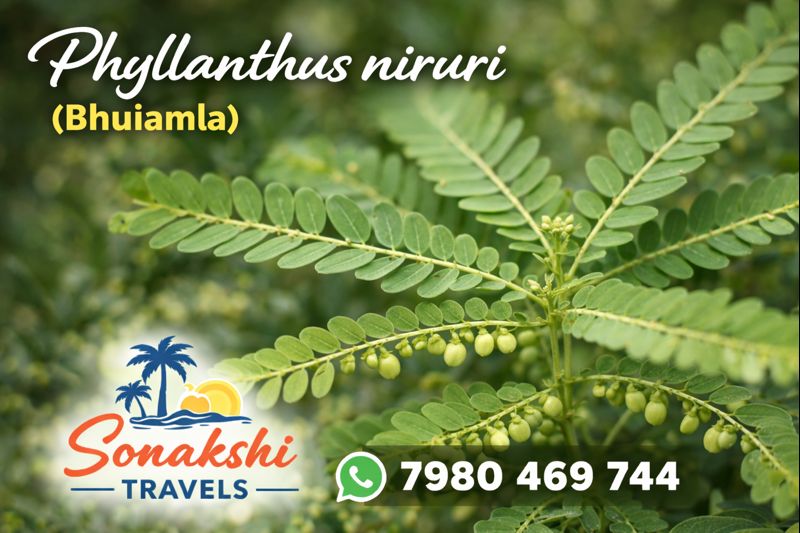
Phyllanthus niruri, widely known in the Indian subcontinent as Bhuiamla, is a small yet biologically powerful herb belonging to the family Phyllanthaceae. Despite its modest stature, this plant holds exceptional ecological, medicinal, and botanical significance across tropical and subtropical regions. Often found growing close to the ground in open landscapes, agricultural margins, and forest fringes, Phyllanthus niruri is renowned for its resilience, rapid life cycle, and remarkable adaptability to disturbed habitats.
The species has attracted considerable attention due to its long-standing role in traditional medicinal systems and its capacity to thrive in diverse environmental conditions. From an ecological perspective, Phyllanthus niruri contributes to soil stabilization, microhabitat formation, and early-stage vegetation succession. In sensitive regions such as the Sundarbans, where land, water, and salinity gradients constantly shift, this herb plays a subtle but meaningful role in maintaining ecological balance.
Taxonomy & Classification
Systematic Position
Phyllanthus niruri is classified under the family Phyllanthaceae, a group of plants characterized by simple leaves, small unisexual flowers, and capsule-type fruits. The genus Phyllanthus is one of the largest within the family, comprising herbs, shrubs, and trees distributed mainly in tropical regions.
Taxonomically, the species is distinguished by its characteristic phyllanthoid branching pattern, in which leaves and flowers appear arranged on flattened branchlets, often mistaken for compound leaves. This feature aids in efficient photosynthesis and reproductive success.
Morphology & Field Identification
Growth Habit
Phyllanthus niruri is an annual, erect or spreading herb, typically growing between 20 and 60 centimeters in height. The plant has a slender, green to reddish stem that branches profusely at the base, forming a compact yet delicate structure.
Leaves
Leaves are small, simple, and elliptic to oblong in shape, arranged alternately along flattened lateral branchlets. They are light green, thin-textured, and measure only a few millimeters in length. This leaf arrangement gives the plant a feathery appearance and allows maximum light interception.
Flowers
The flowers are minute, unisexual, and greenish-white, borne singly in the leaf axils. Male and female flowers occur on the same plant. Although inconspicuous, the flowers are efficiently adapted for pollination by small insects.
Fruits and Seeds
The fruit is a small, smooth, globose capsule containing several tiny seeds. Fruits develop beneath the leaves, a distinctive feature that helps in field identification. The seeds are dispersed primarily by gravity, surface water movement, and soil disturbance.
Habitat & Distribution
General Habitat Preferences
Phyllanthus niruri thrives in warm, humid climates and is commonly found in open areas such as grasslands, agricultural fields, roadside verges, forest clearings, and riverbanks. The species shows a strong preference for disturbed soils, where competition from larger plants is reduced.
Soil and Moisture Conditions
The plant grows well in a variety of soil types, including sandy, loamy, and clayey substrates. It tolerates moderate moisture stress and temporary waterlogging, making it well-suited to monsoon-driven ecosystems.
Global Range
Phyllanthus niruri has a broad pantropical distribution. It is native to the Indian subcontinent and Southeast Asia but is also widely found in Africa, Central and South America, the Caribbean, and parts of Australia. Its global spread is facilitated by its short life cycle, prolific seed production, and adaptability to human-modified landscapes.
In many regions, the species has become naturalized and is considered a characteristic component of tropical herbaceous flora.
Preferred Habitat
The preferred habitat of Phyllanthus niruri includes open, sunlit areas with periodic soil disturbance. Field margins, seasonal floodplains, and lightly shaded forest edges provide optimal conditions for growth, flowering, and seed production.
Occurrence
Phyllanthus niruri typically occurs in scattered populations rather than dense stands. Its presence is often seasonal, with peak abundance during and immediately after the monsoon. The species completes its life cycle rapidly, ensuring successful reproduction before environmental conditions become unfavorable.
Preferred Habitat in the Sundarbans Region
In the Sundarbans, Phyllanthus niruri is primarily found in village outskirts, embankments, agricultural fringes, and freshwater-influenced islands. These areas experience lower salinity levels compared to core mangrove zones. Periodic flooding deposits nutrient-rich silt, creating favorable conditions for germination and growth.
Experience these unique transitional ecosystems through thoughtfully planned itineraries in our Sundarban Tour Package selections.
Ecological Role
Soil Health and Succession
Phyllanthus niruri plays an important role in early-stage ecological succession. By rapidly colonizing bare or disturbed soil, it helps stabilize the surface and reduce erosion. Its organic matter contributes to soil structure and nutrient availability.
Biodiversity Support
The plant provides microhabitats for insects and supports small pollinators. Its presence enhances local biodiversity, particularly in agro-ecological landscapes and forest-edge environments.
Habitat Alteration
Habitat alteration through intensive agriculture, excessive use of herbicides, and urban expansion can negatively affect populations of Phyllanthus niruri. While the species tolerates moderate disturbance, extreme soil modification and chemical exposure reduce its regenerative capacity.
Conservation Efforts
Phyllanthus niruri is not currently classified as threatened due to its wide distribution and adaptability. However, conservation of semi-natural habitats, sustainable farming practices, and preservation of freshwater regimes are essential for maintaining healthy populations, especially in ecologically sensitive regions.
For deeper ecological insight with privacy and expert guidance, explore our curated Sundarban Private Tour experiences.
Did You Know?
Phyllanthus niruri completes its life cycle within a few months.
The plant’s flowers and fruits grow beneath the leaves, a unique identifying feature.
It is one of the most widely distributed medicinal herbs in tropical regions.
The species is often among the first plants to appear after monsoon rains.