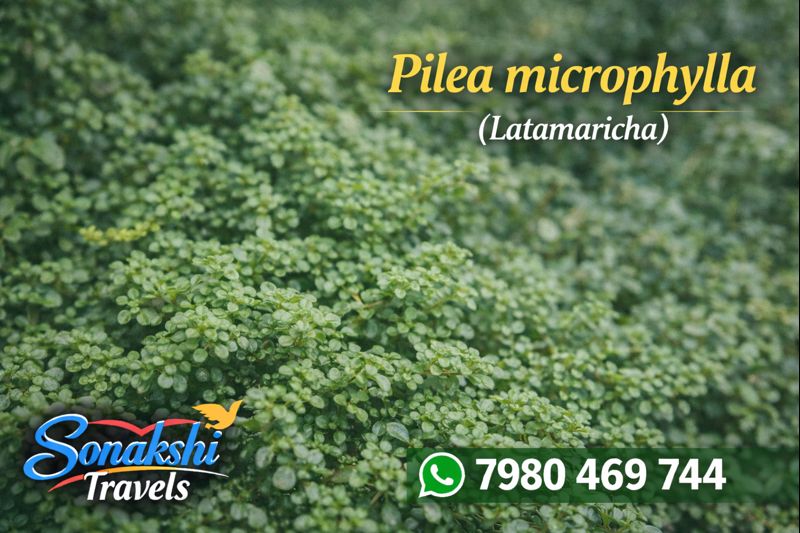
Pilea microphylla, commonly known in several parts of eastern India and Bengal as Latamaricha, is a small, delicate herbaceous plant that often goes unnoticed due to its minute leaves and compact growth habit. Despite its modest appearance, this species holds considerable ecological importance, particularly in moist tropical environments where it acts as a pioneer ground-cover plant. Belonging to the nettle family, this plant exhibits remarkable adaptability, thriving in shaded crevices, damp soils, and disturbed habitats.
Widely distributed across tropical and subtropical regions, Pilea microphylla is especially common in gardens, forest margins, stone walls, embankments, and old masonry structures. In deltaic landscapes such as the Sundarbans periphery, Latamaricha contributes to soil binding, microhabitat formation, and moisture retention. This comprehensive article presents an in-depth, research-based examination of the species, focusing on its taxonomy, morphology, habitat preferences, distribution, ecological role, and conservation relevance.
Taxonomy & Classification
Systematic Placement
Pilea microphylla belongs to the family Urticaceae, a diverse plant family that includes herbs, shrubs, and trees, many of which are adapted to moist and shaded environments. Unlike many members of this family, Pilea species are non-stinging and are characterized by their soft tissues and minute floral structures.
The species epithet microphylla translates to “small-leaved,” accurately describing one of its most distinctive morphological features.
Morphology & Field Identification
Growth Habit
Pilea microphylla is a low-growing, creeping to ascending perennial herb that typically forms dense mats. The plant often spreads horizontally, covering soil surfaces, rock faces, and shaded ground with a fine-textured green carpet.
Stem Characteristics
Stems are slender, succulent, and highly branched. They are pale green to light brown and often translucent, breaking easily when disturbed. Nodes are closely spaced, contributing to the compact growth form.
Leaf Structure
Leaves are extremely small, opposite, and ovate to elliptic in shape, usually measuring only 1–3 mm in length. The leaf surface is smooth and bright green, giving the plant a moss-like appearance from a distance.
Flowers and Inflorescence
The flowers are minute, greenish, and borne in tiny axillary clusters. They lack showy petals and are often overlooked without close examination. The species exhibits explosive pollen release, a characteristic mechanism aiding pollination.
Fruits and Seeds
The fruit is a small achene containing a single seed. Seed dispersal is facilitated by the plant’s unique floral mechanism, which can eject pollen and seeds over short distances.
Habitat & Distribution
Natural Habitat
Pilea microphylla thrives in moist, shaded environments. It is commonly found along forest floors, shaded pathways, damp walls, stone crevices, garden beds, and roadside embankments. The species shows a strong preference for humid microclimates.
Altitude Range
The plant occurs from sea level up to approximately 1,200 meters, demonstrating wide ecological amplitude across lowland and mid-elevation habitats.
Global Range
Geographical Distribution
Pilea microphylla has a pantropical distribution. It is native to tropical regions of the Americas but has become widely naturalized across Asia, Africa, and the Pacific due to its adaptability and rapid growth.
Distribution in South Asia
In the Indian subcontinent, Latamaricha is widespread across moist regions, including West Bengal, Assam, Odisha, Kerala, Tamil Nadu, and the northeastern states.
Preferred Habitat
Soil and Substrate Preferences
The species favors loose, well-drained soils rich in organic matter. It also grows readily on non-soil substrates such as brickwork, stone walls, and concrete cracks where moisture is retained.
Light and Moisture Requirements
Partial shade to full shade is ideal for optimal growth. The plant requires consistent moisture but can tolerate short dry spells once established.
Occurrence
Seasonal Growth Pattern
Growth is most vigorous during the monsoon and post-monsoon seasons. In warm, humid climates, the plant may persist year-round with continuous vegetative growth.
Preferred Habitat in the Sundarbans Region
Local Distribution
In the Sundarbans region, Pilea microphylla is typically found in freshwater-influenced village zones, shaded embankments, canal edges, and homestead gardens. It does not occur within core mangrove forests but thrives in low-salinity transitional habitats.
Adaptation to Deltaic Conditions
The plant’s tolerance to high humidity, fluctuating moisture, and mild salinity makes it well suited to the Sundarbans’ peripheral landscapes.
Observing subtle ground-cover plants adds ecological depth to any guided Sundarban Tour, where even the smallest species shape the landscape.
Ecological Role
Soil Stabilization
Pilea microphylla plays a significant role in binding loose soil and preventing erosion, especially on slopes, embankments, and disturbed ground.
Microhabitat Formation
Dense mats of this plant create favorable microhabitats for small invertebrates, microorganisms, and soil fauna, contributing to local biodiversity.
Habitat Alteration
Human-Induced Changes
Urbanization, excessive use of herbicides, and removal of shaded microhabitats can reduce local populations. However, the species often recolonizes disturbed areas rapidly.
Environmental Resilience
Its ability to grow in minimal soil and artificial substrates makes it resilient to moderate habitat alteration.
Conservation Efforts
Conservation Status
Pilea microphylla is not considered threatened due to its wide distribution and adaptability.
Habitat-Friendly Practices
Preserving shaded, moist environments and minimizing chemical usage help maintain healthy populations of this species.
Learning how ground-layer plants support larger ecosystems enriches a nature-focused Sundarban Tour,
revealing hidden layers of biodiversity.
Did You Know?
Explosive Pollination
Pilea microphylla uses a rapid stamen movement to release pollen explosively, an unusual adaptation among small herbs.
Often Mistaken for Moss
Due to its minute leaves and dense growth, the plant is frequently mistaken for moss by casual observers.
External Reference
For further botanical details, consult the Wikipedia page on Pilea microphylla.