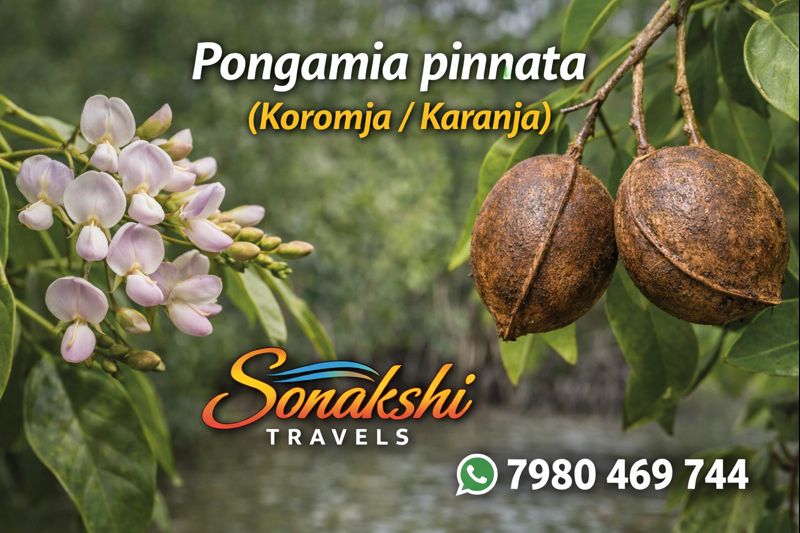
Botanical Characteristics, Ecology, and Significance in Coastal Forest Systems
Pongamia pinnata, commonly known as Koromja or Karanja, is a resilient leguminous tree widely distributed across tropical and subtropical regions of South and Southeast Asia. Renowned for its adaptability, ecological value, and traditional uses, this species occupies a unique position in riverine, coastal, and mangrove-associated landscapes. In the Sundarbans region, Pongamia pinnata plays a crucial supporting role within transitional forest zones, contributing to shoreline stabilization, soil enrichment, and biodiversity support.
Beyond its ecological relevance, Pongamia pinnata has drawn significant scientific and economic interest due to its nitrogen-fixing capability, medicinal properties, and oil-rich seeds. This article presents a detailed, research-oriented exploration of the species, addressing its taxonomy, morphology, habitat preferences, ecological role, conservation considerations, and its particular importance within the Sundarbans ecosystem.
Taxonomy & Classification
Systematic Position
Pongamia pinnata belongs to the Fabaceae family, one of the most ecologically significant plant families due to its symbiotic relationship with nitrogen-fixing bacteria. Its accepted taxonomic classification is as follows:
Kingdom: Plantae
Clade: Angiosperms
Clade: Eudicots
Order: Fabales
Family: Fabaceae
Subfamily: Faboideae
Genus: Pongamia
Species: Pongamia pinnata (L.) Pierre
Historically, the species has been referred to by several synonyms, most notably Millettia pinnata. Advances in molecular phylogenetics have clarified its placement within the genus Pongamia, distinguishing it from closely related taxa based on floral structure and genetic markers.
Morphology & Field Identification
Growth Form and Trunk
Pongamia pinnata is a medium to large evergreen or semi-evergreen tree, typically reaching heights of 15–25 meters. The trunk is generally straight with a broad, spreading crown. Bark is greyish-brown, smooth in young trees, becoming fissured and rough with age. The tree exhibits a robust structure, enabling it to withstand strong winds and occasional tidal influences in coastal environments.
Leaves
The leaves are imparipinnate, consisting of five to seven glossy, ovate to elliptic leaflets. Each leaflet has an entire margin, a pointed apex, and a leathery texture. The dark green upper surface contrasts with a paler underside, an adaptation that reduces transpiration and reflects excess sunlight in exposed habitats.
Flowers
Flowering typically occurs in clusters along leaf axils. The flowers are pea-like, fragrant, and range in color from pale pink to lavender or whitish-purple. Their structure is characteristic of the Fabaceae family, facilitating pollination by bees and other insects.
Fruits and Seeds
The fruit is a flat, woody pod containing one or two seeds. These seeds are rich in non-edible oil, which has been traditionally used for medicinal and industrial purposes. The thick pod wall offers protection against moisture and predation, enhancing seed survival in flood-prone environments.
Habitat & Distribution
Ecological Amplitude
Pongamia pinnata is highly adaptable and can thrive in a wide range of ecological conditions. It is commonly found along riverbanks, estuaries, coastal plains, roadsides, and degraded lands. Its tolerance to salinity, waterlogging, and nutrient-poor soils makes it particularly suited to marginal environments.
Global Range
Geographical Distribution
The natural range of Pongamia pinnata spans South Asia, Southeast Asia, East Africa, and northern Australia. It is native to India, Bangladesh, Sri Lanka, Myanmar, Thailand, Malaysia, Indonesia, and parts of China. Due to its utility and hardiness, the species has been introduced to several tropical regions worldwide for afforestation and biofuel research.
Preferred Habitat
Environmental Conditions
The species prefers warm tropical climates with moderate to high rainfall. It grows best in loamy to sandy soils but can tolerate clayey and saline substrates. Periodic flooding does not significantly hinder its growth, provided prolonged stagnation is avoided.
Exploring mangrove-associated forests offers deep insight into native tree species. Discover curated Sundarban Tour itineraries designed around nature, ecology, and local landscapes.
Occurrence
Population Pattern
Pongamia pinnata typically occurs as scattered individuals or small groves rather than forming dense forests. Its presence is often associated with human-modified landscapes, village outskirts, and river embankments, where it serves both ecological and utilitarian purposes.
Preferred Habitat in the Sundarbans Region
Local Distribution and Adaptation
Within the Sundarbans, Pongamia pinnata is primarily found along embankments, elevated riverbanks, and peripheral zones of mangrove forests. These areas experience reduced salinity compared to core mangrove zones, allowing the species to establish without direct competition from obligate mangroves. Its deep root system aids in soil stabilization, particularly along tidal channels.
Ecological Role
Ecosystem Contributions
As a nitrogen-fixing tree, Pongamia pinnata enriches soil fertility, benefiting neighboring plant species. Its dense canopy provides shade and microhabitats for birds, insects, and small mammals. Leaf litter contributes organic matter, enhancing soil structure and microbial activity in coastal and riverine ecosystems.
Habitat Alteration
Anthropogenic Pressures
Habitat alteration due to embankment construction, land reclamation, agricultural expansion, and changing hydrological regimes poses challenges to the natural regeneration of Pongamia pinnata. Climate-induced sea-level rise and increasing soil salinity may further restrict its suitable habitat range in low-lying coastal areas.
Conservation Efforts
Management and Sustainability
Although not currently listed as threatened, conservation of Pongamia pinnata relies on sustainable land-use practices and the preservation of riverine and coastal buffer zones. The species is increasingly incorporated into afforestation and ecological restoration projects due to its resilience and multifunctional value.
Experience the dynamic relationship between forests and waterways through a guided Sundarban Tour that highlights native flora, wildlife, and conservation landscapes.
Did You Know?
Noteworthy Facts
The seeds of Pongamia pinnata contain oil traditionally used in lamps and herbal preparations.
The tree is widely researched as a potential biofuel source due to its high oil yield.
It is capable of improving degraded soils through nitrogen fixation.
The species exhibits strong tolerance to drought, salinity, and pollution.
External Reference
For detailed taxonomic and botanical information, consult the following external source: Pongamia pinnata – Wikipedia